Last checked: 28 October 2026
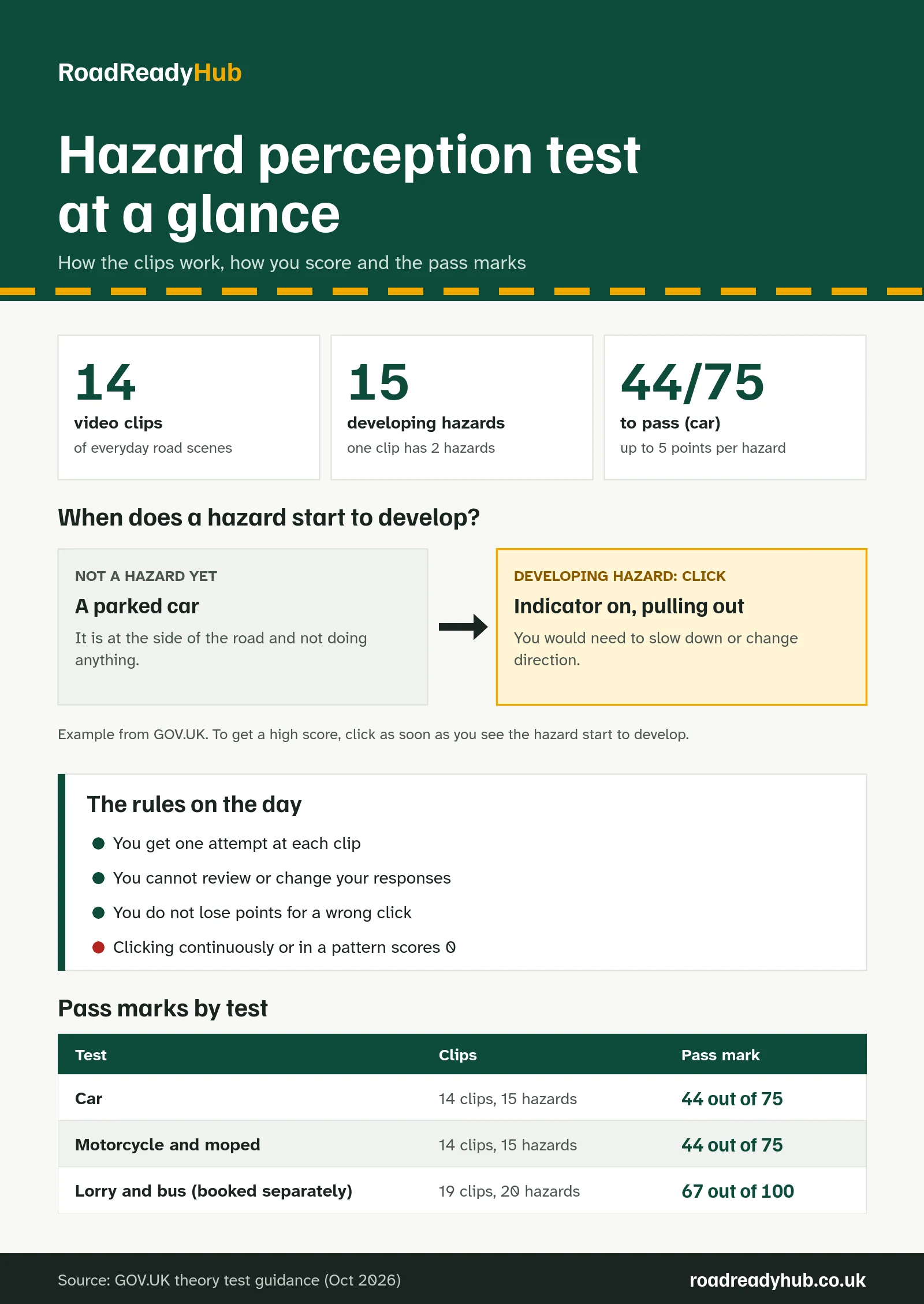
The hazard perception test is the second part of the UK theory test. You watch 14 video clips of everyday road scenes and click when you see a hazard developing. There are 15 hazards to score, each worth up to 5 points, and you need 44 out of 75 to pass the car or motorcycle test. You must pass the multiple-choice part as well.
Most pages about the hazard perception test offer practice clips and a list of tips. Before practising, it helps to know exactly how the test is marked, because the rules explain most of the tips. This guide covers what counts as a hazard, how the points work, the pass mark for each type of test and where to find official practice material, using the rules published by GOV.UK and the Driver and Vehicle Standards Agency (DVSA).
How the hazard perception test works
The hazard perception part comes after the multiple-choice questions, in the same test. Before it starts, you’re shown a short video explaining how it works. Then you watch 14 video clips, one after another, and click the mouse whenever you see a hazard starting to develop.
Each clip has at least one developing hazard, and one clip has 2. That gives 15 hazards to score in total. You only get one attempt at each clip, and you can’t go back to review or change your responses.
The clips are computer-generated (CGI), not filmed. DVSA replaced the old filmed clips with CGI on 12 January 2015, and said at the time that the way the test works and the pass mark stayed the same. In November 2018 it added clips showing fog, rain, snow and ice, wind, and driving at night or in low light such as dawn and dusk.
| What you need to know | Car and motorcycle test |
|---|---|
| Number of clips | 14 |
| Developing hazards to score | 15 (one clip has 2) |
| Points for each hazard | Up to 5 |
| Highest possible score | 75 |
| Pass mark | 44 |
| Attempts at each clip | One |
| Penalty for a wrong click | None |
| Clicking continuously or in a pattern | 0 points for that clip |
What counts as a developing hazard?
GOV.UK defines a developing hazard as something that would cause you to take action, such as changing speed or direction. It gives a simple example: a car parked at the side of the road isn’t doing anything, so it isn’t a developing hazard. When its indicator comes on and it starts to pull out, it becomes one.
That difference matters for your score. A clip can be full of things that might become a problem, such as a pedestrian on the pavement, a junction ahead or a parked van. You don’t score for noticing them. You score when one of them starts to develop into something you’d need to react to. Typical examples on real roads include:
- a pedestrian stepping towards the kerb or looking to cross
- a cyclist moving out to pass a parked car
- a vehicle edging out of a side road or driveway
- a parked car with its indicator on, starting to pull away
- a bus pulling out from a stop
These are general examples of everyday hazards, not a list of what appears in the test clips.
How the scoring works
You can score up to 5 points for each developing hazard. GOV.UK’s advice is: “To get a high score, click the mouse as soon as you see the hazard starting to develop.” In other words, the sooner you react once a hazard starts to develop, the more you can score.
Two rules shape how you should click:
- Wrong clicks cost nothing. You don’t lose points if you click and nothing is developing.
- Pattern clicking scores zero. If you click continuously or in a pattern, you get no points for that clip.
What score do you need?
With 15 hazards worth up to 5 points each, the highest score is 75. To reach the pass mark of 44, you need an average of just under 3 points per hazard (44 divided by 15 is about 2.9). You don’t need to score on every hazard: for example, 4 points on 11 hazards would give you 44 even if you missed the other 4 completely. These figures are our own worked example, not an official calculation.
Pass marks for each type of test
| Theory test | Clips | Hazard perception pass mark |
|---|---|---|
| Car | 14 clips, 15 hazards | 44 out of 75 |
| Motorcycle and moped | 14 clips, 15 hazards | 44 out of 75 |
| Lorry and bus (Driver CPC part 1b) | 19 clips, 20 hazards | 67 out of 100 |
For cars and motorcycles, hazard perception is part of one theory test, so you must pass it and the multiple-choice part (43 out of 50) to pass. Our guide to how long the theory test takes covers the timings on the day.
Lorry and bus drivers book hazard perception as a separate test, which costs £11, and can take it on the same day as the multiple-choice part. Their theory certificate is valid for 2 years from when they passed the first part. Our class 2 licence guide explains the full route to a lorry licence.
Tips that follow from the rules
Most hazard perception tips come straight from how the test is scored:
- Click when you’d act, not when you first notice something. Ask yourself whether you’d slow down or steer. If the answer is yes, click.
- Click again as the hazard develops. A wrong click costs nothing, so a second deliberate click a moment after the first is a sensible safeguard if you’re unsure you caught the start. Keep it to a few clicks, never a steady rhythm.
- Watch the whole screen. Hazards often start at the edges: side roads, driveways, pavements and gaps between parked cars.
- Expect harder conditions. Some clips are set at night, in fog or in rain, where hazards are harder to see early.
- Move on after each clip. You can’t review a clip, so put it out of your mind and focus on the next one.
How to practise for the hazard perception test
GOV.UK lists these official ways to prepare:
- the official DVSA guide to hazard perception
- the Official DVSA Theory Test kit for PC or Mac, which also covers the multiple-choice questions
- the Official DVSA Hazard Perception app for Apple and Android phones and tablets
Safe Driving for Life, run by TSO, DVSA’s official publishing partner, also has a free hazard perception practice page. Many other sites offer free practice clips too, but they aren’t official DVSA material.
Practice on real roads helps too. On lessons or private practice drives, try saying out loud what you can see developing ahead and what you’d do about it. It’s a good way to get used to spotting hazards early, which is exactly what the test rewards.
For the multiple-choice part, try our free mock theory test or the motorbike theory test practice, each with 50 questions and a 57-minute timer like the real test. Neither includes hazard perception clips.
What happens if you fail hazard perception?
If you fail either part of the car or motorcycle theory test, you fail the whole test and have to take both parts again, even the one you passed. You must wait at least 3 working days before your next attempt, and you pay the fee again. Our guide to theory test costs has the current fees.
Once you pass, your pass certificate number lasts for 2 years. You need to pass your practical driving test within that time, or you’ll have to take the theory test again. Our guide to the theory test pass certificate explains what to do if you lose it.
Frequently asked questions
What is the trick to passing the hazard perception test?
There isn’t a trick. You score by clicking as soon as you see a hazard start to develop, so the skill is spotting the moment something on the road would make you slow down or change direction. Practising with clips and looking out for hazards on real drives builds that habit.
What is a good hazard perception score?
For the car and motorcycle tests, any score of 44 or more out of 75 is a pass. GOV.UK only sets the pass mark. It doesn’t grade scores above it, and passing by one point counts the same as passing with 75.
Is there a free online hazard perception test?
GOV.UK’s free practice theory test only covers the multiple-choice questions. For clips, Safe Driving for Life, run by DVSA’s official publishing partner TSO, has a free hazard perception practice page, and DVSA’s official hazard perception app and theory test kit are sold by the same publisher.
Is hazard perception out of 75?
Yes, for the car and motorcycle theory tests. There are 15 developing hazards across 14 clips, each worth up to 5 points. The lorry and bus test is out of 100, because it has 19 clips and 20 hazards.
How many clips are in the hazard perception test?
14 for cars, motorcycles and mopeds, with one clip containing 2 developing hazards. Lorry and bus drivers watch 19 clips.
Do you lose points for clicking too much?
You don’t lose points for a wrong click. But if you click continuously or in a pattern during a clip, you score nothing for that clip.
How many times can you click on the hazard perception test?
GOV.UK does not set a number of clicks. You can click more than once, and a wrong click costs nothing, but clicking continuously or in a pattern scores nothing for that clip. A few deliberate clicks as a hazard develops is the safe approach.
How many hazard perception clips are there in total?
The car and motorcycle tests have 14 clips in total, containing 15 developing hazards to score, because one clip has 2. The lorry and bus test has 19 clips with 20 hazards.
Do you have to pass both parts of the theory test at the same time?
For cars and motorcycles, yes. You must pass both the multiple-choice questions and hazard perception, and if you fail either one you retake the whole test. Lorry and bus drivers book the two parts separately and must pass both within 2 years.
Sources: GOV.UK Theory test: cars: hazard perception test and pass mark and test result; GOV.UK Motorcycle theory test: hazard perception test and pass mark and test result; GOV.UK Driver CPC part 1 test: theory; GOV.UK Theory test revision and practice; DVSA news: Hazard perception clips get a modern makeover and Hazard perception test now features more weather conditions. The scoring examples are our own calculations.