Last checked: 28 October 2026
Practise for your motorbike theory test with a free mock test in the real format: 50 multiple-choice questions in 57 minutes, with a pass mark of 43. The questions are written for riders, and every answer comes with an explanation and the Highway Code rule behind it. No sign-up, and nothing you enter is saved.
This mock test needs JavaScript switched on in your browser.
These are RoadReadyHub’s own practice questions for riders, written from The Highway Code. They are not DVSA’s official test questions, and this mock doesn’t include the case study, the video clip questions or the hazard perception part. Your answers aren’t sent or saved.
How this motorbike theory test practice works
- Full mock test: 50 questions against a 57-minute clock. You can flag questions, jump between them and change your answers, then see your score, a pass or fail against the 43 mark and a breakdown by topic.
- Quick practice: 10 questions with no timer. After each one you see the right answer, why it’s right and which Highway Code rule covers it.
- Practise by topic: pick one topic, such as motorways or road signs, and work through every question on it with instant feedback.
- Written for riders: a bank of 165 questions across 11 topics, including 30 on riding kit, licences and CBT, plus rider-specific questions on visibility, filtering, road surfaces and weather.
- Review what you missed: the results list every question you got wrong, with the correct answer and the rule to revise.
How the real motorcycle theory test works
The test has two parts, taken one after the other, and you must pass both.
| Part | What it involves | Pass mark |
|---|---|---|
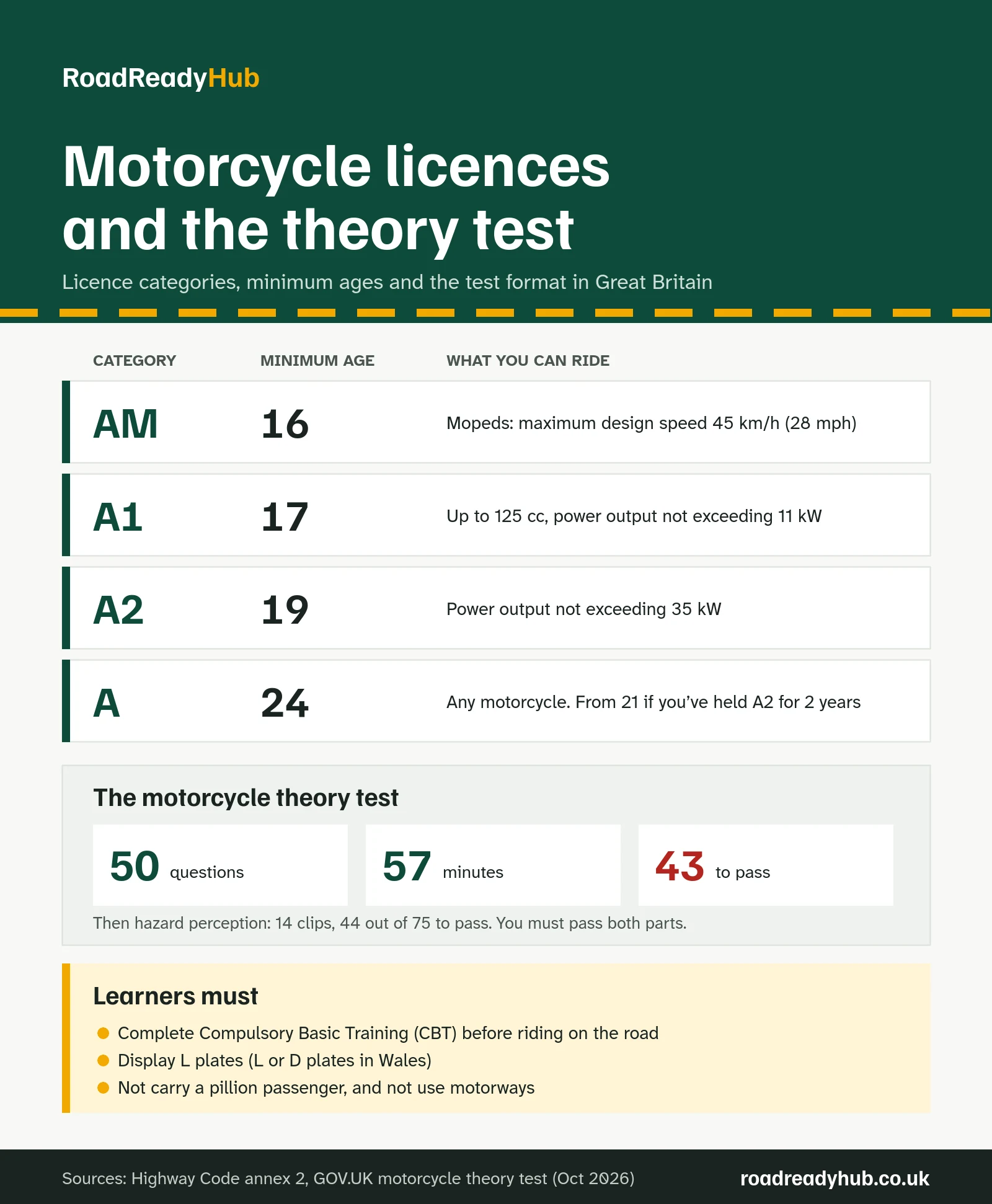
| Multiple-choice questions | 50 questions in 57 minutes | 43 out of 50 |
| Hazard perception | 14 video clips of everyday road scenes. You score up to 5 points for each developing hazard, and one clip has 2 hazards | 44 out of 75 |
The format changes on 5 November 2026
GOV.UK says the multiple-choice part depends on your test date. If your test is before 5 November 2026, some questions are given as a case study: a short story about a real-life riding situation, with 5 questions based on it. If your test is on or after 5 November 2026, three of the questions will be about a short, silent video of a normal riding situation instead. You can watch the video as many times as you like.
When you pass, you get a pass certificate number that lasts for 2 years. You need to pass both modules of the motorcycle test in that time, or you’ll have to pass the theory test again.
What the questions cover
| Topic | Questions in the bank |
|---|---|
| Riding kit, licence and CBT | 30 |
| Signs, signals and road markings | 18 |
| Safety margins and weather | 17 |
| Junctions, roundabouts and crossings | 17 |
| Attitude and vulnerable road users | 15 |
| Speed, overtaking and lane discipline | 15 |
| Incidents, breakdowns and first aid | 15 |
| Motorways | 13 |
| Alertness and fitness to ride | 11 |
| Your motorcycle and documents | 7 |
| Parking and lighting | 7 |
Each test takes 4 or 5 questions from every topic, so you can’t pass by knowing one area well.
Motorcycle licence categories at a glance
| Category | Minimum age | What you can ride |
|---|---|---|
| AM (moped) | 16 | Two-wheeled vehicles with a maximum design speed of 45 km/h (28 mph) |
| A1 | 17 | Motorcycles up to 125 cc, with a power output not exceeding 11 kW |
| A2 | 19 | Motorcycles with a power output not exceeding 35 kW |
| A | 24 (direct access), or 21 with progressive access | Any motorcycle |
If you have a provisional motorcycle licence, you must complete Compulsory Basic Training (CBT) before riding on the road. You can then ride a motorcycle up to 125 cc with L plates for up to two years. Until you’ve passed your test, you must not carry a pillion passenger, pull a trailer or use motorways. Our CBT guide explains what happens on the course and what you need to bring. Our guide to driving licence categories covers every category on a UK licence.
Is the motorbike theory test hard to pass?
About two in three tests end in a pass. DVSA’s official statistics show that 67.8% of motorcycle theory tests were passed in Great Britain in the year from April 2025 to March 2026: 58,030 passes from 85,542 tests. Those figures are provisional, and the rate has been close to 68% for the last four years. So roughly one in three tests is failed, which is a good reason to practise properly first.
How to prepare
- Study the three books the questions are based on: The Highway Code, Know your traffic signs and Riding: the essential skills.
- Use the Official DVSA Theory Test kit or the Official DVSA Theory Test for Motorcyclists book, and DVSA’s official guide to hazard perception.
- Take mock tests under the real time limit, then go back over every question you got wrong and read the rule behind it.
- Use the topic breakdown in your results to find your weakest areas, and practise those again.
Is 2 weeks enough to study?
There’s no official guidance on how long to revise, and it depends on how much you already know. Your mock scores are a better guide than the calendar: you’re in good shape when you pass comfortably every time, not just once.
Is 46 out of 50 a good score?
Yes. The pass mark for the multiple-choice part is 43 out of 50, so 46 is a pass with 3 marks to spare. Remember that you also need 44 out of 75 in the hazard perception part, and you must pass both on the same day.
What this practice test doesn’t do
- These aren’t DVSA’s questions. We wrote them ourselves from The Highway Code and checked each answer against the rule it cites.
- The real test draws on three books: The Highway Code, Know your traffic signs and Riding: the essential skills. Our bank is based on the first, so it has fewer questions on recognising individual signs and on riding technique.
- No case study, video clip questions or hazard perception. This covers the written multiple-choice part only. Our hazard perception test guide explains that part.
Use it alongside the official material. GOV.UK has a free official practice theory test, and DVSA publishes the Official DVSA Theory Test for Motorcyclists book and the Official DVSA Theory Test kit.
If you don’t pass the real test
You’ll get a letter at the test centre showing which parts you didn’t score enough on. You have to book and take the full test again, even if you passed one part, and you must wait at least 3 working days. Car drivers can use our car mock theory test instead.
Frequently asked questions
Is this motorbike theory test practice free?
Yes. There’s no sign-up, and your answers aren’t sent or saved.
What is the pass mark for the motorcycle theory test?
43 out of 50 for the multiple-choice questions and 44 out of 75 for hazard perception. You must pass both parts.
How many questions are in the motorbike theory test?
50 multiple-choice questions, which you have 57 minutes to answer, followed by 14 hazard perception clips.
Is the motorcycle theory test different from the car theory test?
Yes. It’s a separate test with its own questions for riders, and its multiple-choice questions are based on Riding: the essential skills instead of the car drivers’ book. The pass marks are the same: 43 out of 50 and 44 out of 75.
How long does a motorcycle theory test pass last?
2 years. You need to pass both modules of the motorcycle test in that time, or you’ll have to pass the theory test again.
Is it hard to pass the motorbike theory test?
About two in three tests are passed. DVSA figures show a 67.8% pass rate for motorcycle theory tests in Great Britain in the year to March 2026.
Is 46 out of 50 a pass on the theory test?
Yes. The multiple-choice pass mark is 43 out of 50. You also need 44 out of 75 in the hazard perception part.
Sources: GOV.UK Theory test: motorcycles and mopeds (revision and practice, multiple-choice questions, hazard perception test, pass mark and result); The Highway Code, rules for motorcyclists (83 to 88) and annex 2: motorcycle licence requirements, with all questions written from the Code; DVSA motorcycle theory test statistics (table DRT211A, updated 3 September 2026).