Last checked: 28 October 2026
The CBT test is compulsory basic training: a course, usually lasting one day, that you must normally complete before riding a moped or motorcycle on the road. It is not a test you pass or fail. Once your trainer signs you off, you can ride a moped from 16 or a motorcycle up to 125cc from 17, with L plates, for 2 years while you work towards your full test.
Most people call it the CBT test, but the official name is compulsory basic training, and the difference matters: there is no exam at the end. This guide explains each part of the day, how long it takes, what to wear, what you can ride afterwards and the rules that catch new riders out, using guidance from GOV.UK and The Highway Code.
What is CBT?
CBT is a training course run by approved motorcycle training schools. GOV.UK says it makes sure you can ride safely on your own while you practise for your full moped or motorcycle test. You book it directly with a training school, not with DVSA.
It is the first step for most new riders. After CBT you still need to pass the motorcycle theory test and a practical test to get a full licence. Our guide to UK licence categories explains which full licence you can work towards at each age.
Who needs to do CBT?
You usually have to complete CBT before you ride a moped or motorcycle on the road. GOV.UK lists these exceptions. You do not need CBT if you:
- want to ride a moped (up to 50cc) and passed your car driving test before 1 February 2001
- want to ride a motorcycle and have a full moped licence from passing a moped test since 1 December 1990
- have a full motorcycle licence for one category and want to upgrade to another
- live and ride on some offshore islands
- want to ride a trial e-scooter
The island exemption is narrower than many people think. You still need CBT on the Isle of Wight, South Uist, North Uist, Benbecula, Harris, Lewis, mainland Orkney, mainland Shetland and any other island connected to mainland Great Britain by road.
The 5 parts of CBT
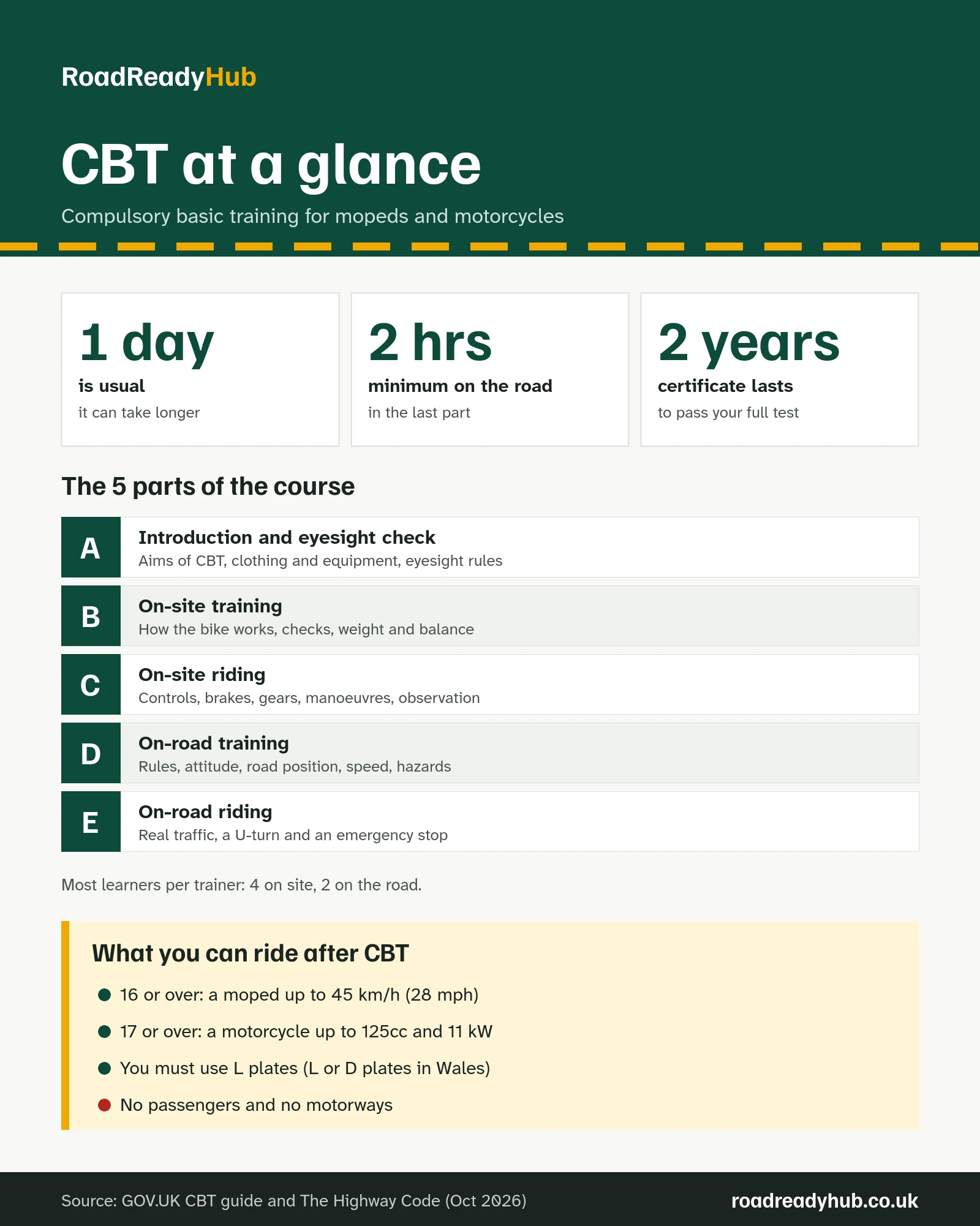
GOV.UK splits the course into 5 parts, and DVSA’s CBT syllabus calls them elements A to E. You move from one part to the next when your trainer is happy you have learnt the theory and shown the practical skills to a safe basic level.
| Part | What happens |
|---|---|
| A: Introduction and eyesight check | The aims of CBT, suitable clothing and equipment, and the eyesight rules. You must be able to read a number plate from 20 metres in good daylight. |
| B: On-site training | How the moped or motorcycle works, the checks it needs and getting used to its weight and balance, away from traffic. |
| C: On-site riding | Riding under full control: using the brakes, changing gear, making observations and carrying out manoeuvres. |
| D: On-road training | Preparing for the road: the legal requirements, attitude, road position, following distances, speed and spotting developing hazards. |
| E: On-road riding | Riding in normal traffic, including traffic lights, roundabouts, junctions, pedestrian crossings, hills and bends, plus a U-turn and an emergency stop. |
How long does CBT take?
The course usually lasts a full day, but GOV.UK says it can take longer depending on how quickly you learn. The final on-road riding part must last at least 2 hours. If a trainer cuts it short, you can complain to DVSA.
There are also limits on group sizes. A trainer can have no more than 4 learners for the on-site parts and no more than 2 learners on the road. If there are more, GOV.UK says you can complain to DVSA.
How much does CBT cost?
There is no fixed national fee. The training school sets the course price, and GOV.UK says it depends on where you do the training and whether you bring your own moped or motorcycle. Bear in mind that you cannot ride your own moped or motorcycle to the course unless you already hold a valid CBT certificate.
Ask what the price includes before you book, such as bike hire, fuel, helmet and clothing hire, and whether you pay again if the course runs into a second day. The training school can also ask you to share your driving licence information before the course.
What to take and wear to your CBT
Take your UK driving licence. GOV.UK says you must wear:
- a motorcycle helmet that meets British safety standards, unless you are Sikh and wearing a turban (check whether the school provides one)
- motorcycle boots or other sturdy footwear that supports and protects your ankles
- textile or leather motorcycle trousers or heavy denim trousers
- a textile or leather motorcycle jacket, or a heavy denim jacket with several layers underneath
- motorcycle gloves
Your course can be stopped, and you can be charged to take it again, if you do not wear suitable clothing.
Can you fail CBT?
Not in the usual sense, because there is no pass mark. But you do not get a certificate until your trainer is satisfied you can ride safely, and your course can be stopped if you turn up unprepared. GOV.UK says your trainer can stop the course if your basic knowledge of The Highway Code and traffic signs is not good enough for you to ride safely, and you can be charged again to retake it.
The easiest way to prepare is to read the rules for motorcyclists in The Highway Code and practise road sign questions. Our motorbike theory test practice covers the same topics, and it will help again later when you take your theory test.
What you can ride after CBT
When you complete the course you get a certificate of completion, sometimes called a DL196. What it lets you ride depends on your age:
| Your age | What you can ride | Conditions |
|---|---|---|
| 16 or over | A moped with a maximum design speed of 45 km/h (28 mph) | L plates (L or D plates in Wales), no passengers, no motorways |
| 17 or over | A motorcycle up to 125cc with a power output of up to 11 kW | L plates (L or D plates in Wales), no passengers, no motorways |
You can ride on your own, without an instructor. The two rules that catch new riders out come from The Highway Code: provisional licence holders must not carry a pillion passenger (Rule 85), and holders of provisional motorcycle licences must not use motorways (Rule 253).
Riding without a valid CBT certificate can lead to a fine of up to £1,000 and up to 6 penalty points. Our guide to how long points stay on your licence explains what those points mean.
The 2-year time limit
A CBT certificate does not last forever. You must pass your theory test and full moped or motorcycle test within 2 years. If you do not, you have to take CBT again or stop riding.
CBT if you already have a car licence
Car drivers have different rules for mopeds up to 50cc, depending on when they passed:
- Passed your car test before 1 February 2001: you can ride a moped up to 50cc without L plates, and you do not need CBT or a moped test. You must take CBT to ride anything larger.
- Passed on or after 1 February 2001: if you pass your car test and then complete CBT, or complete CBT and then pass your car test within 2 years, you can ride a moped up to 50cc without L plates for as long as your car licence lasts.
The Highway Code still recommends that car drivers who passed before February 2001 complete CBT before riding a moped on the road.
What to do after CBT
With your CBT certificate, the next steps towards a full licence are:
- Pass the motorcycle theory test. It costs £23, the same as the car test. See theory test fees, how long the theory test takes and our guide to the hazard perception test.
- Take the practical tests for the category you want, within 2 years of your CBT.
- Keep your certificate safe. If you lose it, contact the training school for a replacement. They can charge up to £20. If the school has closed or does not reply, you can apply to DVSA, which also charges £20.
If you have not applied for your provisional licence yet, our guide on how to apply for a provisional licence takes you through it. This guide covers England, Scotland and Wales. Northern Ireland has its own rules, which are set out on nidirect.
Frequently asked questions
How much does a CBT test cost in the UK?
There is no set national price. The training school sets the course price, and GOV.UK says it depends on where you train and whether you bring your own moped or motorcycle. Compare a few approved training schools near you before you book.
How hard is it to pass a CBT?
CBT is not a test you pass or fail. Your trainer moves you on to each new part of the course once you have learnt the theory and shown the practical skills to a safe basic level. If you need more time, the course can take longer than a day.
How long will a CBT test take?
It usually lasts a full day, but it can take longer depending on how quickly you learn. The on-road riding part alone must last at least 2 hours.
What are CBT test questions?
There is no written exam. Your trainer explains the rules and checks your understanding as you go, and can stop the course if your knowledge of The Highway Code and traffic signs is not good enough for you to ride safely.
Do I need a provisional licence for CBT?
Yes. GOV.UK says you need the right provisional driving licence to learn to ride, and you take your UK driving licence to the course. To ride a moped you must be 16 or over and hold a provisional moped licence.
Can I carry a passenger after CBT?
No. The Highway Code says provisional licence holders must not carry a pillion passenger.
Can I ride on the motorway after CBT?
No. Holders of provisional motorcycle licences must not use motorways.
How long does a CBT certificate last?
It lets you ride for up to 2 years. You must pass your theory test and full moped or motorcycle test within that time, or take CBT again or stop riding.
Sources: GOV.UK CBT motorcycle and moped training (all sections, including how the training works, what to take and if you have a car driving licence); DVSA CBT syllabus and guidance notes; GOV.UK bike categories, ages and licence requirements; GOV.UK replace a lost or stolen CBT certificate; The Highway Code rules for motorcyclists (Rule 85), motorways (Rule 253), Annex 2: motorcycle licence requirements and Rule 92 (eyesight).