
Last checked: 13 September 2026
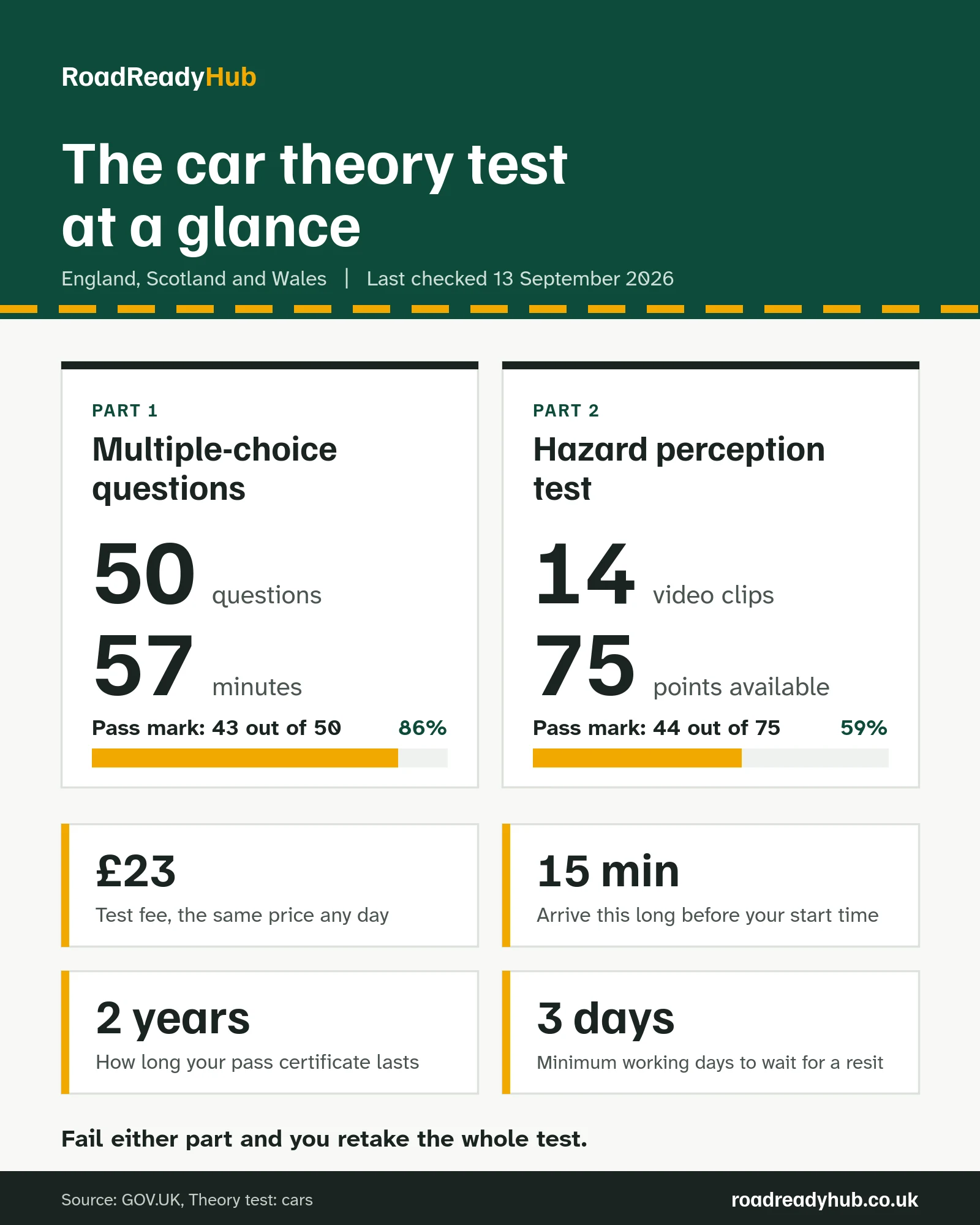
The UK car theory test has two parts. You get 57 minutes to answer 50 multiple-choice questions, then, after an optional break of up to 3 minutes, a hazard perception test made up of 14 video clips. To pass, you need at least 43 out of 50 on the questions and 44 out of 75 on hazard perception, and you have to pass both parts in the same test.
You also need to arrive 15 minutes before your start time, and there are identity and security checks before you sit down. So while the questions themselves have a fixed time limit, your visit to the test centre will take noticeably longer than 57 minutes.
This guide covers the car theory test in England, Scotland and Wales. Motorcycle theory tests use the same timings and pass marks, with one format change coming in October 2026, which we cover below.
Theory test timings at a glance
| Stage | How long | What happens |
|---|---|---|
| Arrival | 15 minutes before your start time | ID and security checks, and your belongings go in a locker |
| Instructions | Before the questions start | How the test works, plus a practice question to get used to the screens |
| Multiple-choice questions | Up to 57 minutes | 50 questions, including 3 based on a short video clip |
| Break | Up to 3 minutes (optional) | A short pause before hazard perception |
| Hazard perception | 14 video clips | A short video explains how it works, then you click as hazards develop |
| Result | At the end | You get your result at the test centre before you leave |
GOV.UK doesn’t publish a single figure for the whole appointment, so be wary of anywhere that quotes one as fact. What you can rely on is the 15-minute arrival time and the 57-minute limit on the questions.
How the multiple-choice part works
Each question appears on screen with several possible answers, and you choose the right one. Three of the 50 questions are based on a short, silent video of an everyday driving situation, such as driving through a town centre or along a country road. You can replay that video as many times as you like.
You don’t have to answer in order. You can flag questions to come back to, and review or change any answer until you finish. If you’ve answered everything before the 57 minutes are up, you can end that part early.
A practical tip: go through the whole paper once, answering everything you’re sure about and flagging the rest. With just over a minute per question on average, that leaves plenty of time for the tricky ones without the clock creeping up on you.
If you’re taking the motorcycle theory test
The motorcycle test also gives you 57 minutes for 50 questions, but the format is changing. If your test is before 29 October 2026, some questions are set as a case study, with 5 questions based on a short story about a riding situation. From 29 October 2026, the case study is replaced by 3 questions based on a short, silent riding video, the same approach the car test uses.
How the hazard perception part works
After the multiple-choice questions you’ll see a short video explaining the hazard perception test, followed by 14 clips of everyday road scenes. Every clip contains at least one developing hazard, and one clip contains two. That means there are 15 hazards to spot in total.
A developing hazard is something that would make you change speed or direction. Picture a cyclist riding along the kerb ahead of you. On its own, that isn’t a developing hazard. Once they glance over their shoulder and start moving out to pass a parked van, you’d need to slow down or give them more room, and that’s the moment it becomes one.
You score up to 5 points for each hazard, and the earlier you click once it starts to develop, the more points you get. A few rules catch people out:
- You don’t lose points for clicking at the wrong time.
- If you click continuously or in a pattern, you score nothing for that clip.
- You only get one attempt at each clip, and you can’t go back and change your responses.
What is the theory test pass mark?
You need to pass both parts in the same test. Here’s what the pass marks mean in practice:
| Part | Pass mark | As a percentage | Room for error |
|---|---|---|---|
| Multiple-choice questions | 43 out of 50 | 86% | You can get up to 7 questions wrong |
| Hazard perception | 44 out of 75 | About 59% | An average of just under 3 points per hazard |
The two parts feel very different. The multiple-choice pass mark is high, so a handful of careless mistakes can cost you, and it’s worth reading every question twice. Hazard perception has a lower pass mark, but because points depend on timing, it rewards practice with real clips more than memorising rules.
Planning your time on the day
Arrive at least 15 minutes before your start time. If you’re late, your test is cancelled and you lose your fee. Build in extra time if you don’t know the area or you’re relying on public transport.
A few other things are worth knowing before you set off:
- All electronic devices, including phones and smart watches, must be switched off before you go in.
- Your belongings, including coats, bags, wallets and anything in your pockets, go in a locker or a clear plastic box.
- There’s no waiting area at the test centre for friends or family who come with you, so they’ll need somewhere else to wait.
- You’ll need your UK photocard driving licence. Without the right ID, your test is cancelled and you won’t get your money back.
Can you get extra time?
Yes, if you have a reading difficulty, disability or health condition. You can ask for more time on the multiple-choice questions, have the test read to you through headphones in English or Welsh, or have a member of staff read out the questions and record your answers. You’ll need to say what support you need when you book, and for some types of support you’ll be asked to send proof.
After the test
You get your result at the test centre. If you pass, you’ll receive a letter with a pass certificate number, which you need to book your practical test. It’s valid for 2 years.
If you fail, the letter tells you which part you didn’t score enough on. You’ll have to retake the whole test, including the part you passed, and wait at least 3 working days. Each attempt costs the full fee, which we break down in our guide to how much the theory test costs. Once you’ve passed, our guide to how long the practical driving test takes explains what comes next.
Lorry and bus theory tests are different
If you’re training to drive a lorry or bus, the Driver CPC part 1 theory test is split into multiple-choice and hazard perception tests that you book separately, although you can take them on the same day. You need to pass both within 2 years of each other. The Driver CPC part 2 case studies test is separate again: it lasts 1 hour and 15 minutes, and the pass mark is 40 out of 50.
Frequently asked questions
How many questions are on the UK theory test?
The multiple-choice part has 50 questions, and you have 57 minutes to answer them. The hazard perception part is separate and has 14 video clips.
What is the pass mark for the driving theory test?
You need 43 out of 50 on the multiple-choice questions and 44 out of 75 on hazard perception. You must pass both parts in the same test.
Can you go back and change answers in the theory test?
In the multiple-choice part, yes. You can flag questions and change any answer before you finish. In hazard perception, no. You get one attempt at each clip and can’t review your responses.
How early should you arrive for your theory test?
You must arrive 15 minutes before your test starts. If you’re late, the test is cancelled and you lose your fee.
What happens if I pass one part of the theory test but fail the other?
You fail the test overall and have to retake both parts. You need to wait at least 3 working days before your next attempt.
Sources: Theory test: cars and Theory test: motorcycles and mopeds on GOV.UK, plus the Driver CPC guidance for lorry and bus tests.