Last checked: 13 September 2026
A standard UK car driving test involves around 35 minutes of driving, according to GOV.UK. If you’ve been banned from driving and have to take the extended test, you’ll drive for around 65 minutes. The whole appointment takes longer than the drive itself, because the eyesight check comes first and the examiner goes through your result with you at the end.
You’ll still see “40 minutes” quoted in plenty of places. GOV.UK’s current guidance puts the drive at around 35 minutes, so that’s the figure we use here. The difference matters less than it sounds: what you actually need to plan for is the time around the drive, and that’s where most people get caught out.
This guide covers the car test in England, Scotland and Wales, which is run by the Driver and Vehicle Standards Agency (DVSA). Further down there’s a comparison with motorcycle, lorry and bus, and driving instructor tests.
How long does a car driving test take?
The drive is around 35 minutes, but it isn’t one continuous block of “just driving”. The test has four parts: an eyesight check, two vehicle safety questions (known as “show me, tell me”), your general driving including a section of independent driving, and one reversing exercise. The test is the same whether you’re in a manual or an automatic.
Here’s how a typical test runs from start to finish, with the official timings where GOV.UK gives one:
| Stage | When it happens | What you do | Official timing |
|---|---|---|---|
| Eyesight check | Before you get in the car | Read a number plate from 20 metres (20.5 metres for an old-style plate) | Not stated |
| “Tell me” question | Before you start driving | Explain how you’d carry out a vehicle safety check | Not stated |
| General driving | Throughout the drive | Drive in different road and traffic conditions (not motorways), including pulling over, pulling out from behind a parked car and a hill start | Part of the 35-minute drive |
| Independent driving | During the drive | Follow a sat nav, traffic signs or both, as the examiner tells you | 20 to 35 minutes |
| “Show me” question | While you’re driving | Show how you’d carry out a safety task while you drive | Not stated |
| Reversing exercise | During the drive | One of: parallel park, park in a bay, or pull up on the right and reverse about 2 car lengths | Part of the drive |
| Result and feedback | Once you’re parked back at the centre | The examiner tells you your result and any faults | Not stated |
You might also be asked to do an emergency stop. Not every test includes one, so don’t be thrown if yours doesn’t. If you want to prepare for the two safety questions, our guide to show me, tell me questions covers all 21 on DVSA’s list.
Why the appointment takes longer than the drive
The 35 minutes only starts once you pull away. Before that, the examiner meets you, checks your documents and does the eyesight check. After you park up, they explain your result and, if you’ve passed, give you your pass certificate and ask whether you want your full licence sent to you automatically.
There are a few other things that can add time or change how the day goes:
- You must bring your UK driving licence and a car that meets the rules. Most people use their instructor’s car. If you use your own, it needs things like an extra interior mirror for the examiner and L-plates front and rear. The full list is on GOV.UK’s rules for using your own car.
- Your instructor, or a friend or relative over 16, can sit in the back and be there for your feedback if you want them to. They can’t take any part in the test.
- The examiner’s supervisor may sit in to check the examiner’s performance. If you refuse, your test can be cancelled and you’d have to pay again.
Our advice: don’t book anything tight straight after your test. Treat it as a half-day commitment, especially if you’re having a lesson beforehand or relying on a lift. Rushing to get back to work is a distraction you don’t need on the drive.
How long is an extended driving test?
If you’ve been banned from driving and need to take an extended driving test before you can get your licence back, the drive lasts around 65 minutes, nearly double the standard test.
It costs more too. GOV.UK lists the extended test for disqualified drivers at £124 on weekdays and £150 for evenings, weekends and bank holidays, compared with £62 and £75 for a standard car test. Our driving test cost guide lists every practical test fee.
How the car test compares with other UK tests
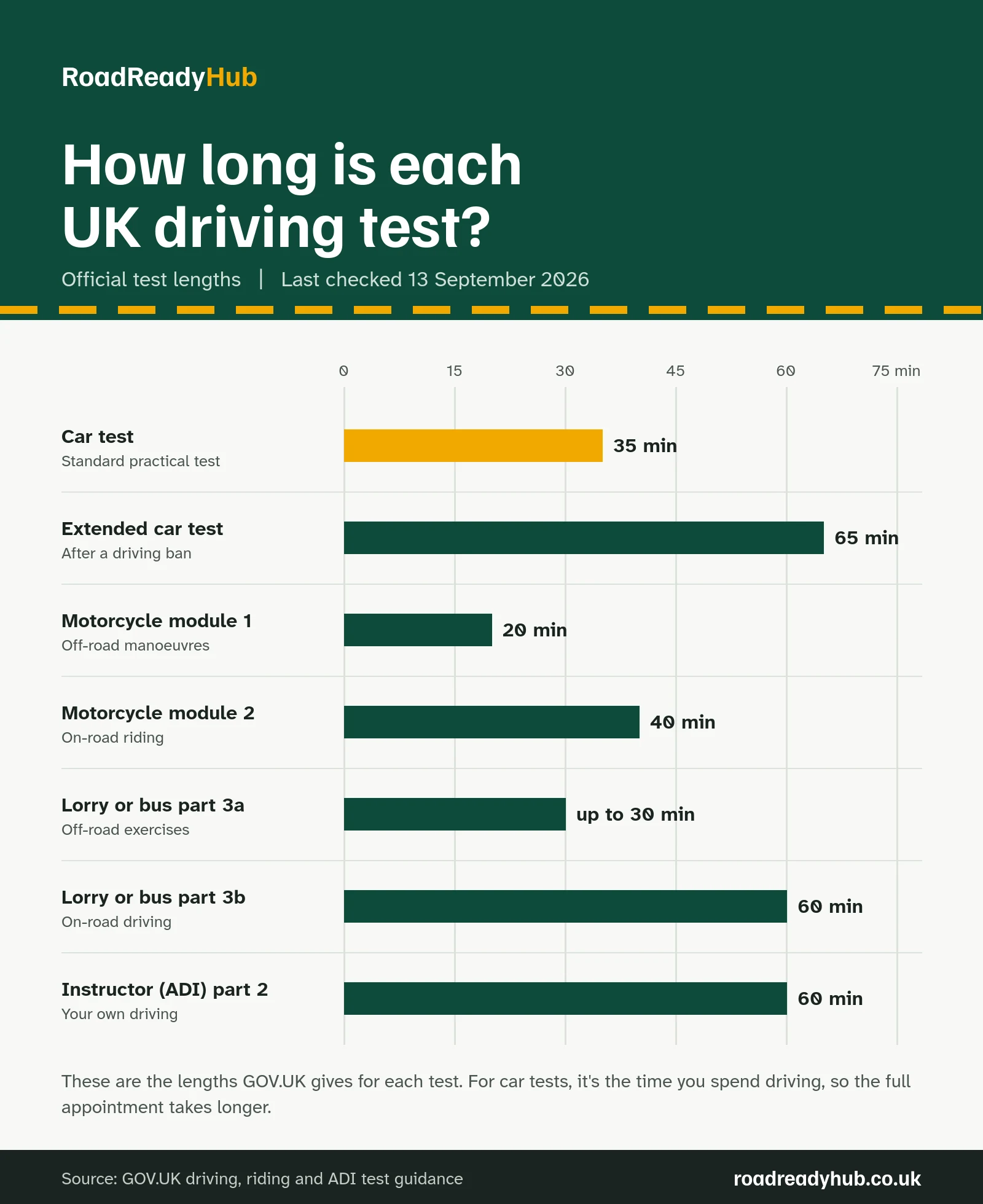
“How long is a driving test” has a different answer depending on what you’re learning to drive. These are the official lengths DVSA publishes for its other practical tests:
| Test | Official length | Worth knowing |
|---|---|---|
| Car test | Around 35 minutes of driving | Includes 20 to 35 minutes of independent driving |
| Extended car test (after a ban) | Around 65 minutes of driving | Costs double the standard weekday fee |
| Motorcycle module 1 (off-road) | Normally about 20 minutes | Manoeuvres such as a slalom, U-turn and emergency stop |
| Motorcycle module 2 (on-road) | Normally about 40 minutes | Includes about 10 minutes of independent riding |
| Lorry or bus Driver CPC part 3a (off-road) | Up to 30 minutes | Includes an S-shaped reverse into a bay |
| Lorry or bus Driver CPC part 3b (on-road) | 1 hour of road driving, plus vehicle safety questions | Includes 10 minutes of independent driving |
| Driving instructor (ADI) part 2 | Around one hour | Tests your own driving to a higher standard |
Sources: Motorcycle and moped tests, Become a qualified HGV or bus driver and ADI part 2 test, all on GOV.UK.
Does the test stop early if you make a mistake?
Usually not. You can carry on after a mistake, and if it isn’t serious it might not affect your result. The examiner will only stop the test early if they think your driving is a danger to other road users.
The one part that ends things straight away is the eyesight check. If you can’t read the number plate, you fail and the test doesn’t continue.
This is worth remembering on the day. Plenty of learners assume they’ve failed after a stall or a wide turn and let the rest of the drive fall apart. To pass, you need no more than 15 driving faults (often called minors) and no serious or dangerous faults. One small error rarely decides it, but giving up mentally can. GOV.UK explains how faults and results work in more detail.
Can your test be cancelled on the day?
Yes. Tests don’t go ahead in dangerous weather, such as icy roads, flooding, thick fog or high winds. If that happens, DVSA automatically books you the next available date and sends the details within 3 working days, or up to 7 days during a long spell of bad weather. You can’t claim expenses for a weather cancellation.
It’s a different story if the problem is on your side. If you’re taken ill during the test, or the car breaks down or doesn’t meet the rules, you’ll need to book and pay for another test. If DVSA cancels at short notice for its own reasons, such as the examiner being unwell, you can apply for a refund of out-of-pocket expenses. The phone number for your test centre is in your booking confirmation email.
What happens after the test?
If you pass, you can start driving on your own straight away. You don’t have to wait for your full licence to arrive. If you chose not to have it sent automatically, you have 2 years from your test to apply for it, and GOV.UK says to contact the DVLA if it hasn’t arrived 3 weeks after you applied.
If you don’t pass, the examiner will tell you which faults you made. You’ll need to book another test and pay again, and the new date must be at least 10 working days away. At £62 for a weekday test and £75 for evenings, weekends and bank holidays, it’s worth using those faults to plan your next few lessons rather than rebooking the first slot you see.
Taking your test in Northern Ireland?
Driving tests in Northern Ireland are run by the Driver & Vehicle Agency (DVA), not DVSA, and GOV.UK notes that the costs are different. Check the current details on nidirect before you book.
Frequently asked questions
Is the UK driving test 35 or 40 minutes?
GOV.UK’s current guidance says you’ll drive for around 35 minutes. You’ll often see 40 minutes quoted elsewhere, but either way the full appointment takes longer once you add the eyesight check and your feedback at the end.
How long is the independent driving part of the test?
GOV.UK says you’ll drive independently for 20 to 35 minutes, following a sat nav, traffic signs or a mix of both. The examiner sets up the sat nav, and you can’t use your own.
Will I drive on a motorway during my driving test?
No. The standard car test covers different road and traffic conditions, but not motorways.
How soon can I retake my driving test if I fail?
You’ll need to book another test and pay again, and the date you choose must be at least 10 working days away.
Can I drive on my own as soon as I pass?
Yes. You can start driving straight away after passing. You don’t need to wait for your full licence to arrive.
Main source: Driving test: cars, what happens during the test and Driving test costs on GOV.UK. Fees quoted are for tests booked through GOV.UK.