Last checked: 13 September 2026
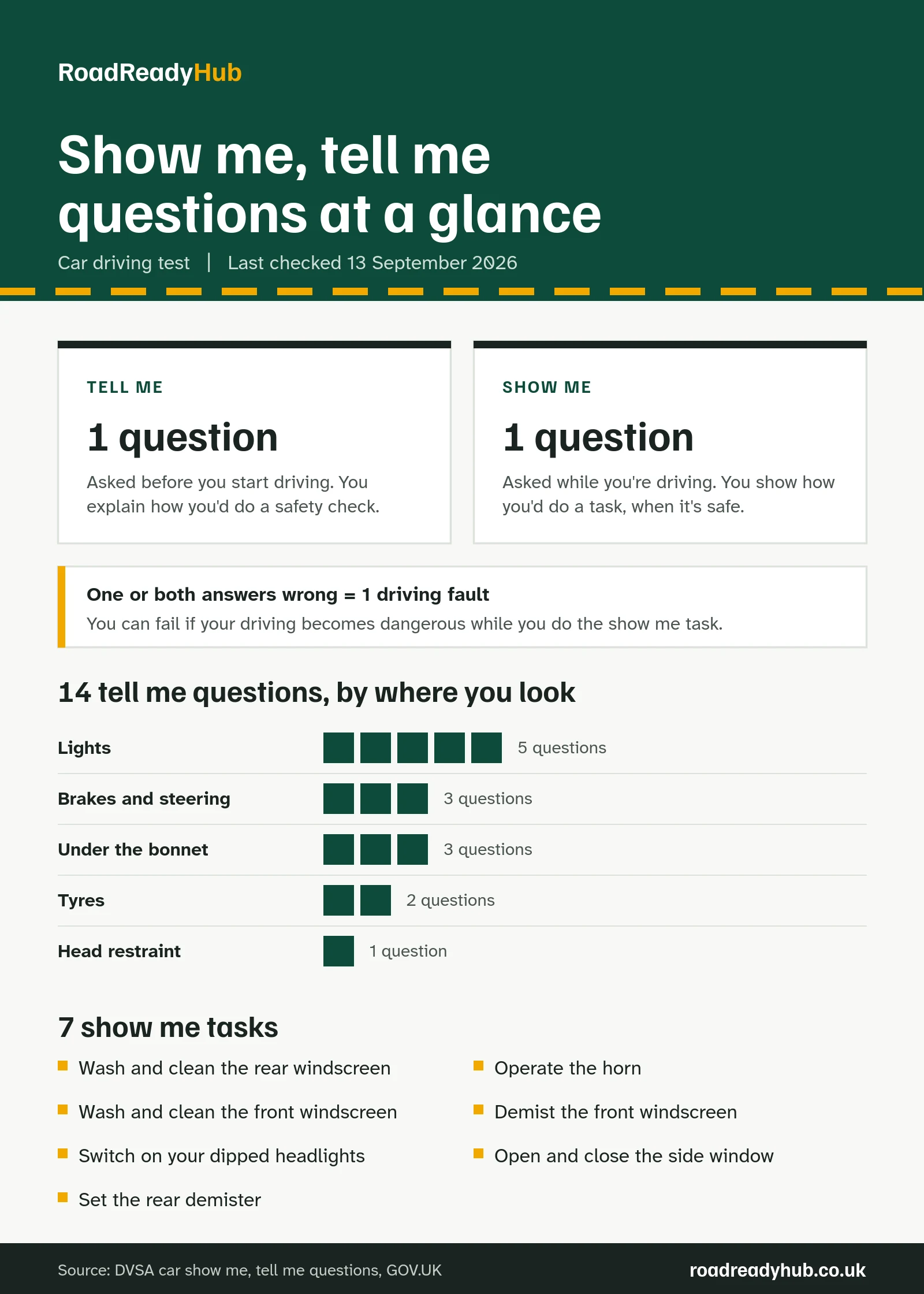
On the UK car driving test you’ll be asked two vehicle safety questions: one “tell me” question before you start driving, where you explain a safety check, and one “show me” question while you’re driving, where you actually carry out a task. DVSA picks them from a published list of 14 “tell me” and 7 “show me” questions. Getting one or both wrong costs you a single driving fault, but doing the “show me” task in a dangerous way can fail your test.
That last point is the one people underestimate. The answers themselves are easy to learn in an evening. The part that actually trips learners up is taking a hand off the wheel, or their eyes off the road, to find a switch they’ve never used while the car is moving.
Below you’ll find every question on DVSA’s current list, explained in plain English and grouped by where you’ll find the answer in the car, which is a far easier way to remember them than learning 21 separate scripts.
How the questions work on test day
The “tell me” question comes at the very start, before you pull away. You explain how you’d carry out a check, and for most questions you don’t need to physically do anything. The exceptions are the three engine questions, where you’ll need to open the bonnet and point out what you’d check.
The “show me” question comes later, while you’re on the move. The examiner will ask you to do it “when it’s safe to do so”, so you choose the moment. There’s no penalty for waiting a few seconds until the road ahead is clear.
| “Tell me” question | “Show me” question | |
|---|---|---|
| When | Before you start driving | While you’re driving |
| What you do | Explain a safety check | Carry out a task using the car’s controls |
| How many on the list | 14 | 7 |
| If you get it wrong | 1 driving fault (1 in total even if both are wrong) | 1 driving fault (1 in total even if both are wrong) |
| Can it fail your test? | Not on its own | Yes, if your driving is dangerous or potentially dangerous while you do it |
To pass the car test you can have up to 15 driving faults and no serious or dangerous faults, so a wrong answer on its own won’t decide your result. Our guide to how long the driving test takes explains where these questions fit into the rest of the test.
The 14 “tell me” questions and how to answer them
We’ve grouped the questions by where the check happens. Answers are summarised in our own words from DVSA’s published guidance. Your instructor will show you exactly where each item is in the car you’ll take your test in, because bonnet catches, fluid reservoirs and light switches vary between models.
Brakes and steering
| What you’re asked | What a good answer covers |
|---|---|
| How you’d check the brakes work before a journey | The pedal shouldn’t feel spongy or slack. Test the brakes as you set off, and the car shouldn’t pull to one side. |
| How you’d check the power-assisted steering works before a journey | Heavy steering suggests a problem. Either keep light pressure on the wheel while starting the engine and feel for a slight movement, or turn the wheel just after moving off and feel the assistance working. |
| How you’d know there’s a problem with the anti-lock braking system (ABS) | A warning light comes on if there’s a fault with the ABS. |
Tyres
| What you’re asked | What a good answer covers |
|---|---|
| Where to find the recommended tyre pressures, and how to check them | Look in the manufacturer’s guide. Use a reliable pressure gauge, check when the tyres are cold, include the spare, and put the valve caps back on. |
| How you’d check the tread depth and general condition of the tyres | No cuts or bulges, and at least 1.6mm of tread across the central three-quarters of the tyre and all the way around it. |
Lights
| What you’re asked | What a good answer covers |
|---|---|
| How you’d check the headlights and tail lights work | Turn on the lights (and the ignition if needed), then walk round the car. You only need to explain this, not get out and do it. |
| How you’d check the indicators work | Operate the indicator switch (with the ignition on if needed), then walk round the car to check. Again, just explain it. |
| How you’d check the brake lights work | Press the brake pedal and look for the reflection in windows or garage doors, or ask someone to watch for you. |
| How you’d switch on the rear fog light, and when you’d use it | Turn on dipped headlights and the ignition if needed, operate the switch and check the warning light comes on. Then explain when rear fog lights should be used. |
| How you’d switch from dipped to main beam, and how you’d know it’s on | Operate the switch with the ignition or engine on if needed, and check for the main beam warning light on the dashboard. |
Seat and head restraint
| What you’re asked | What a good answer covers |
|---|---|
| How you’d adjust the head restraint so it protects you best in a crash | The rigid part should be at least as high as your eyes or the top of your ears, and as close to the back of your head as is comfortable. Some head restraints can’t be adjusted. |
Under the bonnet
These are the three questions where you’ll need to open the bonnet and show the examiner what you’d check.
| What you’re asked | What a good answer covers |
|---|---|
| How you’d check the engine has enough oil | Point out the dipstick or oil level indicator, and describe checking the level against the minimum and maximum marks. |
| How you’d check the engine has enough coolant | Point out the high and low marks on the header tank (or the radiator filler cap), and describe how you’d top it up to the right level. |
| How you’d check the brake fluid level is safe | Point out the brake fluid reservoir and check the level against the high and low marks. |
The 7 “show me” questions
Each “show me” question starts with “when it’s safe to do so”. You’ll be asked to show how you’d:
- wash and clean the rear windscreen
- wash and clean the front windscreen
- switch on your dipped headlights
- set the rear demister
- operate the horn
- demist the front windscreen
- open and close the side window
None of these is complicated, which is exactly why the risk sits in how you do them rather than whether you know the answer. A few habits make a big difference:
- Wait for a quiet moment. A straight road with nothing developing ahead is better than a junction or a bend. The examiner has told you to pick a safe time, so use that.
- Know the control by feel. Practise until you can find the wiper stalk, demister and window switch without a long look down.
- Keep steering steady. Use one quick movement, then get both hands back on the wheel.
- Don’t panic if you pick the wrong switch. Correct it calmly. A wrong answer is one driving fault, while drifting across the lane because you’re flustered is far more serious.
How to practise so it sticks
Rather than memorising the list word for word, learn it by location. Sit in the car you’ll take your test in and work through it zone by zone: the pedals and steering, the dashboard warning lights, the light and wiper stalks, the head restraint, and then the engine bay.
For the “tell me” questions, say each answer out loud in a sentence or two. You’re explaining a check, not reciting a script, and the examiner is listening for whether you understand it.
For the “show me” questions, practise with the engine off first so you know where everything is. Then ask your instructor to throw them at you on a quiet road during lessons. That’s the closest you’ll get to the real thing, and it’s an easy step to skip.
Show me, tell me questions for other tests
The questions above are for the car test. DVSA publishes separate lists for other vehicles:
- Motorcycle module 2: you’ll be asked 2 vehicle safety questions. See the motorcycle list on GOV.UK.
- Lorry and bus: vehicle safety questions are part of the Driver CPC part 3b on-road test. See the lorry and bus list on GOV.UK.
- Driving instructor (ADI) part 2: you’ll get 5 questions (3 “tell me” and 2 “show me”), and a driving fault for each one you get wrong.
Frequently asked questions
How many show me, tell me questions are there?
DVSA’s list for the car test has 21 questions: 14 “tell me” questions and 7 “show me” questions. You’ll only be asked 2 of them on your test, one of each type.
Can you fail your driving test on a show me, tell me question?
Not for a wrong answer on its own. Getting one or both questions wrong adds one driving fault. You can fail, though, if your driving becomes dangerous or potentially dangerous while you carry out the “show me” task.
Do I have to open the bonnet on my driving test?
Only if you’re asked one of the three engine questions, about oil, coolant or brake fluid. For those you open the bonnet and explain how you’d do the check.
Are the show me, tell me questions the same in an automatic car?
Yes. The driving test is the same for manual and automatic cars, and the questions come from the same DVSA list.
When will I be asked the show me question?
While you’re driving. The examiner will ask you to do it when it’s safe, so you can wait until the road is clear before you take a hand off the wheel.
Source: Car ‘show me, tell me’ vehicle safety questions (DVSA, GOV.UK). Answers on this page are summarised in our own words.