Last checked: 6 October 2026
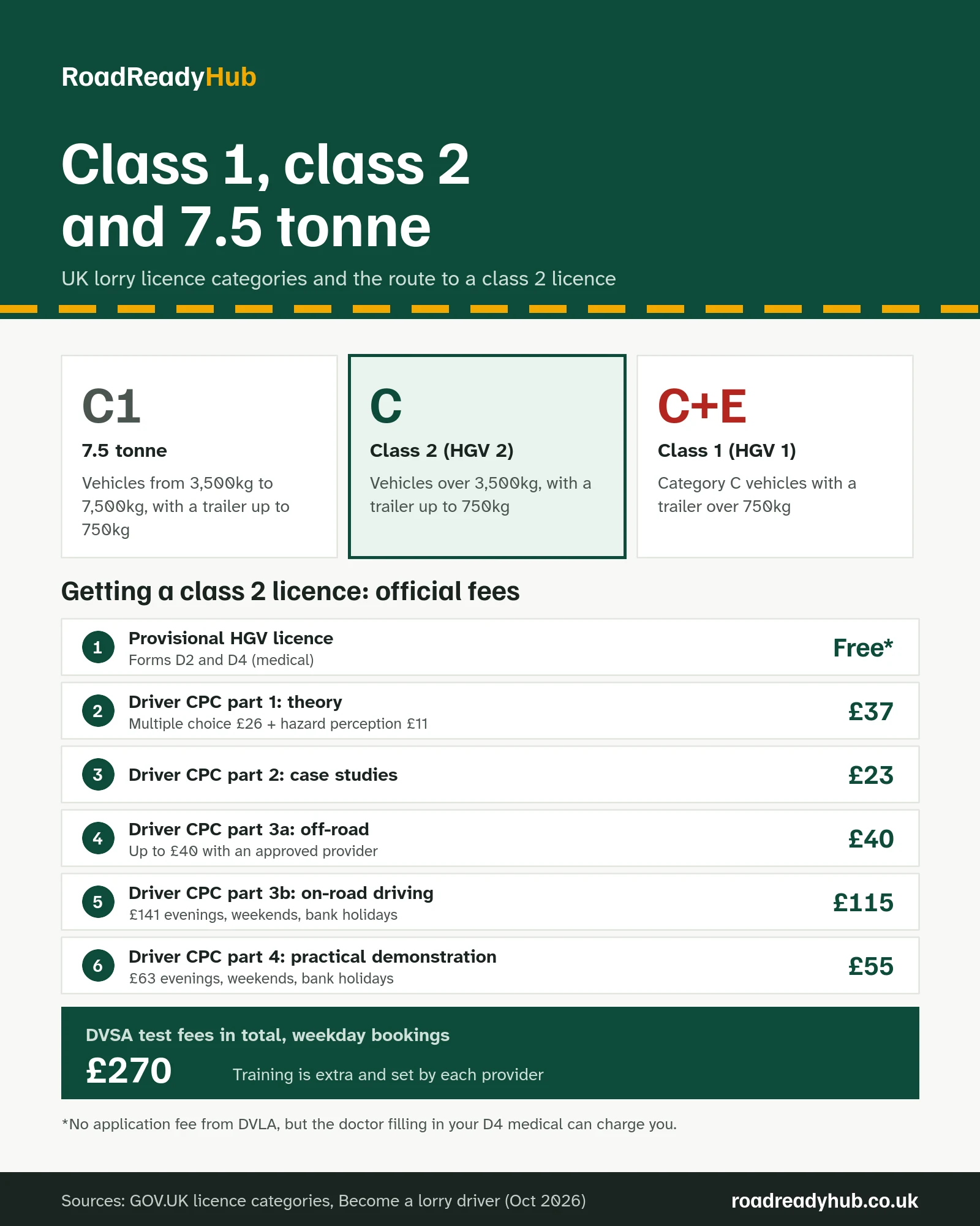
A class 2 licence is the old name for a category C licence. It lets you drive vehicles over 3,500kg, such as rigid lorries, with a trailer up to 750kg. To get one you need a full car licence, a provisional lorry licence and to pass the 5 Driver CPC tests. DVSA’s test fees come to £270 for weekday bookings; training costs are extra.
“Class 2” and “class 1” are still how most people talk about lorry licences, but they aren’t the names on your licence any more. GOV.UK puts it simply: you might know a category C licence as an “HGV 2” licence, and towing heavier trailers as “HGV 1”.
This guide explains exactly what class 2 covers, how it differs from class 1 and the 7.5 tonne licence, and every step and official fee on the way to getting one in Great Britain.
What a class 2 licence lets you drive
| Licence category | Often called | What you can drive |
|---|---|---|
| C1 | 7.5 tonne licence | Vehicles between 3,500kg and 7,500kg maximum authorised mass (MAM), with a trailer up to 750kg |
| C1+E | C1 vehicles with a trailer over 750kg, up to a combined MAM of 12,000kg | |
| C | Class 2 or HGV 2 | Vehicles over 3,500kg, with a trailer up to 750kg |
| C+E | Class 1 or HGV 1 | Category C vehicles with a trailer over 750kg |
Maximum authorised mass is the most the vehicle can weigh when it’s loaded. Our guide to driving licence categories covers every category on a UK licence, from mopeds to buses.
Is class 2 the same as a 7.5 tonne licence?
No. The “7.5 tonne” licence is category C1, which stops at 7,500kg. Category C (class 2) covers vehicles over 3,500kg with no 7,500kg upper limit, so it includes the heavier rigid lorries that C1 doesn’t.
If you passed your car test before 1 January 1997, your licence may already include more than a newer car licence does. GOV.UK says you’re usually allowed to drive a vehicle and trailer combination up to 8,250kg MAM. Check exactly what’s on yours with the view your driving licence service.
Class 2 vs class 1
Class 1 (C+E) is category C with a trailer over 750kg. Each Driver CPC qualification covers the category you took your test in, so if you later want to tow a larger trailer, you’ll need to upgrade your licence. When you apply for a provisional category C licence, DVLA gives you provisional entitlement for C1, C1+E, C and C+E. Our guide to becoming a class 1 driver covers both routes and the fees.
Who can get a class 2 licence
To become a lorry driver, GOV.UK says you need to:
- have a full car licence
- be over 18, although there are some exceptions
- get the Driver Certificate of Professional Competence (CPC) if driving a lorry will be the main part of your job
You might not need the full Driver CPC if, for example, you only carry goods for personal, non-commercial use, or driving isn’t the main part of your job. GOV.UK has a full list of exemptions.
How to get a class 2 licence, step by step
1. Apply for a provisional lorry licence
Fill in two forms, both available from a Post Office that offers DVLA services:
- D2, the application form, choosing category C
- D4, a medical examination report, which must be filled in by a doctor. This can be your GP (an optician might need to complete the eyesight section) or a private firm that specialises in drivers’ medicals
Send both forms with your photocard licence to DVLA. There’s no application fee, although your doctor, optician or a private firm can charge you for the medical. You should get your licence within 3 weeks of DVLA receiving the application.
2. Pass the Driver CPC part 1 theory test
It has two parts, multiple choice and hazard perception, booked separately. You can take them on the same day and in either order, but you must pass both within 2 years of each other to get your certificate.
3. Pass the part 2 case studies test
If you’re taking all 4 parts, you can book this online as soon as you have your provisional licence. You don’t need to have passed part 1 first.
4. Pass the part 3a off-road exercises
You need to have passed part 1 first. You can take it with DVSA or an approved private test provider, and if your training organisation is also your test provider, your assessor must not have been involved in your training. You bring a lorry in the category you want to get a licence for.
5. Pass the part 3b on-road driving test
You must have passed part 3a, and you use the same category of vehicle as you did for 3a.
6. Pass the part 4 practical demonstration
You must have passed part 2 before you can book part 4. You can arrange it with your trainer or book it yourself.
How much does a class 2 licence cost?
These are the official fees for booking with DVSA:
| Test | Weekday | Evening, weekend and bank holiday |
|---|---|---|
| Provisional lorry licence application | Free | Free |
| Driver CPC part 1: multiple choice | £26 | £26 |
| Driver CPC part 1: hazard perception | £11 | £11 |
| Driver CPC part 2: case studies | £23 | £23 |
| Driver CPC part 3a: off-road exercises | £40 | £40 |
| Driver CPC part 3b: on-road driving | £115 | £141 |
| Driver CPC part 4: practical demonstration | £55 | £63 |
| Total | £270 | £304 |
Part 3a may cost up to £40 with an approved test provider. GOV.UK warns that you may be charged more if you book through an unofficial website.
Those are only the test fees. On top come the D4 medical and, usually the biggest cost, training, which each provider prices for itself. GOV.UK notes that some employers offer help with the cost of training, so it’s worth asking before you pay.
After you qualify
- Apply for a digital tachograph card to record your daily work.
- Take 35 hours of Driver CPC training every 5 years to stay qualified.
- Keep to the drivers’ hours rules and the HGV working time rules, which limit your driving and your total working week.
- Renew your lorry licence every 5 years, and every year once you reach 65.
- Keep your car licence clean: you automatically lose your lorry licence if you lose your car licence.
Lorry drivers also have strict limits on driving time. Our HGV driving hours calculator checks your daily, weekly and fortnightly totals.
Lorry and bus entitlement needs renewing every 5 years, then every year from 65. Our driving licence renewal calculator shows when your forms are due.
Wondering what the job pays? Our guide to HGV driver salaries uses the official ONS figures.
Frequently asked questions
What is a class 2 licence?
It’s the old name for a category C licence, which lets you drive vehicles over 3,500kg with a trailer up to 750kg.
How much does it cost to do your HGV class 2?
DVSA’s test fees total £270 for weekday bookings, or £304 if you take parts 3b and 4 at evenings or weekends. The provisional licence is free, but the medical and training cost extra.
Is class 2 the same as a 7.5 tonne licence?
No. The 7.5 tonne licence is category C1 (3,500kg to 7,500kg). Class 2 is category C, which covers vehicles over 3,500kg.
What’s the difference between class 1 and class 2?
Class 2 (C) covers the vehicle with a trailer up to 750kg. Class 1 (C+E) lets you tow a trailer over 750kg with a category C vehicle.
Do I need a car licence to get a class 2 licence?
Yes. You need a full car licence, and you automatically lose your lorry licence if you lose your car licence.
Sources: GOV.UK Become a qualified heavy goods vehicle (HGV) or bus driver (getting qualified, provisional entitlement, Driver CPC parts 1 to 4, after you’ve qualified, heavier trailers and fees) and Driving licence categories.