Last checked: 19 September 2026
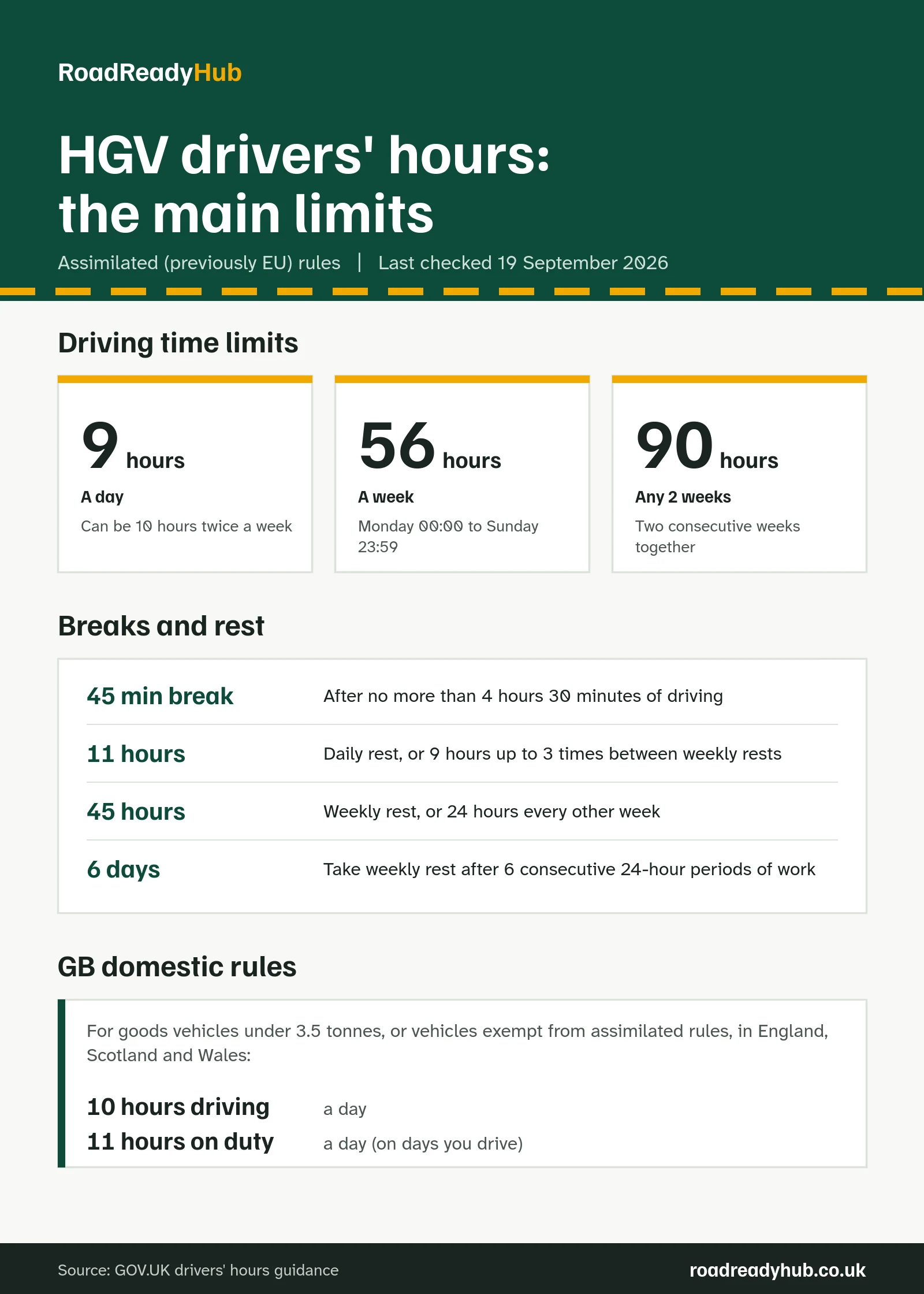
Under the assimilated rules (previously called EU rules) that cover most HGVs over 3.5 tonnes, you can drive no more than 9 hours a day (10 hours twice a week), 56 hours in a week and 90 hours in any 2 consecutive weeks. Enter your driving time below to see how much you have left today and this week.
This calculator needs JavaScript switched on in your browser.
This checks driving time only. It doesn’t replace your tachograph records or check the timing of your breaks and rest. It doesn’t send or save anything you enter. Full rules: drivers’ hours on GOV.UK.
How to use the calculator
Choose the rules you drive under, then enter the time you spent actually driving on each day of the current week, from Monday to Sunday. Don’t include breaks, loading or other work. Add your total driving time from last week, and pick today’s day.
The calculator then shows how much more you can drive today and how much is left this week, taking the daily, weekly and two-week limits into account at the same time. It flags any day over 9 hours as one of your two 10-hour days, and warns you if you’ve gone over any limit.
It’s a planning tool, not a replacement for your tachograph. It only checks driving time. It doesn’t check when you took your breaks or whether your rest periods were long enough, and your tachograph records are what enforcement officers look at.
Which drivers’ hours rules apply to you?
The rules depend on the weight of your vehicle, where you’re driving and what you’re using it for:
| Rules | When they usually apply |
|---|---|
| Assimilated rules (previously EU rules) | Vehicle or combination over 3.5 tonnes, driving in the UK or to, from or through an EU country |
| AETR rules | Vehicle over 3.5 tonnes, driving to, through or from a country that follows AETR rules, such as Norway, Switzerland or Turkey |
| GB domestic rules | In England, Scotland and Wales, for vehicles under 3.5 tonnes or vehicles exempt from the assimilated rules |
AETR rules are mostly the same as the assimilated rules, with a few differences around weekly rest. Northern Ireland has its own rules. Some vehicles are exempt from the assimilated rules, and GOV.UK’s goods vehicle guidance lists them in full.
HGV driving time limits
These are the main driving limits under the assimilated rules. A week runs from 00:00 on Monday to 23:59 the following Sunday.
| Limit | Maximum driving | Worth knowing |
|---|---|---|
| Daily | 9 hours | Can be extended to 10 hours twice a week |
| Weekly | 56 hours | Monday 00:00 to Sunday 23:59 |
| Two weeks | 90 hours | Any 2 consecutive weeks added together |
The two-week limit is the one that catches drivers out. Two back-to-back 56-hour weeks would come to 112 hours, which is well over 90. In practice, a heavy week has to be balanced by a lighter one.
A worked example
Say you drive 9 hours on Monday, 10 hours on Tuesday, 8 hours 30 minutes on Wednesday, 9 hours on Thursday and 10 hours on Friday. That’s 46 hours 30 minutes, comfortably under 56. But if you drove 40 hours last week, your two-week total is already 86 hours 30 minutes, so you only have 3 hours 30 minutes left this week, not 9 hours 30 minutes. You’ve also used both of your 10-hour days. Press “Try an example” in the calculator to see this week worked through.
Breaks and rest periods
Driving limits only work alongside the rules on breaks and rest. Under the assimilated rules, you must take:
- a break or breaks totalling at least 45 minutes after no more than 4 hours 30 minutes of driving
- at least 11 hours of rest every day, which you can reduce to 9 hours 3 times between any 2 weekly rest periods
- an unbroken weekly rest of 45 hours, which you can reduce to 24 hours every other week
- your weekly rest after 6 consecutive 24-hour periods of working, starting from the end of your last weekly rest
If you drive goods vehicles internationally, there are extra rules about taking reduced weekly rests outside the UK. GOV.UK’s assimilated rules page has the details.
GB domestic rules for goods vehicles
If your goods vehicle is under 3.5 tonnes, or is exempt from the assimilated rules, the GB domestic rules usually apply in England, Scotland and Wales. They’re simpler:
- Daily driving limit: no more than 10 hours of driving in a day.
- Daily duty limit: no more than 11 hours on duty in any working day. This doesn’t apply on days when you don’t drive.
- Records: you must record your hours on a weekly record sheet or a tachograph.
Duty time depends on how you work. If you drive for a company, duty time is any working time. If you’re self-employed, it’s only the time you spend driving or doing other work related to the vehicle or its load. Switch the calculator to GB domestic rules to check your daily driving against the 10-hour limit.
Driving limits aren’t the only ones. Drivers covered by the drivers’ hours rules also have to keep within the working time rules, which count loading, vehicle checks and other work as well as driving. Our guide to the HGV working time directive explains the 48-hour average and the 6-hour and 9-hour break rules.
What happens if you break the rules?
You may be prosecuted or fined. For serious or dangerous offences, penalties include:
- a prohibition notice
- a fine or points on your licence (a fixed penalty), depending on how serious the offence is
- your vehicle being immobilised if it’s a danger to road safety, with a release charge to pay
Less serious offences can lead to an offence rectification notice or a verbal warning. If you’re worried about points, our penalty points calculator shows how close you are to a ban.
Employers have duties too. They must keep drivers’ hours records for at least a year, make sure drivers are trained and understand the rules, and organise work so drivers can follow them. They can’t pay drivers based on delivery speed, distance or the amount carried if that encourages breaking the rules.
Thinking about becoming an HGV driver?
To drive lorries professionally you need the right licence category and the Driver Certificate of Professional Competence (CPC). Our guides to how long each driving test takes and driving test costs cover the lorry and bus tests, including the Driver CPC fees.
New to lorry driving? Our guide to the class 2 licence covers the categories, the 5 Driver CPC tests and the official fees.
Moving up to articulated lorries? Our guide to becoming a class 1 driver explains the C+E licence, the two routes and the official fees.
Long hours are a big part of lorry drivers’ pay. Our guide to HGV driver salaries shows the official figures per year, week and hour.
Frequently asked questions
How many hours can an HGV driver drive in a day?
Under the assimilated rules, 9 hours a day. You can extend this to 10 hours twice a week.
How many hours can an HGV driver drive in a week?
No more than 56 hours in a week, and no more than 90 hours in any 2 consecutive weeks.
When do HGV drivers have to take a break?
You must take a break or breaks totalling at least 45 minutes after no more than 4 hours 30 minutes of driving.
How much daily rest do HGV drivers need?
At least 11 hours every day. You can reduce this to 9 hours up to 3 times between any 2 weekly rest periods.
What are the driving hours rules for vans under 3.5 tonnes?
In England, Scotland and Wales, goods vehicles under 3.5 tonnes usually follow the GB domestic rules: no more than 10 hours of driving and 11 hours on duty in a day.
Source: Drivers’ hours on GOV.UK, including the goods vehicles, assimilated rules, GB domestic rules and AETR rules sections. This page is general information and doesn’t replace your tachograph records or official guidance.