Last checked: 5 November 2026
If you pass your driving test in a manual car, you can drive both manual and automatic cars. If you pass in an automatic (a car with 2 pedals), you can only drive automatics, and your licence shows code 78. To drive manuals later, you have to pass a driving test in a manual car, but you do not need to take the theory test again.
More learners than ever are taking their test in an automatic. This guide explains what each licence lets you drive, how to check which one you have, what DVSA’s figures show about automatic tests, and how to upgrade from automatic to manual. It covers car licences in England, Scotland and Wales.
Automatic vs manual licence: the differences
| Manual licence | Automatic licence | |
|---|---|---|
| Car you take the test in | A manual car, with 3 pedals | An automatic or semi-automatic car, with 2 pedals |
| What you can drive | Manual and automatic cars | Automatic and semi-automatic cars only |
| On your licence | Category B with no transmission code | Category B with code 78: restricted to automatic transmission |
| The test itself | The same test | The same test |
| Pass rate, 2025/26 | About 52.3% (all tests not in automatics) | 44.6% |
| To drive the other type | Nothing to do | Pass a test in a manual car. No new theory test |
GOV.UK says the driving test is the same for manual and automatic cars, and the fees are the same: £62 on a weekday, or £75 in the evening, at weekends or on bank holidays. The difference is only in what your licence lets you drive afterwards.
What counts as an automatic?
GOV.UK separates the two by the pedals. A manual car has 3 pedals (clutch, brake and accelerator). An automatic or semi-automatic car has 2. If you pass your test in a semi-automatic, you can only drive automatic and semi-automatic cars afterwards.
The same rule applies to electric and hybrid cars: if the car you take your test in has 2 pedals, which most electric cars do, your licence will be restricted to automatics.
How to check which licence you have
Licence codes are printed on the back of your photocard. Code 78 means you are restricted to vehicles with automatic transmission. If code 78 is not shown against category B, you can drive manual cars too. You can also check the vehicles you can drive online with the View your driving licence service, which our guide to sharing your driving licence explains. For what the other categories mean, see our guide to UK driving licence categories.
What DVSA’s figures show
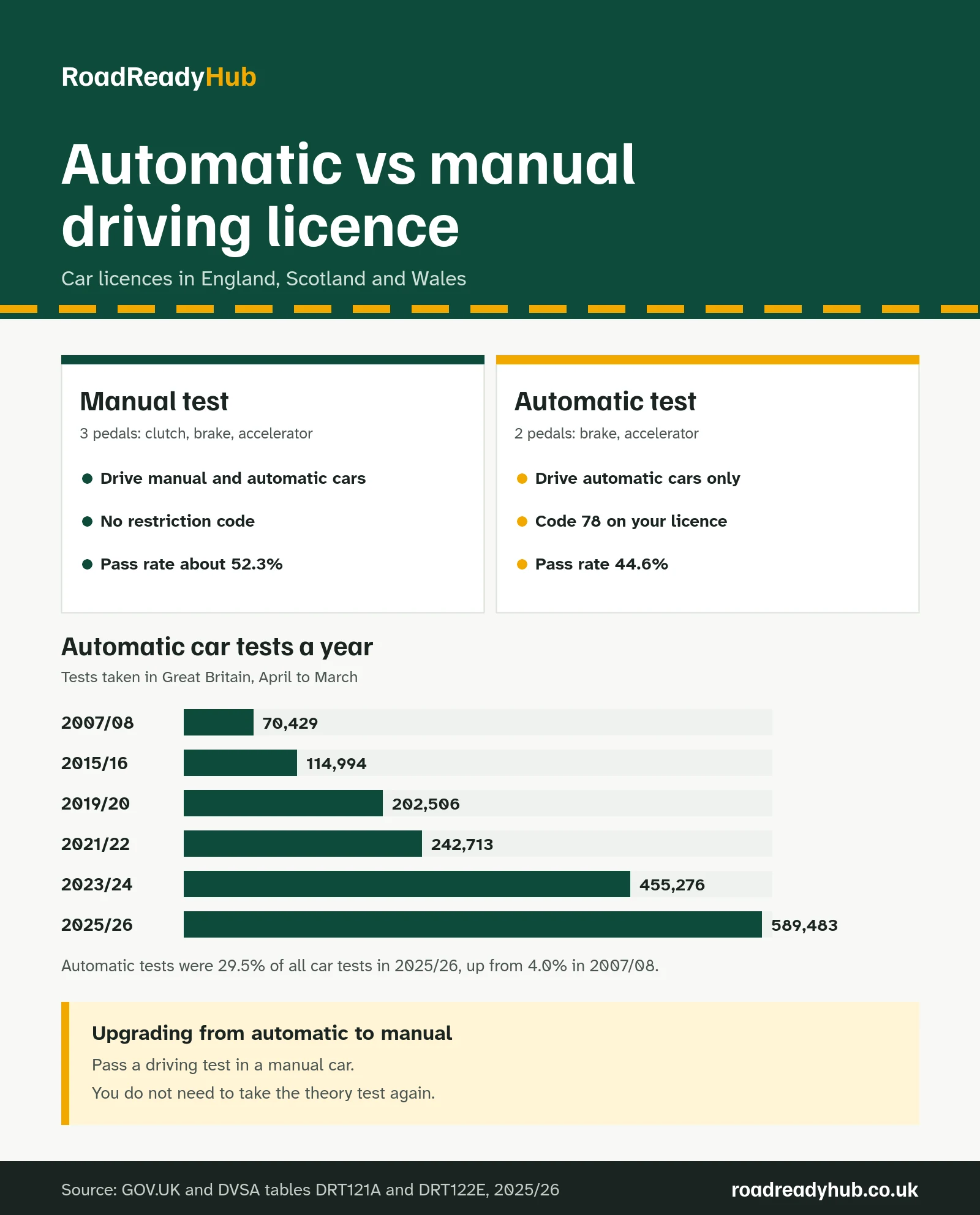
Automatic tests have grown fast. In 2007/08, DVSA carried out 70,429 car tests in automatics, 4.0% of all car tests. By 2025/26 the number had risen to 589,483, or 29.5% of all car tests in Great Britain.
| Year (April to March) | Automatic tests | Automatic pass rate |
|---|---|---|
| 2007/08 | 70,429 | 37.5% |
| 2015/16 | 114,994 | 39.3% |
| 2019/20 | 202,506 | 39.5% |
| 2021/22 | 242,713 | 41.7% |
| 2023/24 | 455,276 | 42.8% |
| 2025/26 | 589,483 | 44.6% |
The automatic pass rate has risen every year shown, but it is still well below the rate for other tests. In 2025/26, automatic tests had a pass rate of 44.6%, compared with about 52.3% for all other car tests (our calculation from DVSA’s totals). DVSA’s figures do not explain the gap.
Women took 60.3% of automatic tests in 2025/26. Men passed 46.0% of their automatic tests and women 43.7%. You can compare automatic pass rates at every centre in our table of driving test pass rates by test centre.
Should you learn in an automatic or a manual?
There is no official advice either way. It depends on what you will drive after you pass. These are the main points to weigh up:
- Flexibility. A manual licence covers both types, so you can drive any car you borrow, hire or buy. An automatic licence limits you to automatics until you take another test.
- Fewer controls to learn. In an automatic you do not use a clutch or change gear yourself, so there is less to coordinate, particularly when moving off, on hills and in slow traffic.
- The car you will actually drive. If the family car, a car you plan to buy, or a work vehicle is a manual, a manual licence avoids problems later. If you will drive an electric car, an automatic licence may be all you need.
- Health and disability. Some drivers find automatics easier for physical reasons. The rules differ if you have a disability or health condition, and you can tell DVSA about this when you book.
- Cost. Driving instructors set their own prices, so compare lesson prices for both types. Our driving lesson cost calculator helps you budget.
There is no minimum number of lessons either way. Our guide to how many driving lessons you need explains how to judge your progress.
How to upgrade from automatic to manual
To have the code 78 restriction removed, you need to pass a driving test in a manual car.
- No theory test. GOV.UK says you do not need to take the car theory test if you are upgrading an automatic car licence to a manual one.
- Learn in a manual car first. Anyone supervising you without being paid must be over 21, have held a full licence for 3 years and be qualified to drive a manual car. You also need to be insured to practise in that car. You can also take lessons with an instructor in a manual car.
- Book a car driving test on GOV.UK in the usual way and take it in a manual car. The fees and the 2026 booking rules are the same as for any car test: see how to book a driving test.
- Keep driving automatics on your full licence while you learn. Your automatic entitlement does not change unless you pass the manual test.
You will take the same test as everyone else, including the manoeuvres and the show me, tell me questions.
Frequently asked questions
Can I drive a manual car with an automatic licence?
No. If your licence has code 78, you can only drive automatic and semi-automatic cars. To drive a manual, you need to pass a driving test in a manual car.
Can I drive an automatic with a manual licence?
Yes. If you passed your test in a manual car, you can drive both manual and automatic cars.
Do I need to retake the theory test to upgrade to manual?
No. GOV.UK says you do not need to take the car theory test if you are upgrading an automatic car licence to a manual one. You only need to pass the practical test in a manual car.
Is the automatic driving test easier?
The test is the same for manual and automatic cars. In 2025/26 the pass rate for automatic tests was 44.6%, lower than about 52.3% for other car tests.
What does code 78 mean on a driving licence?
Code 78 means you are restricted to vehicles with automatic transmission. It is printed on the back of your photocard licence.
If I pass my test in an electric car, can I drive a manual?
No, if the car had 2 pedals, which most electric cars do. GOV.UK treats any car with 2 pedals as automatic or semi-automatic, so you would only be able to drive automatics.
Can I take my test in my own automatic car?
Yes, if it meets the rules for test cars, such as being taxed, insured for a driving test and roadworthy. Our driving test checklist lists them.
Sources: GOV.UK Driving test: using your own car (manual and automatic cars); GOV.UK What happens during the test; GOV.UK Driving licence categories; GOV.UK Driving licence codes; GOV.UK Theory test: cars; GOV.UK Practising with family or friends; GOV.UK Driving test costs; DVSA car driving test data (tables DRT121A and DRT122E, to March 2026). The pass rate for tests not taken in automatics and the share of tests are RoadReadyHub calculations from DVSA totals.