Last checked: 5 November 2026
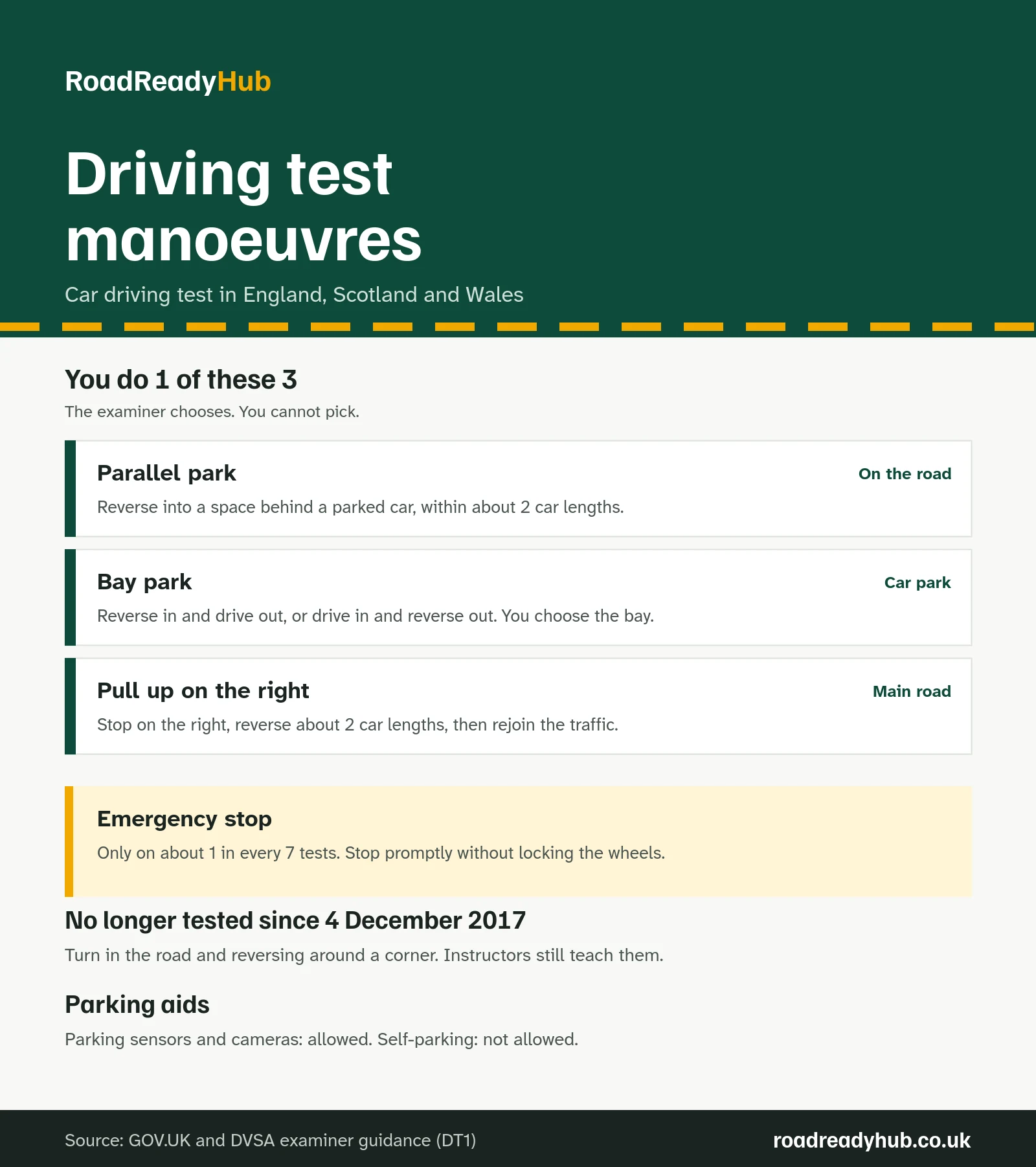
On the car driving test you do one of 3 reversing manoeuvres, chosen by the examiner: parallel parking, bay parking (reversing in and driving out, or driving in and reversing out) or pulling up on the right and reversing about 2 car lengths. About 1 in 7 tests also include an emergency stop. Turning in the road and reversing around a corner have not been tested since 4 December 2017.
This guide explains each manoeuvre the way DVSA’s own examiners are told to set it up and mark it, using GOV.UK, the examiner guidance known as DT1, DVSA’s Ready to Pass learning guide and The Highway Code. For the rest of the test, see what happens on a driving test.
3 manoeuvres or 4?
You will often see “the 4 driving test manoeuvres”. That count splits bay parking into forward and reverse bay parking. GOV.UK lists 3 exercises, with bay parking as one of them, and the examiner tells you which way round to do it. Some guides also count the emergency stop, which is a separate exercise that only comes up on some tests.
| Manoeuvre | What you do | Where it happens |
|---|---|---|
| Parallel park | Reverse into a space behind a parked car within about 2 car lengths, or between 2 parked cars | On the road |
| Reverse bay park | Reverse into a bay, then drive out | Usually the test centre car park, at the start or end of the test |
| Forward bay park | Drive into a bay, then reverse out to the left or right | A car park on the test route |
| Pull up on the right | Pull up on the right-hand side, reverse about 2 car lengths, rejoin the traffic | A main road with light to medium traffic |
| Emergency stop (some tests) | Stop quickly and under control when asked | On the road, about 1 in 7 tests |
How the examiner chooses
You cannot choose your manoeuvre. DVSA lets examiners pick between pulling up on the right, forward parking and reverse parking, as long as they use each one equally over time. That means you need to be ready for all of them. Where you can choose is in a car park: the examiner should let you use any convenient bay and do the exercise your own way.
Parallel parking
The examiner asks you to pull up well before a parked vehicle, then drive alongside it and reverse into a parked position, either:
- behind one parked car, finishing within about 2 car lengths, or
- between 2 parked cars, where the gap is about 2 car lengths
Examiners do not use cars parked on the other side of the road. The skills being tested are control and all-round observation. The Highway Code says that before reversing you should use all your mirrors, check the blind spot behind you and check for pedestrians, especially children, and other road users. While reversing, go slowly, look mainly through the rear window and remember that the front of the car swings out as you turn.
How it is marked: having to reposition to correct a small loss of control or accuracy is a driving fault. Excessive repositioning to correct a complete misjudgement, or a significant loss of control, is a serious fault.
Reverse bay parking
This is usually done in the test centre car park, either at the start of the test or as you return at the end. At the start, the examiner asks you to drive out of your bay to the left or right, stop with the wheels straight, then reverse into any convenient bay. You may drive forward to adjust your angle first, and if there is space you can drive forwards into one bay before reversing straight back into the bay opposite.
Examiners are told not to worry too much about exactly where you finish in the bay, and you should not normally be marked down for crossing the lines on the way in. Finishing outside the bay is not acceptable. The examiner may ask you to secure the car and switch off the engine so they can get out and check.
Forward bay parking
The examiner directs you into a car park on the route and asks you to drive forwards into any convenient bay. You then reverse out to the left or right. You do not have to park between 2 cars.
| Fault | DVSA example for forward parking |
|---|---|
| Driving fault | Finishing with one or two wheels on the bay line |
| Serious fault | Finishing with one or two wheels fully in the next bay, or very poor control of speed or direction |
| Dangerous fault | Losing control so the examiner has to act to stop you hitting a car in the next bay |
For both kinds of bay parking, you must look all around throughout, even in an empty car park. DVSA’s guidance says the question is not whether anyone is there, but whether you checked well enough to keep the manoeuvre safe.
Pulling up on the right and reversing
On a straight stretch of a fairly quiet main road, the examiner asks you to pull up on the right-hand side when it is safe. Once you have stopped, they ask you to reverse about 2 car lengths and then drive on, rejoining the traffic. The manoeuvre ends when you have stopped reversing and put the car in neutral.
- If you start to pick an unsuitable place, the examiner should stop the exercise before you cross over and try again later.
- If another vehicle pulls up in front of you, the examiner may ask you to reverse further to get a clear view ahead. If a vehicle blocks you from reversing, the manoeuvre is abandoned and tried again later.
- The examiner will not get out to guide you. If you ask for help, they will tell you to do it as if you were driving alone.
How it is marked: misjudging an oncoming vehicle as you move across to the right, without affecting anyone’s safety, is a driving fault. Making an oncoming driver brake heavily so you can cross is a serious fault.
This is a test exercise. In everyday driving, The Highway Code says not to park facing against the traffic flow, and you must not park on a road at night facing against the traffic unless you are in a recognised parking space.
The emergency stop
DVSA’s guidance says the emergency stop should be done on 1 in every 7 tests, chosen at random. You need to stop safely, promptly and under full control, without locking the wheels. DVSA’s Ready to Pass guide adds that you should understand the limits of anti-lock brakes (ABS), adapt to the road and weather, and move away safely afterwards.
How it is marked: locking the wheels and skidding briefly, but regaining control well, is a driving fault. Braking so harshly that the car keeps skidding out of control, with little or no attempt to regain it, is a serious fault. After stopping, take all-round observations before moving off: DVSA lists moving off after the emergency stop without checking behind as a common mistake.
Manoeuvres that are no longer tested
Since 4 December 2017, the turn in the road and reversing around a corner have not been part of the car test. DVSA says instructors should still teach them, and both are in its list of the skills you need: Ready to Pass covers reversing around corners and into driveways, and turning the car around safely.
Can you fail your driving test on a manoeuvre?
Yes. A manoeuvre is marked like the rest of your drive. Small corrections usually mean a driving fault at most, but a serious fault, such as finishing outside the bay, ending up fully in the next bay, making another driver brake hard or not looking around at all, means you fail. Our guide to driving test faults explains how examiners decide.
It helps to keep this in proportion. None of the 10 most common faults on car tests in 2025/26 was a manoeuvre: the list was led by junctions, mirrors and turning right. You can usually correct your position during a manoeuvre, and a correction made with good observation is far better than finishing badly.
Which manoeuvre is hardest?
DVSA does not rank the manoeuvres or publish how often each one leads to a fail, so any list of the “hardest” manoeuvre is opinion. Which one feels hardest varies from learner to learner. Because the examiner chooses, the practical answer is to practise all of them until none feels hard.
Can you use parking sensors and cameras?
Yes. GOV.UK says you can use parking sensors and cameras on the test, but not self-parking. Use them as an aid only: DVSA expects you to keep checking all around, and you cannot rely on a camera instead of proper observation.
How to practise
- Ask your instructor to watch your observation in particular. DVSA suggests asking them whether you are missing anything when you reverse.
- Practise each manoeuvre in different places: busy and quiet car parks, roads with and without traffic, and on slopes.
- Keep the car slow, with smooth control of the clutch and brake, so you have time to look around.
- Practise with family or friends between lessons if they meet the supervision rules.
Frequently asked questions
What are the 4 manoeuvres on the UK driving test in 2026?
There are 3 official manoeuvres: parallel parking, bay parking and pulling up on the right. Guides that list 4 count forward and reverse bay parking separately. You do only one on your test, chosen by the examiner.
Can I fail my driving test on manoeuvres?
Yes, if you make a serious or dangerous fault, such as finishing outside the bay, ending up fully in the next bay or making another driver brake hard. Small corrections are usually a driving fault at most.
What is the hardest manoeuvre in the driving test?
DVSA does not rank them or publish fail rates for each manoeuvre, so there is no official answer. You have to be ready for all 3 because the examiner chooses.
What is the easiest manoeuvre?
There is no official answer. It depends on what you have practised most. Since you cannot choose, aim to be comfortable with all 3.
Is the emergency stop on every driving test?
No. DVSA’s examiner guidance says it should be carried out on 1 in every 7 tests, chosen at random.
Do I have to do a turn in the road on my driving test?
No. The turn in the road and reversing around a corner were removed from the car test on 4 December 2017, although instructors still teach them.
Can I use a reversing camera on my driving test?
Yes. Parking sensors and cameras are allowed, but self-parking is not. You still need to look all around while you reverse.
Sources: GOV.UK Driving test: what happens during the test and Using your own car; GOV.UK Carrying out driving tests: examiner guidance (DT1), section 1 and section 11; DVSA Ready to Pass: manoeuvres (skills 17 to 20); DVSA Driving test changes: 4 December 2017; The Highway Code rules 200 to 203 and rules 239 and 248; DVSA car driving test data, table DRT121F (top 10 faults, 2025/26).