Last checked: 25 September 2026
There’s no minimum number of driving lessons in the UK. GOV.UK says how many you need depends on how quickly you learn. Instead of a set number of hours, DVSA says you’re ready for your test when you’re consistently at level 5 in all 27 driving skills, you don’t need prompts from your instructor, and your instructor agrees you’re ready.
It’s one of the first questions every learner asks, usually because it decides how much learning to drive will cost. The honest answer is that nobody can give you a number in advance. What DVSA does give you is a clear way to measure your progress, so you can see how close you are and avoid booking your test too early.
Is there a minimum number of driving lessons?
No. GOV.UK says there’s no minimum number of lessons you must have or hours you must practise driving, and there’s no minimum number of lessons you must have done before you book and take your test. You do need to pass your theory test before you can book the driving test.
How many lessons you need will depend on how quickly you learn. DVSA puts it the same way on its Ready to Pass? site: how quickly you progress depends on how you learn, and that’s different for everyone.
What about the “45 hours” figure?
You’ll often see a figure of 45 hours of lessons plus 22 hours of private practice quoted online as an average. DVSA’s current guidance for learners doesn’t give an average number of hours. It says there’s no minimum and focuses on the skills you can show rather than the time you’ve spent.
So treat any average as a rough talking point, not a target. Some learners will need a lot more than any average, and some will need fewer. What matters on test day is whether you can drive safely and independently.
How DVSA measures when you’re ready
DVSA breaks learning to drive into 27 skills, grouped like this:
| Skills | Group |
|---|---|
| 1 to 4 | Basics |
| 5 to 7 | Control and positioning |
| 8 to 13 | Observation, signalling and planning |
| 14 to 16 | Junctions, roundabouts and crossings |
| 17 to 20 | Manoeuvres |
| 21 to 23 | Road types |
| 24 to 26 | Driving conditions |
| 27 | Following routes |
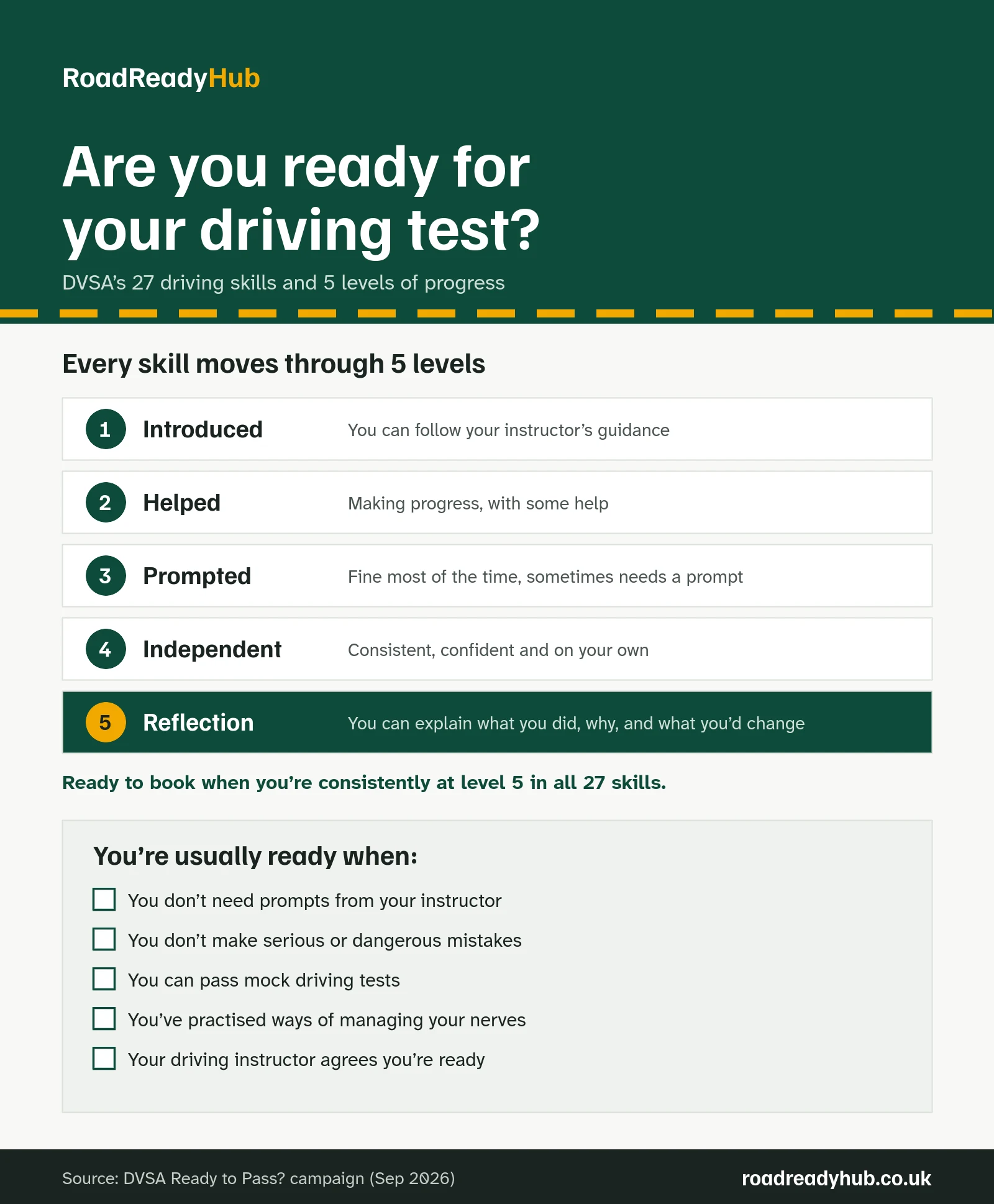
Each skill has 5 levels of progress. You’ll be ready to take your driving test when you’re consistently achieving level 5 for all 27 skills.
- Level 1, introduced: you’ve been introduced to the skill and can follow your instructor’s guidance.
- Level 2, helped: you’re making progress but still benefit from some help.
- Level 3, prompted: you can handle the skill most of the time, but sometimes need a prompt.
- Level 4, independent: you handle the skill consistently, confidently and on your own.
- Level 5, reflection: you can explain what you did, why it mattered and what you’d do differently next time.
DVSA recommends tracking this with its official driver’s record, which you and your instructor can use to see which skills need work. Your instructor may use a different form or app, which is fine as long as you’re working towards level 5.
Signs you’re ready for your test
According to DVSA, you’ll usually be ready to take your driving test when:
- you don’t need prompts from your driving instructor
- you don’t make serious or dangerous mistakes when you’re driving
- you can pass mock driving tests
- you’ve practised ways of managing your nerves
- your driving instructor agrees you’re ready
If you’ve booked a test and you’re not there yet, you can move it. It’s free to change the appointment as long as you do it at least 10 full working days (Mondays to Saturdays) before the test. Our guide to driving test cancellations covers how changing a test works.
How to make every lesson count
DVSA’s recommended route through learning to drive starts with an instructor, not a family car:
- Choose a driving instructor.
- Start studying The Highway Code.
- Start taking driving lessons with your instructor.
- Start studying and practising for your theory test.
- Book and take your theory test when your instructor thinks you’re ready.
- Start private practice between lessons, when your instructor says you’re ready.
- Book your driving test only when your instructor agrees you’re ready to pass and drive on your own.
There’s evidence behind that order. DVSA research found that learners who hadn’t taken any lessons before their theory test were 16% more likely to fail the multiple-choice part first time, and 25% more likely to fail their driving test first time. Pass rates also vary a lot by area: see our driving test pass rates by test centre for the figures near you.
Private practice between lessons
DVSA says combining professional lessons with private practice can help you build experience more quickly, and that learners who do both tend to do better in their test. Anyone you practise with, without paying them, must:
- be over 21
- have held a full driving licence for 3 years
- be qualified to drive the type of vehicle you’re learning in, for example a manual car licence for a manual car
They mustn’t use a mobile phone while supervising you, and you must have the right insurance and display L plates (or D plates in Wales) on the front and back. You can be fined up to £1,000 and get up to 6 penalty points on your provisional licence if you drive without the right supervision. You also can’t practise on motorways with family or friends; learners can only drive on motorways in England, Scotland and Wales, with an approved driving instructor in a car with dual controls. Our guide to learner drivers on motorways explains the rules.
What it could cost you
Because the number of hours varies, so does the cost. The fixed part is the official fees: £34 for a provisional licence online, £23 for the theory test and £62 for a weekday driving test. Our driving lesson cost calculator adds your instructor’s price and the hours you expect to those fees, and shows how many weeks it could take at your pace.
When you get there, our guide to how many minors you can have on a driving test explains exactly how the test is marked.
Revising for your theory test alongside your lessons? Try our free mock theory test.
Frequently asked questions
How many driving lessons do you need to pass?
There’s no set number. GOV.UK says it depends on how quickly you learn. DVSA says you’re ready when you’re consistently at level 5 in all 27 driving skills and your instructor agrees.
Is there a minimum number of hours of driving lessons in the UK?
No. There’s no minimum number of lessons or hours of practice, and no minimum number of lessons before you book your driving test.
Is 45 hours of driving lessons the average?
The figure of 45 hours is often quoted online, but DVSA’s current guidance doesn’t give an average. It says progress is different for everyone.
Does private practice reduce the number of lessons I need?
DVSA says combining professional lessons with private practice can help you build experience more quickly, and learners who do both tend to do better in their test.
How do I know I’m ready for my driving test?
You’re usually ready when you don’t need prompts, don’t make serious or dangerous mistakes, can pass mock tests, have practised managing your nerves and your instructor agrees.
Sources: GOV.UK Driving lessons and learning to drive and Driving test: cars; DVSA Ready to Pass? Learning to drive and practising and Keep track of your progress.