Last checked: 23 September 2026
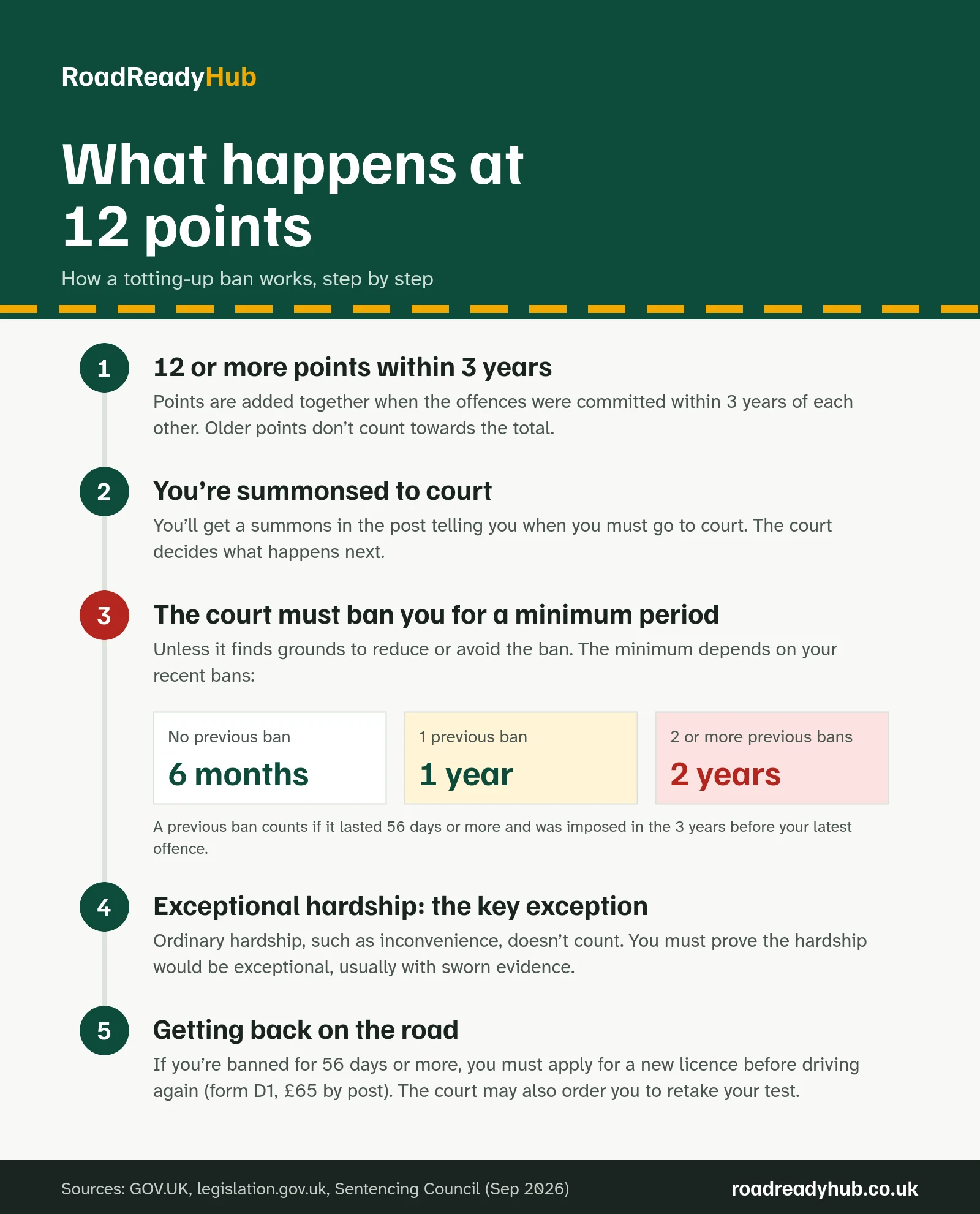
If you get 12 or more penalty points within 3 years, you’ll be summonsed to court and the court must ban you from driving for at least 6 months. The minimum rises to 1 year if you’ve had one ban in the 3 years before your latest offence, and 2 years if you’ve had two or more. The court can only shorten or avoid the ban if it accepts there are grounds to, and ordinary hardship doesn’t count.
A ban for reaching 12 points is known as a “totting-up” disqualification, because the points from separate offences are totted up until they cross the line. It catches drivers who never did anything that would get them banned on its own: four speeding offences at 3 points each is enough.
This guide walks through the whole process, from how the points are counted to getting your licence back. It’s based on GOV.UK, the Road Traffic Offenders Act 1988 and the Sentencing Council’s guideline for courts in England and Wales. Some disqualification rules are different in Northern Ireland.
How the 12 points are added up
GOV.UK says you can be disqualified if you build up 12 or more penalty points within a period of 3 years. The law behind this, section 29 of the Road Traffic Offenders Act, is precise about which points count:
- the points for the offence you’re being convicted of now
- points already on your driving record from earlier offences
- but not points from an offence committed more than 3 years before another one
So the 3 years is measured between the dates of the offences, not the dates you were convicted or paid a fixed penalty.
A worked example
Imagine a driver with three speeding endorsements, each for 3 points, from offences on 1 February 2024, 10 September 2024 and 5 May 2025. They then commit a fourth 3-point offence.
- If the fourth offence is on 20 January 2027, all four offences fall within 3 years of each other. That’s 12 points, and a totting-up ban applies.
- If the fourth offence is on 1 March 2027, the February 2024 offence was committed more than 3 years earlier, so its points aren’t added. The total is 9, and there’s no totting-up ban.
Our penalty points calculator runs this check for you. Enter the date and points for each offence to see your total and when each set of points stops counting.
What happens when you reach 12 points
You’ll get a summons in the post telling you when you must go to court. Section 35 of the Act then says the court must disqualify you for at least the minimum period, unless it’s satisfied there are grounds for mitigating the normal consequences of the conviction. If it finds those grounds, it can ban you for a shorter period or not ban you at all.
If you’re convicted of more than one offence at the same hearing, the court can only impose one totting-up ban, but it takes all the offences into account when deciding how long it should be.
How long is a driving ban for 12 points?
The minimum depends on how many earlier bans count against you:
| Earlier bans that count | Minimum totting-up ban |
|---|---|
| None | 6 months |
| 1 | 1 year |
| 2 or more | 2 years |
An earlier ban only counts if it lasted 56 days or more and was imposed in the 3 years immediately before the date of your latest offence.
These are minimums. GOV.UK says the court decides how long the disqualification lasts, based on how serious it thinks the offence is. The Sentencing Council’s guideline asks courts to weigh things like how bad the driving was, your driving history, whether the public will be at risk, and the effect of the ban on your employment and family responsibilities, and on other people such as children and dependent family members.
You might have to retake your test
A court can order that a totting-up ban lasts until you pass an extended driving test. According to the Sentencing Council, the extended test costs double the standard practical test, lasts more than 60 minutes, and always includes an emergency stop and driving on roads with the national speed limit.
Exceptional hardship: can you avoid the ban?
The law sets clear limits on what the court can consider when deciding whether to reduce or avoid a totting-up ban. It must not take into account:
- anything that’s claimed to make the offence, or any of the offences behind your points, not serious
- hardship, other than exceptional hardship
- anything that was already used to reduce or avoid a totting-up ban in the 3 years before this conviction
The Sentencing Council’s guideline explains how courts should approach an exceptional hardship claim:
- it’s up to you to prove it, and other than very exceptionally that means giving evidence yourself, under oath
- almost every ban causes hardship for the driver and their family, so the court needs evidence of exceptional hardship, not inconvenience
- courts should be cautious unless there’s evidence that alternatives, including other ways of travelling, genuinely aren’t workable
- losing your job isn’t enough on its own; it depends on your circumstances and the effect on you and on other people
- if you kept offending after you knew your licence was at risk, the court can take that into account
Because of the last point on the first list, circumstances the court has accepted once can’t be relied on again for another totting-up ban within 3 years. If you’re planning to argue exceptional hardship, get legal advice before your hearing.
What happens to your points after the ban
Under section 29, points that were on your record before a totting-up ban aren’t counted again towards a future totting-up ban. They don’t vanish from your record, though. An offence that results in disqualification stays on your driving record for 4 years from the date of conviction, and insurers and employers may be able to find out about it during that time.
The ban itself also matters for the future. If you reach 12 points again within 3 years of it, the minimum ban goes up to 1 year. Our guide to how long penalty points stay on your licence explains the record periods for every type of offence.
Getting your licence back
You can’t drive until your disqualification has ended. What you need to do next depends on the length of the ban:
- Less than 56 days: you don’t need to apply for a new licence. Check your driving record online to confirm when the ban ends.
- 56 days or more: you must apply for a new licence before driving again. As the minimum totting-up ban is 6 months, this applies to most 12-point bans.
DVLA sends a reminder, form D27, 56 days before your disqualification ends. If you don’t get one, you can order form D1 for a car or motorbike licence. Getting your licence back after a ban for anything other than drink driving costs £65, and it’s a postal application only. If the court told you to retake your test, you’ll need a new provisional licence and must pass the theory and practical tests again.
GOV.UK also lets you ask the court to cut a ban short, but only after you’ve served 2 years of a ban under 4 years long, so it won’t help with a typical points ban.
New drivers usually hit a different limit first
If you passed your test in the last 2 years, you’re unlikely to reach 12. Getting 6 or more points within 2 years of passing means your licence is cancelled (revoked) automatically. That’s not a court ban: you apply for a new provisional licence and pass both tests again, and getting your licence back after a revocation under the New Drivers Act costs £50. Our guide to the new driver 6-point rule covers it in full.
Can you appeal a 12-point ban?
If you think the magistrates’ court got it wrong, GOV.UK’s guide to appealing a magistrates’ court decision explains the process. You usually need to appeal to the Crown Court within 15 working days of the date you were sentenced, and GOV.UK recommends talking to a legal representative or adviser first. There are different rules for challenging a court decision in Scotland and Northern Ireland.
Frequently asked questions
How long is a driving ban for 12 points?
At least 6 months. It’s at least 1 year if you’ve had one ban of 56 days or more in the 3 years before your latest offence, and at least 2 years if you’ve had two or more. The court can set a longer ban.
Do points get wiped after a 12-point ban?
They don’t count towards another totting-up ban, but they aren’t wiped from your record. An offence that leads to a ban stays on your driving record for 4 years from the date of conviction.
Can you keep your licence with 12 points?
Only if the court is satisfied there are grounds to reduce or avoid the ban. Ordinary hardship doesn’t count, and losing your job isn’t enough on its own to prove exceptional hardship.
Do you have to retake your driving test after a 12-point ban?
Not automatically. The court can order that you stay banned until you pass a driving test, which can be an extended test.
How much does it cost to get your licence back after a ban?
£65 by post if you were banned for anything other than drink driving. It’s £90 if you were banned for drink driving and need a medical with a DVLA doctor. Our drink drive calculator explains units and how long alcohol can take to leave your body.
Sources: GOV.UK Driving disqualifications, Penalty points (endorsements), Reapply for your driving licence, Driving licence fees and Appeal a magistrates’ court decision; Road Traffic Offenders Act 1988, section 29 and section 35 (legislation.gov.uk); Sentencing Council Driving disqualification guideline.