Last checked: 23 September 2026
Add your drinks below to count the units of alcohol you’ve had and see a cautious estimate of how long they could take to leave your body. The NHS says the average adult processes about 1 unit an hour, but it varies. No calculator can tell you if you’re under the drink drive limit: GOV.UK says it’s impossible to say how many drinks that equals.
This calculator needs JavaScript switched on in your browser.
A rough guide using the NHS unit formula and the NHS rule of thumb that the average adult processes about 1 unit of alcohol an hour. It can’t tell you whether you’re under the drink drive limit or fit to drive. It doesn’t send or save anything you enter.
How this calculator works
It does two simple sums, both based on NHS guidance:
- Units. Each drink is converted using the NHS formula: strength (ABV %) × volume (ml) ÷ 1,000. A pint (568ml) of 5.2% lager works out at 2.95 units.
- Time. The NHS says one unit is around the amount of alcohol the average adult can process in an hour, and that this varies from person to person. The calculator allows 1 hour per unit.
We’ve chosen to count from your last drink rather than your first, and to round up to the next full hour, so the estimate leans later rather than earlier. Even so, it’s a rough guide to when the alcohol may have left your blood, not a time when you’ll be fit to drive.
Units in common drinks
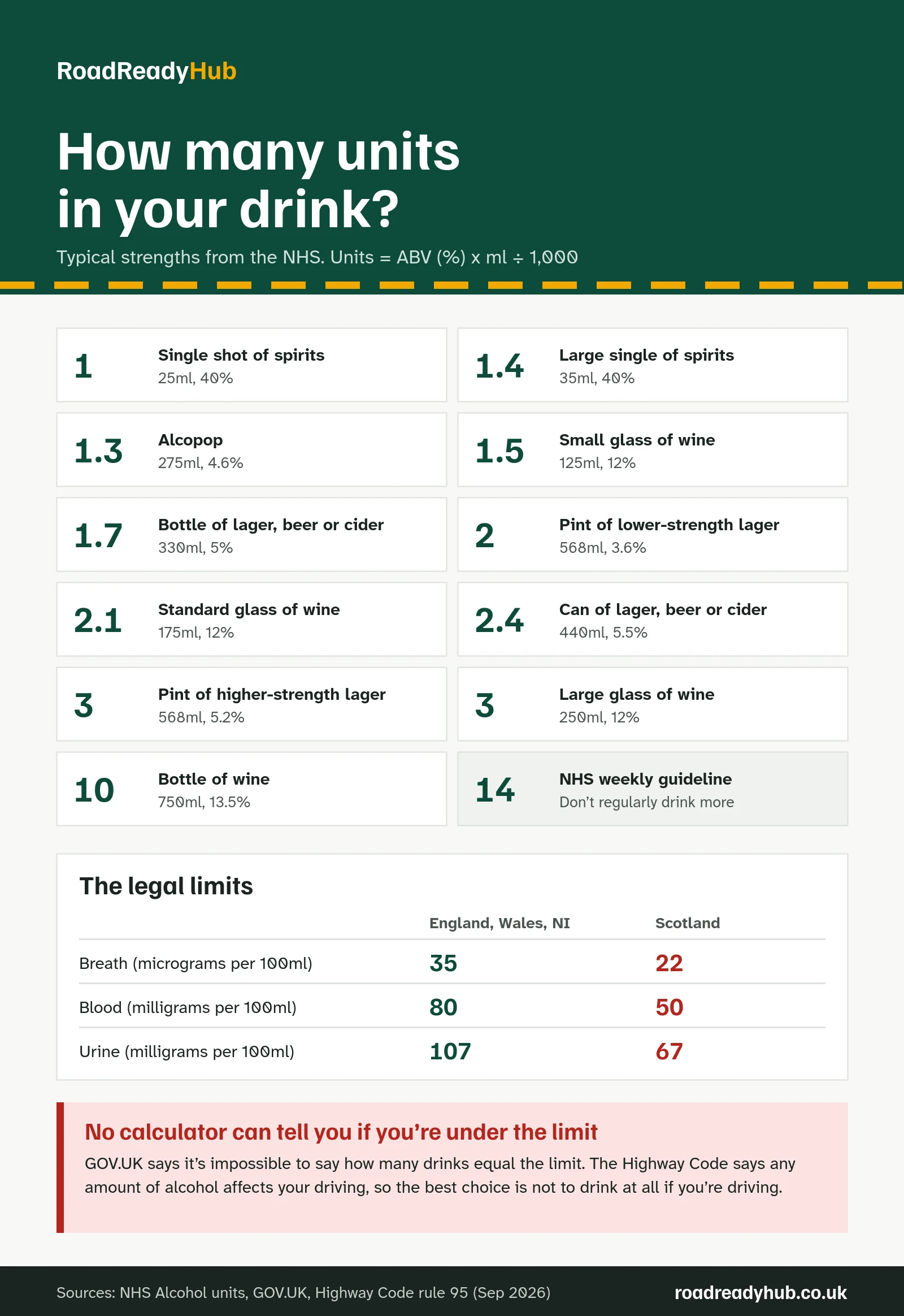
These are the NHS figures for drinks at typical strengths. Check the label, because the ABV of beer, cider and wine varies a lot.
| Drink | Size and strength | Units |
|---|---|---|
| Single small shot of spirits | 25ml, 40% | 1 |
| Large single of spirits | 35ml, 40% | 1.4 |
| Alcopop | 275ml, 4.6% | 1.3 |
| Small glass of wine | 125ml, 12% | 1.5 |
| Bottle of lager, beer or cider | 330ml, 5% | 1.7 |
| Can of lager, beer or cider | 440ml, 5.5% | 2.4 |
| Pint of lower-strength lager, beer or cider | 568ml, 3.6% | 2 |
| Standard glass of wine | 175ml, 12% | 2.1 |
| Pint of higher-strength lager, beer or cider | 568ml, 5.2% | 3 |
| Large glass of wine | 250ml, 12% | 3 |
| Bottle of wine | 750ml, 13.5% | 10 |
For your general health, the NHS advises men and women not to regularly drink more than 14 units a week.
The drink drive limit in the UK
The legal limits are set as the amount of alcohol in your breath, blood or urine. Scotland’s limits are lower than the rest of the UK.
| Level of alcohol | England, Wales and Northern Ireland | Scotland |
|---|---|---|
| Micrograms per 100ml of breath | 35 | 22 |
| Milligrams per 100ml of blood | 80 | 50 |
| Milligrams per 100ml of urine | 107 | 67 |
GOV.UK says it’s impossible to say exactly how many drinks this equals, because it’s different for each person. The way alcohol affects you depends on:
- your weight, age, sex and metabolism
- the type and amount of alcohol you’re drinking
- what you’ve eaten recently
- your stress levels at the time
Why no calculator can say you’re fit to drive
That’s why this tool counts units and time, and stops there. Alcohol affects everyone differently, and the NHS rule of thumb only describes the average adult.
Being under the legal limit doesn’t mean alcohol isn’t affecting you either. Rule 95 of the Highway Code says alcohol will:
- give a false sense of confidence
- reduce co-ordination and slow down reactions
- affect judgement of speed, distance and risk
- reduce your driving ability, even if you’re below the legal limit
Its advice is clear: the best solution is not to drink at all when you’re planning to drive, because any amount of alcohol affects your ability to drive safely. If you are going to drink, arrange another way to get home.
Driving the morning after
Alcohol takes time to leave your body. The Highway Code warns that you may be unfit to drive in the evening after drinking at lunchtime, or in the morning after drinking the previous evening.
Try the calculator’s example to see why. Three pints of higher-strength lager and two standard glasses of wine come to about 13 units. If the last drink was at 11:30pm, allowing 1 hour per unit takes you to at least 1:30pm the next day, and it could be later.
Penalties for drink driving
The penalty is up to the magistrates who hear your case. For driving or attempting to drive while above the legal limit or unfit through drink, GOV.UK says you may get:
- 6 months’ imprisonment
- an unlimited fine
- a ban from driving for at least 1 year (3 years if convicted twice in 10 years)
Refusing to provide a specimen of breath, blood or urine carries the same penalties. Being in charge of a vehicle while over the limit can mean 3 months’ imprisonment, a fine of up to £2,500 and a possible ban. Causing death by careless driving while under the influence of drink can lead to life imprisonment and a ban of at least 5 years.
A drink driving endorsement also stays on your driving record for 11 years from the date of conviction. Our guide to how long penalty points stay on your licence explains what that means for insurers and employers.
Frequently asked questions
How many units can I drink and still drive?
There’s no safe number. GOV.UK says it’s impossible to say exactly how many drinks equal the limit, because it’s different for each person. The Highway Code advises not drinking at all if you’re planning to drive.
How long does it take for 1 unit of alcohol to leave your body?
The NHS says one unit is around the amount of alcohol the average adult can process in an hour. It varies from person to person, so it can take longer.
What is the drink drive limit in Scotland?
22 micrograms of alcohol per 100ml of breath, 50 milligrams per 100ml of blood, or 67 milligrams per 100ml of urine. That’s lower than the limit in England, Wales and Northern Ireland.
Can I drive the morning after drinking?
You may still be unfit to drive. The Highway Code warns that alcohol takes time to leave your body and you may be unfit to drive in the morning after drinking the previous evening.
How many units are in a pint?
About 2 units in a pint of lower-strength (3.6%) lager, beer or cider, and about 3 units in a pint of higher-strength (5.2%), according to the NHS.
Sources: NHS Alcohol units; GOV.UK The drink drive limit and Drink-driving penalties; The Highway Code, rule 95. The time estimate is our own calculation from the NHS figure of about 1 unit an hour.