Last checked: 23 September 2026
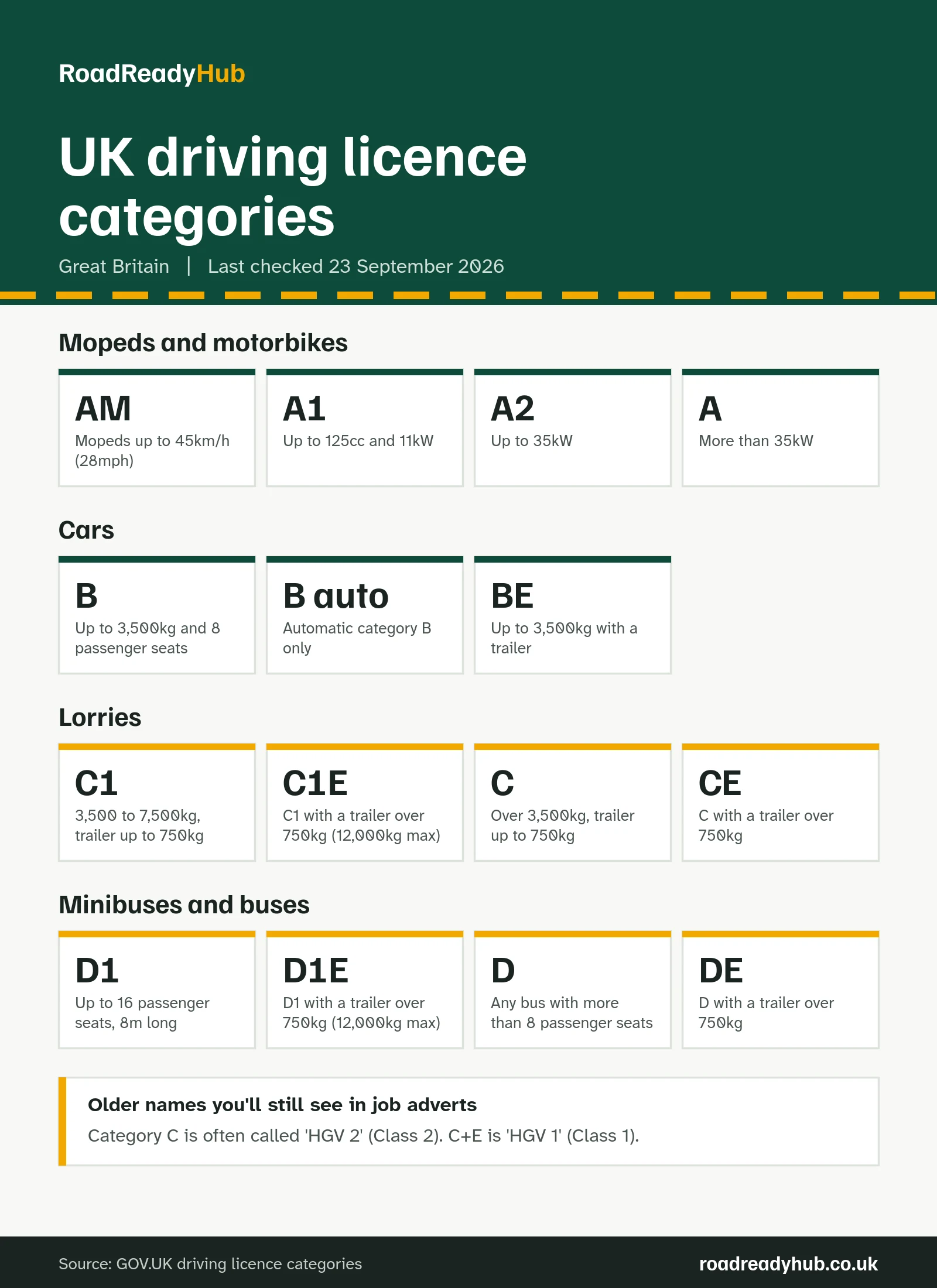
Each letter on your driving licence is a category of vehicle you’re allowed to drive. A standard car licence (category B) covers vehicles up to 3,500kg with up to 8 passenger seats. For anything bigger you need extra categories: C1 for lorries between 3,500kg and 7,500kg, C for larger lorries (often called Class 2), C+E for lorries with heavier trailers (Class 1), D1 for minibuses and D for buses.
Licence categories trip up a lot of drivers, partly because the official codes and the names people actually use don’t match. Job adverts ask for “Class 1”, your licence says “CE”, and someone at work calls it an “HGV 1”. They’re all the same thing. This guide explains every category in plain English, what an older licence lets you drive, and how to add lorry or bus categories if you want to drive for a living.
It covers licences issued in Great Britain by the DVLA. Categories are different in Northern Ireland.
How to check which categories you have
The quickest way is GOV.UK’s view your driving licence information service. It shows every vehicle category you can drive, whether each one is full or provisional, and any restrictions. You’ll need your driving licence number, your National Insurance number and the postcode on your licence.
Some entitlements come with restriction codes, for example if you can only drive automatic vehicles in a category. The service shows these too, and our guide to sharing your driving licence explains the most common codes.
UK driving licence categories explained
These are the main categories, with what each one lets you drive. Weights are the vehicle’s maximum authorised mass (MAM), which is how much it can weigh when fully loaded, not its empty weight.
| Category | What you can drive |
|---|---|
| AM | Mopeds and light quad bikes with a top design speed over 25km/h (15.5mph) and up to 45km/h (28mph) |
| A1 | Light motorbikes up to 125cc and 11kW, and motor tricycles up to 15kW |
| A2 | Motorbikes up to 35kW |
| A | Motorbikes over 35kW, and motor tricycles over 15kW |
| B1 | 4-wheeled vehicles up to 400kg unladen, or 550kg if designed for carrying goods |
| B | Cars and vans up to 3,500kg with up to 8 passenger seats (see below for electric vehicles and trailers) |
| B auto | Category B vehicles, automatic only |
| BE | A vehicle up to 3,500kg towing a trailer, with trailer limits depending on when you got BE |
| C1 | Vehicles between 3,500kg and 7,500kg, with a trailer up to 750kg |
| C1E | C1 vehicles with a trailer over 750kg, up to 12,000kg combined |
| C | Vehicles over 3,500kg, with a trailer up to 750kg |
| CE | Category C vehicles with a trailer over 750kg |
| D1 | Minibuses with no more than 16 passenger seats, up to 8 metres long, with a trailer up to 750kg |
| D1E | D1 vehicles with a trailer over 750kg, up to 12,000kg combined |
| D | Any bus with more than 8 passenger seats, with a trailer up to 750kg |
| DE | Category D vehicles with a trailer over 750kg |
There are also smaller categories for mopeds (P and Q) and specialist vehicles: f (agricultural tractors), G (road rollers), H (tracked vehicles), k (mowing machines or pedestrian-controlled vehicles), l (electrically propelled vehicles), M (trolley vehicles) and n (exempt from duty). You don’t need a licence for an electric bike, mobility scooter or powered wheelchair.
What does C1 mean on my driving licence?
C1 lets you drive medium-sized vehicles between 3,500kg and 7,500kg, which is why it’s often called a “7.5 tonne licence”. It covers things like larger vans, small lorries, horseboxes and some motorhomes. With C1E you can add a trailer over 750kg, as long as the combined weight doesn’t go over 12,000kg.
If C1 is on your licence and you’ve never taken a lorry test, it’s probably because of when you passed your car test. If you passed your car test before 1 January 1997, your licence already shows C1, C1E (up to 8.25 tonnes), D1 and D1E. The D1 and D1E entitlements are “not for hire or reward”, so you can’t use them to carry paying passengers.
If you passed your car test on or after 1 January 1997, you don’t get C1 automatically. You need to apply for a provisional C1 entitlement and pass the tests.
What are Class 1 and Class 2 licences?
“Class 1” and “Class 2” are older names that are still widely used in the haulage industry, especially in job adverts. GOV.UK notes that you might know a category C licence as an “HGV 2” licence, and towing heavier trailers as “HGV 1”. Here’s how the everyday names match the official categories:
| Name you’ll hear | Official category | What it usually means |
|---|---|---|
| Class 2, HGV 2, LGV 2 | C | A rigid lorry over 3,500kg |
| Class 1, HGV 1, LGV 1 | CE (C+E) | A lorry with a heavier trailer, such as an articulated lorry |
| 7.5 tonne licence | C1 | A medium vehicle up to 7,500kg |
| Minibus licence | D1 | Up to 16 passenger seats |
| PCV or bus licence | D | Any bus with more than 8 passenger seats |
The usual route is to get category C first, then upgrade to C+E. You don’t need a new provisional licence or another theory test to upgrade. You complete training for the vehicle and trailer combination you want, then pass the Driver CPC part 3a (off-road) and part 3b (on-road) tests in it.
D1 and D: minibus and bus licences
“PCV” stands for passenger-carrying vehicle. There are two main categories:
- D1 (minibus): vehicles with no more than 16 passenger seats and a maximum length of 8 metres, with a trailer up to 750kg.
- D (bus): any bus with more than 8 passenger seats, with a trailer up to 750kg.
A standard car licence covers vehicles with up to 8 passenger seats, so a 9-seater and above needs a D1 or D entitlement. If you drive a bus or coach professionally, you also need the Driver Certificate of Professional Competence (Driver CPC).
What can you drive on a car licence (category B)?
It depends on when you passed your test.
If you passed on or after 1 January 1997
- Vehicles with up to 8 passenger seats and a maximum authorised mass of 3,500kg for petrol, diesel or hybrid vehicles.
- Up to 4,250kg for electric or hydrogen vehicles, with an extra 750kg allowed for equipment for disabled passengers.
- A trailer up to 3,500kg, as long as the vehicle and trailer together don’t go over 7,000kg.
- Motor tricycles with a power output over 15kW, if you’re over 21.
If you passed before 1 January 1997
You’re usually allowed to drive a vehicle and trailer combination up to 8,250kg, and a minibus with a trailer over 750kg, in addition to the C1, C1E, D1 and D1E entitlements described above. It’s worth checking your licence online to see exactly what you have.
How to add a lorry or bus category to your licence
To become a lorry, bus or coach driver, you need a full car licence and must be over 18, although there are some exceptions. The process is:
- Apply for a provisional lorry or bus entitlement. Fill in form D2 (the application) and form D4 (a medical examination report, completed by a doctor). You can get both from a Post Office that offers DVLA services. The application itself is free, but your doctor or a private medical firm can charge for the D4.
- Send both forms with your photocard licence to DVLA. Your licence should arrive within 3 weeks, or longer if your health or personal details need checking.
- Pass the Driver CPC tests. For most new professional drivers that means the part 1 theory test, part 2 case studies, part 3a off-road exercises, part 3b on-road driving and the part 4 practical demonstration.
The category you choose on form D2 decides which provisional entitlements you get:
| You apply for | Provisional entitlements you get |
|---|---|
| C1 | C1 |
| C or C1+E | C1, C1+E, C and C+E |
| D or D1 | D1, D1+E, D and D+E |
The Driver CPC tests cost £26 (part 1 multiple choice), £11 (part 1 hazard perception), £23 (part 2), £40 (part 3a), £115 (part 3b on a weekday) and £55 (part 4 on a weekday). Our driving test cost guide has the full fee table, and our guide to how long each driving test takes covers the lorry and bus tests.
Two rules are easy to miss. Lorry and bus licences must be renewed every 5 years, and every year once you reach 65. And if you lose your car licence, for example through a ban, you automatically lose your lorry or bus entitlement too. Our penalty points calculator shows how close you are to a ban.
Which licence do driving jobs need?
Job adverts rarely use the official codes, so it helps to translate them:
- “Class 2 driver” or “HGV 2 driver” jobs need category C, plus a Driver CPC card if driving is the main part of the job.
- “Class 1 driver” jobs need category C+E.
- “7.5 tonne driver” jobs need C1, which you may already have if you passed your car test before 1997.
- Van delivery jobs usually only need a car licence, as long as the van is 3,500kg or under.
- Bus and coach driver jobs need category D and the Driver CPC.
Professional lorry and bus drivers also have to follow the drivers’ hours rules. Our HGV driving hours calculator checks your time against the daily, weekly and two-week limits.
Northern Ireland
Driving licence categories are different in Northern Ireland, where licences are issued by the Driver & Vehicle Agency (DVA). Check the details on nidirect.
Thinking about driving lorries for a living? Our guide to the class 2 licence (category C) explains how it compares with class 1 and 7.5 tonne licences, and every step and fee to get one.
Photocard licences need renewing every 10 years, and from 70 every 3 years. Our driving licence renewal calculator shows when yours is due.
For lorry licences, see our guides to the class 2 licence and becoming a class 1 driver.
Frequently asked questions
What is a C1 licence?
C1 lets you drive vehicles between 3,500kg and 7,500kg, with a trailer up to 750kg. It’s often called a 7.5 tonne licence.
What is a Class 1 and Class 2 licence?
They’re older industry names. Class 2 (HGV 2) is category C, for rigid lorries over 3,500kg. Class 1 (HGV 1) is category C+E, for lorries with heavier trailers such as articulated lorries.
What is a PCV licence?
PCV means passenger-carrying vehicle. A PCV licence usually means category D (any bus with more than 8 passenger seats) or D1 (minibuses with up to 16 passenger seats).
Can I drive a 7.5 tonne lorry on my car licence?
Only if your licence shows C1. If you passed your car test before 1 January 1997, it usually will. If you passed on or after that date, you need to add C1 by applying for a provisional entitlement and passing the tests.
What can I drive with a category B licence?
If you passed on or after 1 January 1997, vehicles up to 3,500kg (4,250kg for electric or hydrogen vehicles) with up to 8 passenger seats, and a trailer up to 3,500kg as long as the combined weight is no more than 7,000kg.
Sources: Driving licence categories, Become a qualified HGV or bus driver, Changes to the driving licence and categories and View or share your driving licence information, all on GOV.UK.