Last checked: 12 November 2026
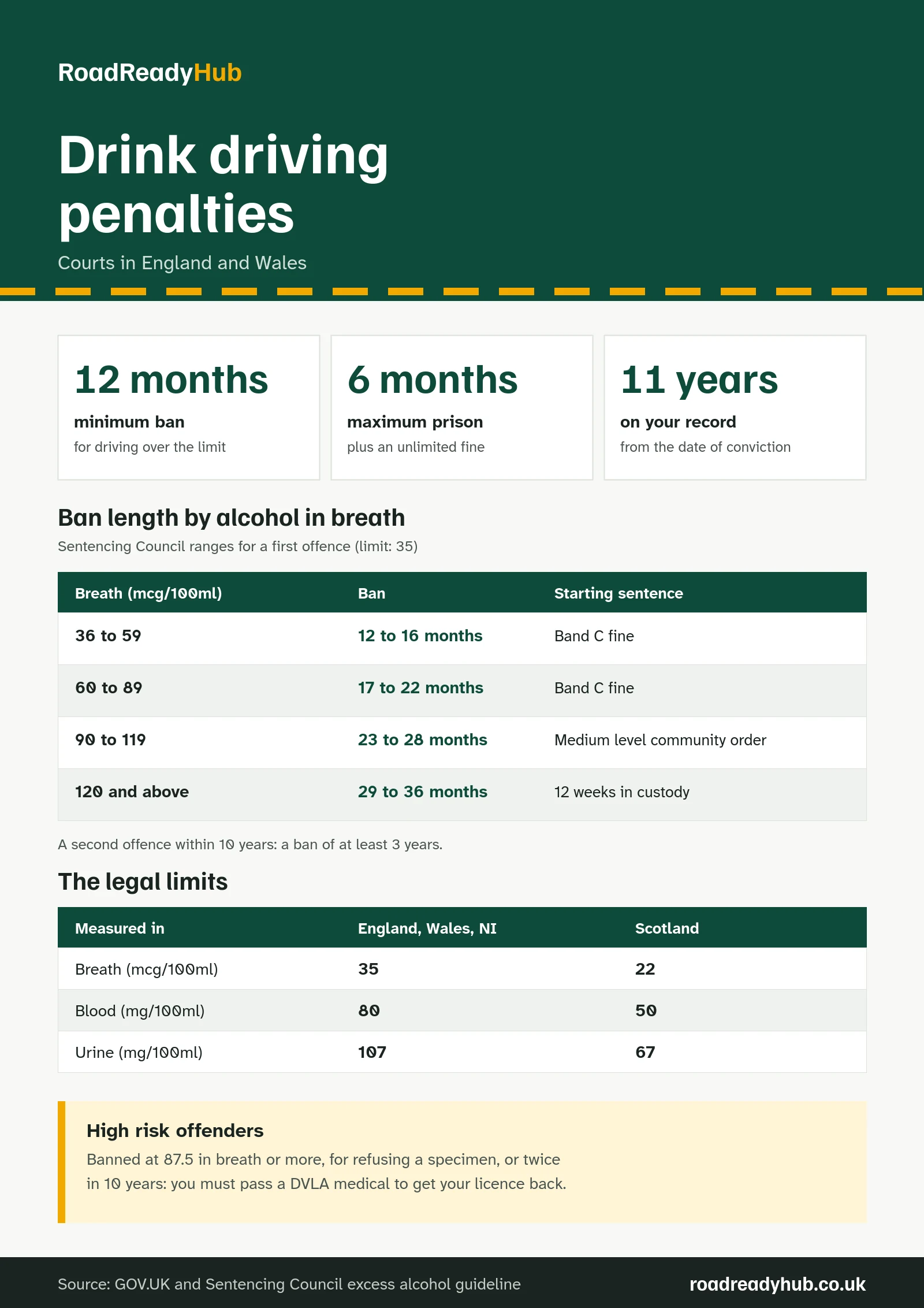
If you are convicted of driving over the drink drive limit, you will be banned for at least 12 months, and you could get up to 6 months in prison and an unlimited fine. A second conviction within 10 years means a ban of at least 3 years. In England and Wales, the higher your alcohol reading, the longer the ban: from 12 to 16 months just over the limit to 29 to 36 months at the highest levels.
This guide explains the penalties for drink driving and related offences in the UK, how courts in England and Wales decide the length of a ban, what being a high risk offender means, and how long a conviction stays on your record. It uses GOV.UK and the Sentencing Council’s guideline for magistrates. To understand units and how long alcohol takes to clear, use our drink drive calculator.
The drink drive limits
| Measured in | England, Wales and Northern Ireland | Scotland |
|---|---|---|
| Breath (micrograms per 100ml) | 35 | 22 |
| Blood (milligrammes per 100ml) | 80 | 50 |
| Urine (milligrammes per 100ml) | 107 | 67 |
GOV.UK says it is impossible to say how many drinks this equals, because alcohol affects people differently depending on weight, age, sex, metabolism, what they have eaten and other factors. If you are banned by any UK court for drink driving, you cannot drive anywhere in the UK.
Maximum penalties for each offence
GOV.UK sets out the maximum penalties. The actual penalty is decided by the court and depends on your offence.
| Offence | Prison | Fine | Ban |
|---|---|---|---|
| Driving or attempting to drive over the limit or unfit through drink | Up to 6 months | Unlimited | At least 1 year (3 years if convicted twice in 10 years) |
| Refusing to provide a specimen of breath, blood or urine | Up to 6 months | Unlimited | At least 1 year (3 years if convicted twice in 10 years) |
| Being in charge of a vehicle over the limit or unfit through drink | Up to 3 months | Up to £2,500 | Possible ban |
| Causing death by careless driving when under the influence of drink | Up to life | Unlimited | At least 5 years, and an extended driving test |
Refusing to give a specimen carries the same maximum penalties as driving over the limit, so refusing a test is not a way to avoid a ban. Being “in charge” of a vehicle while over the limit is a separate offence from driving, with lower maximum penalties.
How long a drink driving ban lasts
In England and Wales, magistrates follow the Sentencing Council’s excess alcohol guideline for offenders aged 18 and over. It sets a starting point and a ban range based on how much alcohol was in your breath, blood or urine:
| Breath (mcg/100ml) | Blood (mg/100ml) | Urine (mg/100ml) | Starting point | Ban (first offence) | Ban (second offence in 10 years) |
|---|---|---|---|---|---|
| 36 to 59 | 81 to 137 | 108 to 183 | Band C fine | 12 to 16 months | 36 to 40 months |
| 60 to 89 | 138 to 206 | 184 to 274 | Band C fine | 17 to 22 months | 36 to 46 months |
| 90 to 119 | 207 to 275 | 275 to 366 | Medium level community order | 23 to 28 months | 36 to 52 months |
| 120 and above | 276 and above | 367 and above | 12 weeks’ custody | 29 to 36 months | 36 to 60 months |
The court must also follow these minimum bans:
- at least 12 months for any conviction
- at least 2 years if you have had two or more bans of 56 days or more in the 3 years before the offence
- at least 3 years if you were convicted of a relevant offence in the 10 years before the offence
If the court sends you to prison, it should extend the ban. Scotland and Northern Ireland have their own courts and sentencing practice.
Drink driving fines
Fines in England and Wales are based on your weekly income. A Band B fine has a starting point of 100% of your relevant weekly income (range 75 to 125%), and a Band C fine 150% (range 125 to 175%). The court must take your finances into account. Unlike speeding, there is no fixed upper limit for drink driving: the maximum is an unlimited fine.
Reducing your ban with a rehabilitation course
If you are banned for 12 months or more, you may be able to reduce your ban by taking a drink-drive rehabilitation scheme (DDRS) course. GOV.UK says it is up to the court to offer this.
High risk offenders
You are classed as a high risk offender if you were banned:
- with an alcohol level of at least 87.5 micrograms in breath, 200 milligrammes in blood or 267.5 milligrammes in urine
- for failing to provide a specimen, or
- two or more times within 10 years for driving over the limit or while unfit through drink
High risk offenders do not get their licence back automatically. You must satisfy DVLA that you are medically fit to drive again, which means completing and paying for a medical assessment that includes blood tests. Our guide to 12 points and getting your licence back covers the fees for reapplying after a ban.
How long drink driving stays on your record
Drink driving offences carry codes DR10 to DR61. Driving over the limit (DR10), driving while unfit (DR20) and failing to supply a specimen after driving (DR30) carry 3 to 11 points, and being in charge over the limit (DR40) or while unfit (DR50) carries 10 points. Codes DR10 to DR61 stay on your driving record for 11 years from the date of conviction, much longer than the 4 years for most offences. Our guide to how long points stay on your licence explains the difference.
GOV.UK also warns of other consequences: your car insurance costs will increase significantly, an employer will see the conviction on your licence if you drive for work, and you may have trouble travelling to countries such as the USA.
The morning after
You can still be over the limit the morning after drinking, and the penalties are the same. Our drink drive calculator shows how long alcohol can take to leave your body, but no calculator can tell you that you are safe or under the limit. The only safe approach is not to drink at all if you are going to drive. Drugs carry similar penalties: see our guide to drug driving law for the legal limits.
Frequently asked questions
How long is a ban for drink driving?
At least 12 months. In England and Wales, the Sentencing Council guideline gives ranges from 12 to 16 months for readings just over the limit up to 29 to 36 months at 120 micrograms in breath or more. A second offence within 10 years means at least 3 years.
Can you go to prison for drink driving?
Yes. Driving over the limit carries up to 6 months in prison, and the guideline starting point at the highest alcohol levels is 12 weeks’ custody. Causing death by careless driving under the influence can mean life imprisonment.
What is the fine for drink driving?
There is no fixed amount. In England and Wales it is based on your weekly income, usually a Band B or Band C fine, and the maximum is unlimited.
What happens if you refuse a breath test?
Refusing to provide a specimen of breath, blood or urine carries the same maximum penalties as drink driving: up to 6 months in prison, an unlimited fine and a ban of at least 1 year. If you are banned for it, you are also classed as a high risk offender.
How long does drink driving stay on your licence?
Codes DR10 to DR61 stay on your driving record for 11 years from the date of conviction.
Can I reduce my drink driving ban?
If you are banned for 12 months or more, the court may offer you a drink-drive rehabilitation scheme course, which can reduce your ban.
Is the limit lower in Scotland?
Yes. The limit in Scotland is 22 micrograms of alcohol per 100ml of breath, compared with 35 in England, Wales and Northern Ireland.
Can I drive anywhere in the UK if I am banned in Scotland?
No. GOV.UK says you cannot drive anywhere in the UK if you have been banned by any UK court for drink driving.
Sources: GOV.UK The drink drive limit; GOV.UK Drink-driving penalties; GOV.UK Endorsement codes and penalty points; Sentencing Council Excess alcohol (drive/attempt to drive) (Revised 2017) guideline, last updated 5 October 2026. This is general information, not legal advice.