Last checked: 5 November 2026
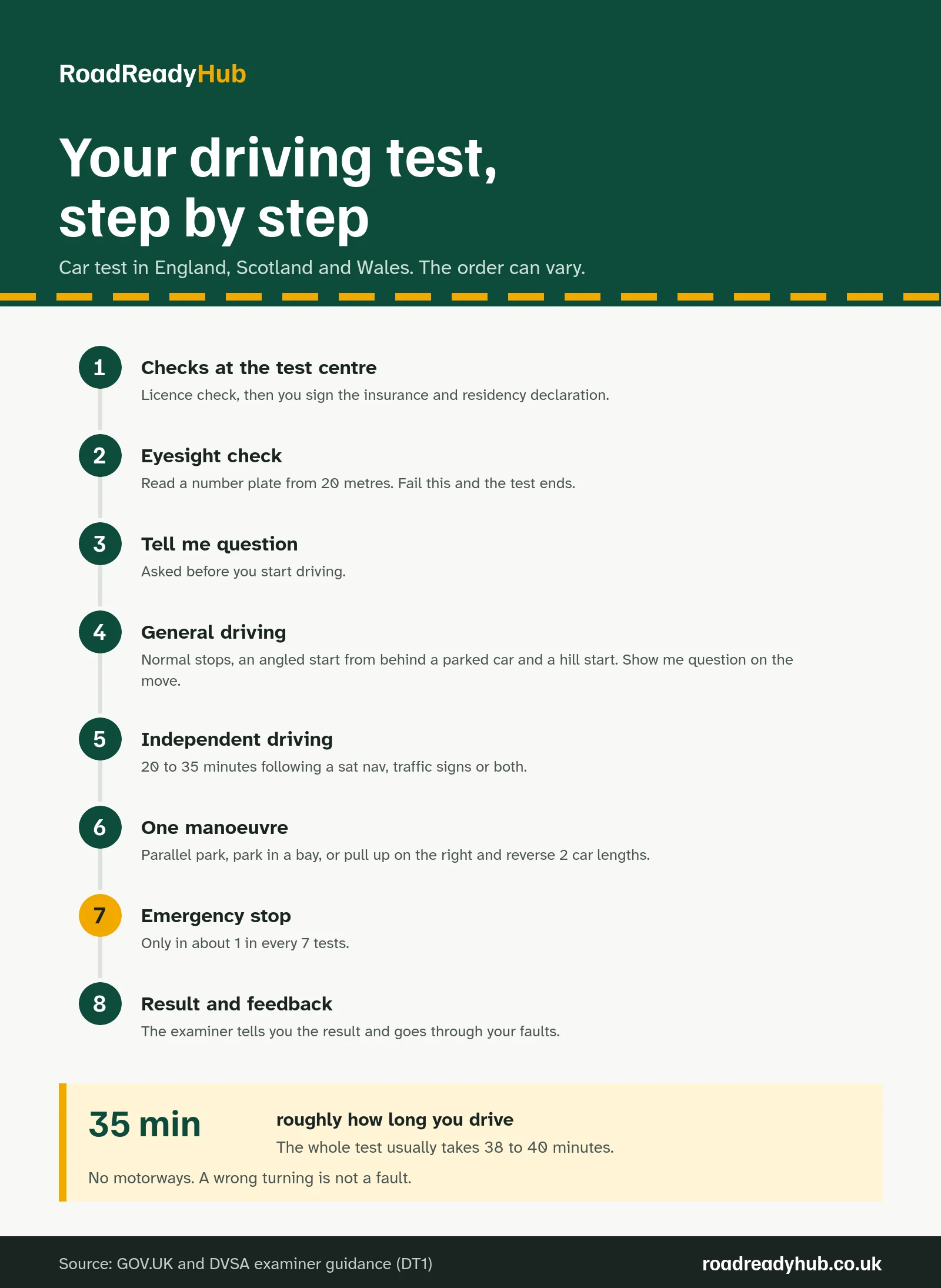
The car driving test has 4 parts: an eyesight check, 2 show me, tell me questions, general driving including 20 to 35 minutes of independent driving, and one reversing manoeuvre. You drive for around 35 minutes. The emergency stop is not on every test: DVSA’s guidance says examiners carry it out on about 1 in every 7 tests.
Knowing what is coming takes a lot of the stress out of test day. This guide walks through the car driving test in the order it usually happens, from meeting the examiner to getting your result, using GOV.UK and the guidance DVSA gives its own examiners, known as DT1. For timings, see how long a driving test is, and for how mistakes are marked, see our guide to driving test faults.
| Part of the test | What happens | How often |
|---|---|---|
| Eyesight check | Read a number plate from 20 metres | Every test |
| Tell me question | Explain how you would carry out a safety check | Every test, before you drive |
| Show me question | Show how to work a control while driving | Every test, on the move |
| General driving | Normal stops, an angled start and a hill start on different roads | Every test |
| Independent driving | Follow a sat nav, traffic signs or both | Every test, 20 to 35 minutes |
| Reversing manoeuvre | Parallel park, bay park, or pull up on the right and reverse | One per test |
| Emergency stop | Stop quickly and under control when asked | About 1 in 7 tests |
Before you start driving
Meeting the examiner
Your examiner will call your full name in the waiting room. They check your driving licence and ask you to read and sign a declaration confirming that the car is insured and that you meet the residency rule. You will also be asked whether you want your end-of-test summary sent by email or by post, and whether you would like your instructor or someone else to come with you.
Anyone who comes along must be over 16 and cannot take part in the test. Sometimes the examiner’s supervisor sits in to check how the examiner is doing. If you refuse to let them, your test can be cancelled and you will have to book and pay again. Our driving test checklist covers the documents and car rules in full.
The eyesight check
Outside, you will be asked to read a number plate from 20 metres away, or 20.5 metres for an old-style plate. You can wear glasses or contact lenses for this if you normally need them to drive. If you cannot read the plate, you fail and the test ends there.
The tell me question
Before you drive off, the examiner will ask you one “tell me” question, such as how you would check that the brakes are working. They will also check the car’s indicators and brake lights before getting in. The examiner sits in the front passenger seat, so the car needs a passenger head restraint and an extra interior mirror for them. Our list of all 21 show me, tell me questions has the answers.
General driving
You drive on a range of roads in different traffic conditions, but never on a motorway. The examiner gives you directions in good time, and DVSA tells examiners to make their instructions so clear that you are never left unsure where to go. During this part you can expect:
- Normal stops. At least 2 stops at the side of the road, where you need to choose a safe, legal and convenient place.
- An angled start. Every test includes moving off at an angle from behind a parked vehicle.
- A hill start. Where there is a suitable hill, you will be asked to pull up and move off uphill. If not, you will do an extra stop at a set point.
- The show me question. While you are driving, the examiner asks you to show how to work something, such as the rear demister or the dipped headlights.
Independent driving
For 20 to 35 minutes, you drive without turn-by-turn directions from the examiner. They will pull you over on the left and tell you which method to use:
- a sat nav, which the examiner provides and sets up. You cannot use your own
- traffic signs
- a mix of both
If you cannot see a sign, for example because a tree is covering it, the examiner will direct you until you can see the next one. Taking a wrong turning is not a fault, and the examiner will help you get back on the route. Test routes are not published, so you cannot learn them in advance. If you have dyslexia or dyspraxia and it affects your driving, tell the examiner: DVSA asks them to choose the method that suits you best.
The reversing manoeuvre
You will be asked to do one of 3 manoeuvres. The examiner chooses, and DVSA asks examiners to use each one equally over time, so practise all of them.
| Manoeuvre | What you do | Where |
|---|---|---|
| Parallel park | Reverse into a space behind a parked car, within about 2 car lengths, or between 2 parked cars | On the road |
| Bay park | Reverse into a bay and drive out, or drive in and reverse out. The examiner tells you which | The test centre car park (at the start or end of the test) or a car park on the route |
| Pull up on the right | Pull up on the right-hand side of the road, reverse about 2 car lengths, then rejoin the traffic | A fairly quiet main road |
A few points from the examiner guidance are worth knowing. In a car park, you can choose any bay and do the manoeuvre your own way. Crossing the lines on the way in is not normally marked, but finishing outside the bay is not acceptable. You must look all around throughout, even if the car park is empty, because the examiner judges your observation as if you were on the road. The examiner will not get out to help, and if you ask for help reversing, they will remind you to drive as if you were alone.
The emergency stop
GOV.UK says you might be asked to do an emergency stop. DVSA’s examiner guidance is more specific: it should be carried out in 1 out of every 7 driving tests, chosen at random so there is no pattern by time or route. Many websites still say 1 in 3, which is out of date.
If it comes up, you need to stop safely, promptly and under full control, without locking the wheels. Before moving off again, take all-round observations: DVSA lists moving off after the emergency stop without checking behind you as a common mistake.
What else the examiner records
The examiner also notes how fuel efficiently you drive, such as planning ahead and using the right gear. This “eco-safe driving” assessment is included in your feedback but does not affect your result.
If you make a mistake, carry on. It may not affect your result if it is not serious, and the examiner will only stop the test early if your driving is a danger to other road users.
At the end of the test
When you get back to the test centre, the examiner tells you whether you have passed and goes through any faults you made. Your instructor or companion can listen to the feedback if you want them to. The examiner’s decision is final.
- If you pass, you get a pass certificate, and the examiner asks if you want your full licence sent to you automatically. You can drive on your own straight away.
- If you fail, you can book another test, at least 10 working days away. Our guide on how to book a driving test explains the rules.
Overall, you drive for around 35 minutes, and DVSA says the whole test should take between 38 and 40 minutes.
Frequently asked questions
Do you always have to do an emergency stop on your driving test?
No. DVSA’s guidance for examiners says the emergency stop should be done in 1 out of every 7 tests, chosen at random.
Can you choose which manoeuvre you do?
No. The examiner chooses one of the 3 manoeuvres: parallel parking, bay parking, or pulling up on the right and reversing about 2 car lengths. In a car park, you can choose which bay to use.
Do you drive on the motorway during the driving test?
No. You drive on a range of roads and in different traffic, but not on motorways.
What happens if you go the wrong way on your driving test?
Nothing, as long as you drive safely. A wrong turning is not a fault, and the examiner will help you get back on the route.
Can my instructor sit in on my driving test?
Yes, if you want them to. Anyone who sits in must be over 16 and cannot take part. They can also listen to your feedback at the end.
Can you fail the driving test on the eyesight check?
Yes. If you cannot read a number plate from 20 metres, you fail and the test ends.
When are the show me, tell me questions asked?
The tell me question comes at the start, before you drive. The show me question is asked while you are driving.
Sources: GOV.UK Driving test: what happens during the test; GOV.UK Carrying out driving tests: examiner guidance (DT1), section 1: car driving test; GOV.UK Driving test faults and your result; DVSA Top 10 reasons for failing the driving test.