Last checked: 5 November 2026
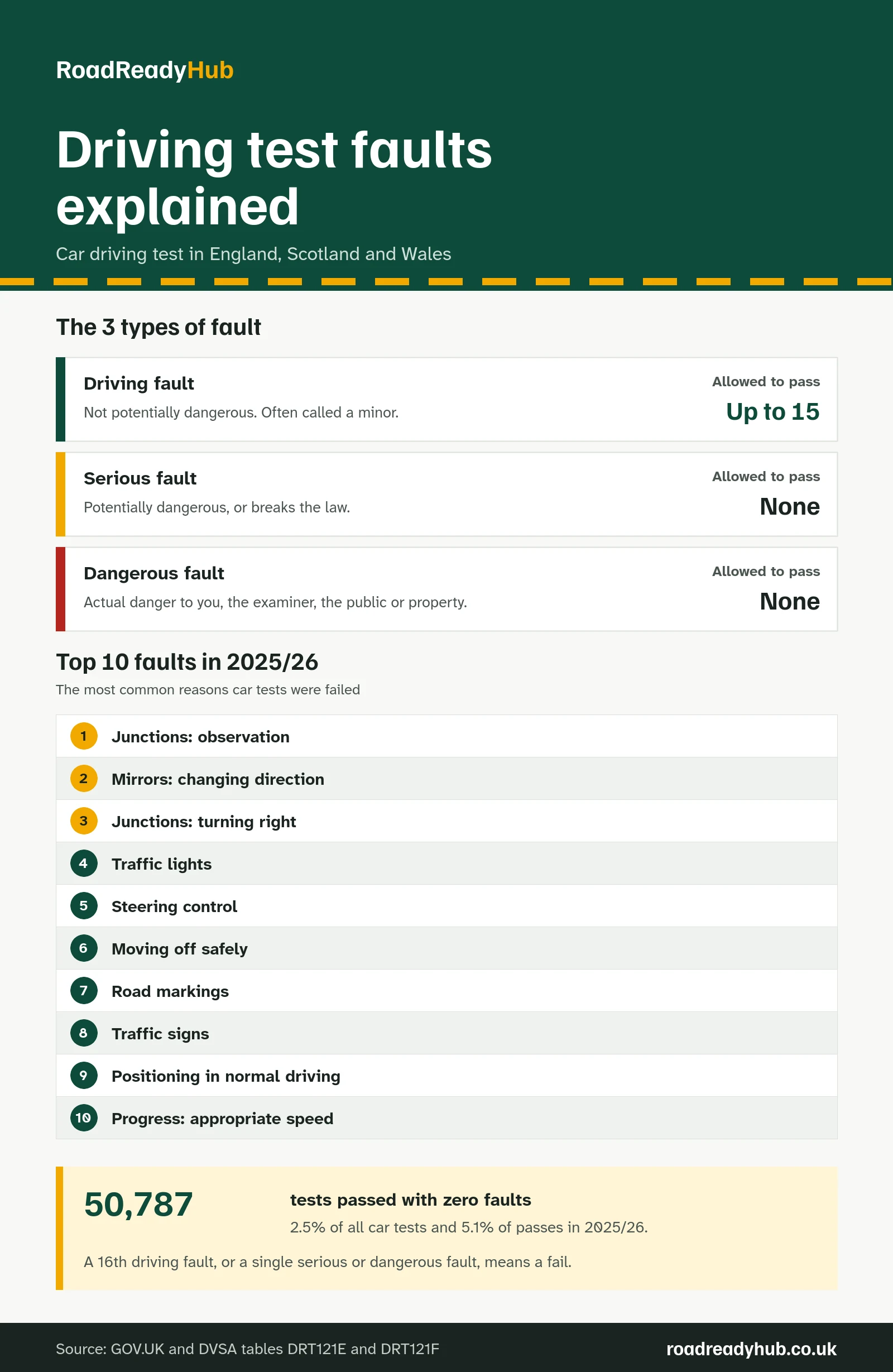
There are 3 types of driving test fault: a driving fault (often called a minor), a serious fault and a dangerous fault. You pass if you make no more than 15 driving faults and no serious or dangerous faults. In 2025/26 the most common fault was not making effective observations at junctions.
Every fault you make on your driving test is recorded under a heading on your test report, such as junctions, mirrors or use of speed. This guide explains what each type of fault means, how examiners decide which type to mark, what each heading on the report covers with DVSA’s own examples, and which faults catch out the most learners. If you want to know what each part of the test involves, see what happens on a driving test. If you only want to know the pass mark, our guide to how many minors you can have on a driving test covers that in detail.
The 3 types of driving test fault
| Type of fault | What it means | Example at a junction | Effect on your result |
|---|---|---|---|
| Driving fault (minor) | Falls short of the standard of a safe and competent driver, but is not potentially dangerous | You look before emerging but misjudge an approaching car, which has to slow down slightly. Safety is not compromised. | You can make up to 15 and still pass. A 16th means you fail. |
| Serious fault (major) | Potentially dangerous, or breaks the law | You emerge without effective observation, unaware of any road user who might be there. | One serious fault means you fail. |
| Dangerous fault (major) | Involves actual danger to you, the examiner, the public or property | You misjudge an approaching vehicle so badly that the examiner has to act to avoid a collision. | One dangerous fault means you fail. |
The junction examples come from DVSA’s guidance for driving examiners, known as DT1. It also describes a fourth level, a fault that is “not worthy” of recording at all. This is an insignificant slip that does not affect safety, and DVSA gives dry steering (turning the wheel while the car is stationary), sequential gear changes and not pressing the button on the handbrake when you apply it as examples.
How examiners decide what type of fault to mark
DVSA says examiners are trained to assess tests to a uniform standard set by the Chief Driving Examiner, with supervision and quality checks to keep marking consistent. The DT1 guidance gives examiners several rules to apply:
- Wait until the event is over. The examiner should not mark a fault too quickly, but wait until the situation has finished and then judge it.
- No double marking. One mistake is recorded once. The exception is a manoeuvre, where control and observation can both be marked.
- The first rule. The examiner asks: if the drive had been perfect before and after this fault, would this fault alone fail the candidate? If so, it is a serious or dangerous fault.
- The 16th fault rule. For every possible driving fault, the examiner asks: if this were the 16th fault, could I justify failing the candidate for it? If not, it is not worth recording.
- Adding and taking away. The examiner considers whether the fault could have been worse or better. Brushing the kerb when pulling up is less serious than mounting it.
- Breaking the law is serious. Ignoring a red light or a stop sign, or driving well above the speed limit, is a serious fault.
- Repeated faults can become serious. A driving fault you make again and again in the same area, such as habitually not checking your mirrors, can be marked as a serious fault.
If the examiner has to step in to keep you safe, by telling you to stop or by using the dual controls, this is recorded as examiner action. When a fault is judged to be dangerous, it is marked as dangerous whether or not the examiner took action.
Every heading on the test report, with DVSA examples
These are the main headings examiners use on the car test, with an example of a driving fault and a serious fault for each, taken from the DT1 guidance. For every heading, a dangerous fault is the same kind of mistake when it causes actual danger.
| Heading | Driving fault example | Serious fault example |
|---|---|---|
| Eyesight | Not applicable | You cannot read a number plate from 20 metres |
| Show me, tell me | Getting one or both questions wrong (counts as 1 driving fault) | Losing control while doing the show me task on the move |
| Reverse parking | Having to reposition to correct a small loss of control or accuracy | Excessive repositioning, or finishing outside the bay |
| Control (gears) | Wrong gear that slows you down with no risk to anyone behind | Wrong gear that slows you suddenly, so following traffic has to react |
| Precautions | Trying to restart the engine in gear after stalling, with the handbrake on | Starting the engine in gear at a junction so the car moves into the new road |
| Ancillary controls | Not completely familiar with the controls, with no effect on road safety | Not knowing where the controls are, leading to a serious loss of control |
| Move off | Checking your blind spot too late, with no risk to others | Moving off into the path of traffic, or not looking at all |
| Use of mirrors | Late mirror check before changing direction | No mirror check before a significant change of direction |
| Signals | Cancelling a signal before the turn is complete | Missing an essential signal before changing direction |
| Junctions | Misjudging an approaching vehicle, with no risk to safety | Emerging without effective observation, into the path of other vehicles |
| Judgement | Reacting late when meeting oncoming vehicles | Driving on when you should clearly have given way |
| Positioning | Driving too close to the kerb | Persistently driving too close to the kerb, putting pedestrians at risk |
| Pedestrian crossings | Reacting late to a flashing amber light at a pelican crossing | Not giving way to people who have started to cross |
| Normal stops | Stopping partly across a driveway, with no one inconvenienced | Blocking a driveway completely, so a vehicle cannot get out |
| Awareness and planning | Reacting late to what other road users are doing | A sudden last-minute reaction that puts others at risk |
| Clearance | Passing too close to a parked vehicle when there was room | Narrowly avoiding hitting a parked vehicle |
| Following distance | Not keeping the full gap from the vehicle in front | Driving so close there is little margin for error |
| Use of speed | Too fast for the conditions for a short time | Too fast for the conditions, or over the speed limit |
| Progress | Not going when it is safe and correct to do so | Stopping and waiting when it is clearly safe to go |
| Response to signs and signals | Reacting late to an amber traffic light, with no effect on safety | Not obeying a traffic light, or breaking another legal requirement |
Notice the pattern. The same mistake moves from a driving fault to a serious fault when it affects another road user or breaks the law. That is why driving more slowly and carefully is not always safer: the progress heading means hesitating at a clear junction can fail you too. For the following distance heading, our stopping distance calculator shows the gaps the Highway Code gives at each speed.
The most common driving test faults
DVSA publishes the 10 most common faults each year. These were the top 10 for car tests from April 2025 to March 2026:
- Junctions: observation. Not looking effectively before emerging, looking too late, or misjudging the speed of an approaching vehicle.
- Mirrors: changing direction. Not checking mirrors before changing lanes or leaving a roundabout.
- Junctions: turning right. Positioning wrongly, such as waiting too far left when turning right into a minor road.
- Traffic lights. Going on red, stopping in the cyclists’ box, or blocking a junction.
- Steering. Steering too early or late, clipping the kerb or swinging wide.
- Moving off safely. Pulling out without blind spot checks or into the path of traffic.
- Road markings. Ignoring lane arrows, straddling lanes or entering a box junction when the exit is not clear.
- Traffic signs. Missing stop, no entry or speed limit signs, or using a bus lane.
- Positioning in normal driving. Driving too close to the kerb or the centre line, or staying in the right lane of a dual carriageway.
- Progress. Not keeping up a safe and appropriate speed.
Junction observations and mirrors have been the top 2 faults every year since at least 2023/24. Two things changed from 2024/25: moving off safely fell from 3rd to 6th, and use of speed (driving too fast) dropped out of the top 10, replaced by progress, which covers driving too slowly or hesitating.
How many people pass with no faults?
In 2025/26, 50,787 car driving tests were passed with zero faults recorded. That is 2.5% of all tests and 5.1% of passes. It is far more common than it used to be: in 2007/08, only 4,107 tests were passed with no faults, 0.5% of passes.
How to avoid the most common faults
DVSA’s advice is simple: if you regularly make any of these mistakes in lessons or private practice, you are not ready for your test. Ask your instructor to watch for these points in particular:
- Look early at junctions. Make your observations before you are already partly into the new road, and look left as well as right when turning left.
- Judge the speed of approaching traffic, not just whether something is coming. Emerging so that a vehicle has to slow down is the most common junction fault.
- Use mirror, signal, manoeuvre every time, including when changing lanes and leaving a roundabout.
- Check your blind spot before moving off, especially after pulling up on the right and after the emergency stop.
- Position close to the centre of the road when waiting to turn right, if it is safe, so traffic can pass on your left.
- Read lane markings and signs early on the approach to roundabouts and traffic lights.
- Keep moving when it is safe. Speed limits are not targets, but waiting at a clear junction is a fault too.
DVSA groups everything you need into 27 driving skills. Our guides to how many driving lessons you need and the show me, tell me questions help you check you are ready, and driving test pass rates by test centre shows how results vary around the country.
What happens after the test
At the end of the test, the examiner tells you what faults you made, whether you passed or not. If you pass, you get your pass certificate and can drive straight away. If you fail, you have to book and pay for another test, and the date must be at least 10 working days away. Our guide on how to book a driving test explains the 2026 booking rules.
You cannot appeal against the examiner’s judgement of your driving. You can only appeal if you can prove the examiner did not follow the law. Even then, the result cannot be changed, but you might get a refund or a free retest. Court appeals must be made within 6 months of the test in England and Wales, or 21 days in Scotland.
Frequently asked questions
How many major faults are allowed on a driving test?
None. One serious or dangerous fault, often called a major, means you fail the test, even if you made no other faults.
What is the most common mistake in a driving test?
Not making effective observations at junctions. It was the most common fault on car driving tests in 2025/26, followed by not using mirrors correctly when changing direction and turning right at junctions.
What is a grade 2 fault in a driving test?
Grades are used on the driving test in Ireland, which is run by the Road Safety Authority (RSA), where a build-up of grade 2 faults can fail you. The test in England, Scotland and Wales does not use grades. Its faults are driving faults, serious faults and dangerous faults.
How do you impress a driving examiner?
You cannot earn extra marks. The examiner records faults against a set standard, so the best approach is to drive the way you do in lessons: safely, legally and with good observation. Small things such as dry steering are not worth recording, so do not worry about them.
Is getting a show me, tell me question wrong a fail?
No. Getting one or both questions wrong counts as one driving fault. It only becomes a serious or dangerous fault if you lose control of the car while doing the show me task on the move.
Can you fail your driving test for driving too slowly?
Yes. Stopping and waiting when it is clearly safe to go can be marked as a serious fault under progress. In 2025/26, progress was one of the 10 most common faults.
Can a minor fault become a serious fault?
Yes. If you keep making the same driving fault, such as not checking your mirrors, the examiner can treat it as a serious fault.
Does the examiner using the dual controls mean you fail?
It means the examiner had to act for safety, which is recorded on your report. A fault that caused actual danger is marked as dangerous, and any serious or dangerous fault means you fail.
Sources: GOV.UK Driving test faults and your result; GOV.UK Carrying out driving tests: examiner guidance (DT1), section 11: guide to assessment and marking; DVSA Top 10 reasons for failing the driving test in Great Britain; DVSA car driving test data (tables DRT121E, tests with zero faults, and DRT121F, top 10 faults, to March 2026); RSA driver tester marking guidelines (Ireland).