
Last checked: 17 October 2026
The HGV working time rules limit lorry drivers to an average of 48 hours of work a week, normally worked out over 17 weeks, and 60 hours in any single week. You can’t work more than 6 hours in a row without a break, and your breaks must total 30 minutes if you work 6 to 9 hours, or 45 minutes if you work more than 9. There’s no opt-out.
Most lorry drivers know the drivers’ hours rules, which cap how long you can spend behind the wheel. The working time rules sit alongside them and count far more than driving: loading, vehicle checks, paperwork and time stuck in traffic all go on the clock. This guide sets out both, using the limits published by GOV.UK and the Driver and Vehicle Standards Agency (DVSA), and answers the questions drivers ask most.
What is the HGV working time directive?
“Working time directive” is the name most drivers still use, after the EU law the rules came from. In Great Britain they’re set out in the Road Transport (Working Time) Regulations 2005, and DVSA enforces them.
They apply to “mobile workers”: drivers and crew of lorries, buses and coaches that come under the assimilated or AETR drivers’ hours rules. Self-employed drivers have been covered since 1 May 2012. The working time rules don’t replace the drivers’ hours rules. You have to keep to both at the same time.
The working time limits at a glance
| Rule | Limit |
|---|---|
| Average working week | 48 hours, over a 17-week reference period (26 weeks if a collective or workforce agreement allows it) |
| Most in any single week | 60 hours, as long as the 48-hour average isn’t exceeded |
| Night work | No more than 10 hours of work in any 24-hour period, unless a collective or workforce agreement allows more |
| Night time for goods vehicles | 00:00 to 04:00 |
| Work in a row without a break | No more than 6 hours |
| Breaks if you work 6 to 9 hours | At least 30 minutes in total |
| Breaks if you work more than 9 hours | At least 45 minutes in total |
| Shortest break that counts | 15 minutes |
| Daily and weekly rest | The same as the drivers’ hours rules |
| Opt-out | None |
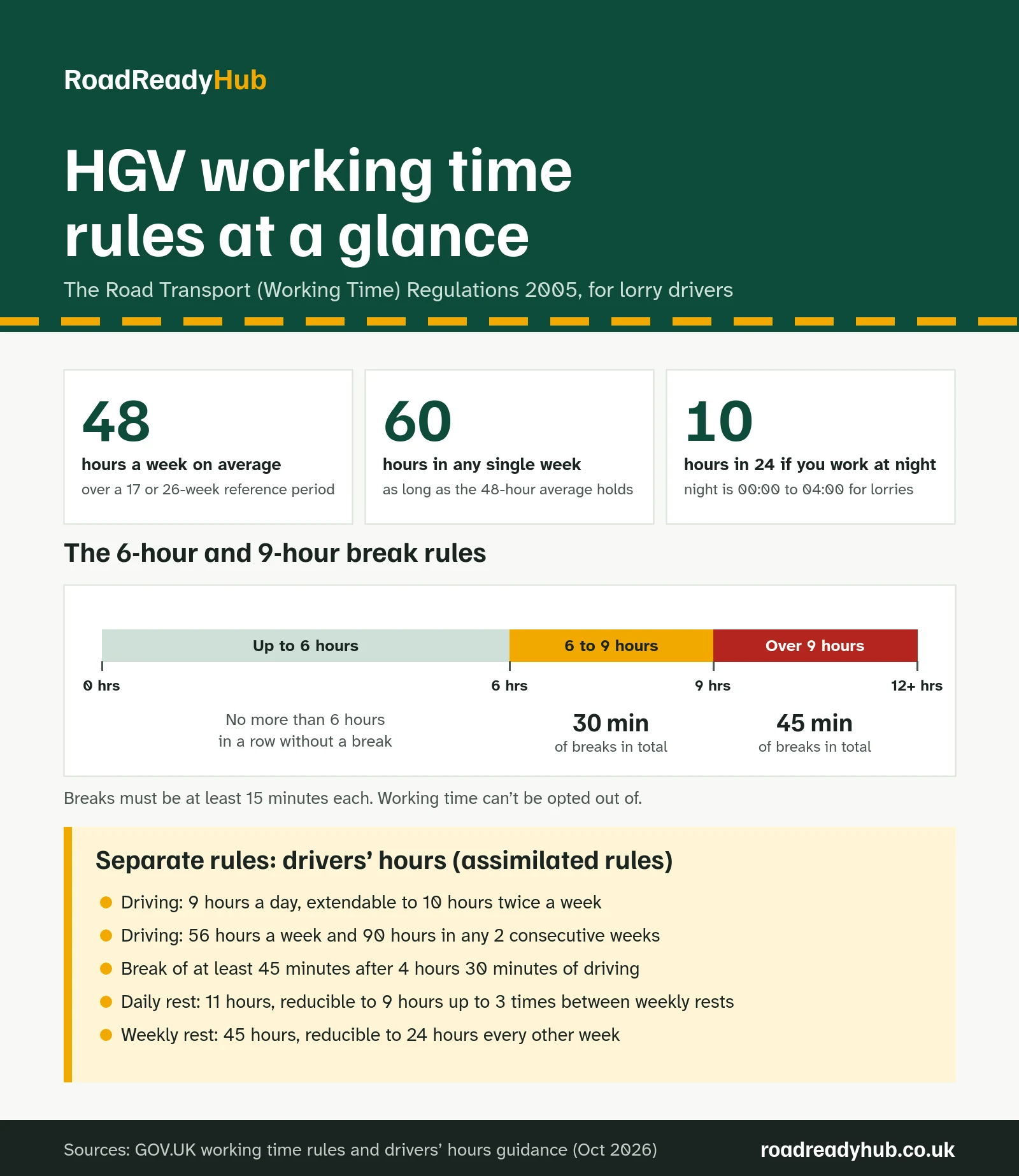
The 6-hour rule
You must not work for more than 6 hours in a row without taking a break. The rule counts all work, not just driving, which makes it easy to miss.
Say you spend 2 hours loading at a warehouse and then drive for 4 hours. You’ve driven for less than the 4 hours 30 minutes that triggers a break under the drivers’ hours rules, but you’ve now worked for 6 hours in a row. You need a break before you carry on.
The 9-hour rule
How long your breaks must add up to depends on how many hours you work that day:
- 6 to 9 hours of work: breaks totalling at least 30 minutes.
- More than 9 hours of work: breaks totalling at least 45 minutes.
- Every break: at least 15 minutes long, or it doesn’t count.
So a 10-hour working day could include three 15-minute breaks or one 45-minute break, provided none of the stretches between them goes over 6 hours.
When most of your day is driving, the breaks you take under the drivers’ hours rules (45 minutes after 4 hours 30 minutes of driving) may also satisfy the working time break rules. GOV.UK says the drivers’ hours break rules take precedence while you’re driving.
The 48-hour average and the 60-hour week
The weekly limit is an average, which lets employers plan around busy and quiet spells. Over a 17-week reference period, 48 hours a week adds up to 816 hours. Any single week can go up to 60 hours, but long weeks have to be balanced by shorter ones.
For example, if you work 60 hours a week for 8 weeks (480 hours), you’d have 336 hours left for the other 9 weeks of a 17-week period. That’s about 37 hours a week. These figures are our own worked example, not an official calculation.
Breaks and periods of availability don’t count towards the 48 hours. Statutory annual leave, sick leave and maternity or paternity leave do count as working time, according to GOV.UK.
If you work for more than one employer that runs vehicles under the drivers’ hours rules, you must tell each of them in writing about the hours you work for the other, so your combined hours can be counted.
Night work
Any work done during night time counts as night work under the regulations. For goods vehicles, night time is midnight to 4am. If you do any night work, your working time must not go over 10 hours in any 24-hour period, unless a collective or workforce agreement allows longer.
Lorry drivers also have a right to health checks as night workers, under the Working Time Regulations 1998.
What counts as working time?
In general, any activity connected with the transport operation counts as work. GOV.UK gives these examples:
- driving
- loading and unloading
- walkaround checks
These don’t count as working time:
- travelling between home and your normal place of work
- lunch and other breaks
- periods of availability (POAs)
Periods of availability
A POA is waiting time when you don’t have to stay at your workstation but must be available for work, and you know in advance roughly how long it will last. GOV.UK lists these examples:
- delays at a distribution centre
- travelling in the vehicle, as long as you do no work such as navigating
- reporting for work and being told no duties are planned for a set period
- going with a vehicle that’s being carried by boat or train
You can take a POA in the cab, provided you’re free to read or relax for a known length of time. Two kinds of waiting are not POAs and count as work: sitting in a traffic jam, because you keep stopping and starting, and moving up in a queue to load or unload every other minute.
If you’re not sure how to record something, GOV.UK advises contacting DVSA. Choosing the right mode on your tachograph matters, because your employer may use those records as your working time record.
Can HGV drivers opt out?
No. If you’re covered by the 2005 Regulations, you can’t opt out of the 48-hour average. GOV.UK states that “there is no opt-out available.”
Two groups of drivers follow different rules:
- Drivers who only work under the GB domestic drivers’ hours rules.
- Occasional mobile workers: drivers who work 10 days or fewer under the assimilated or AETR rules in a reference period shorter than 26 weeks, or 15 days or fewer in a reference period of 26 weeks or more.
These drivers come under the Working Time Regulations 1998 instead. They still have a 48-hour average limit, normally over a rolling 17 weeks, but they can choose to opt out of it. Their employer must still make sure they get adequate rest.
How many 15-hour days can an HGV driver work?
A driver working alone can have up to three between weekly rest periods. The 15 hours comes from the daily rest rules in the drivers’ hours rules, which the working time regulations also follow:
- You must take daily rest within each 24-hour period after the end of your last daily or weekly rest.
- A regular daily rest is at least 11 hours, which leaves a 13-hour window for work, breaks and driving.
- You can cut it to 9 hours up to 3 times between weekly rests, which leaves a 15-hour window on those days.
The 15 hours is the longest stretch between rests, not the amount of work allowed. It includes your breaks, your driving still can’t go over 9 hours a day (10 hours twice a week), and your working time across the week must still fit within 60 hours and the 48-hour average. Vehicles with more than one driver on board (multi-manning) follow a different daily rest rule, based on a 30-hour period.
Is there a 12-hour rule?
Not in the working time regulations. A search for a 12-hour rule may be about split daily rest. Under the drivers’ hours rules, you can take your regular daily rest in two parts: at least 3 hours first and at least 9 hours later, adding up to at least 12 hours.
The GB domestic rules have their own daily limits: 10 hours of driving and 11 hours on duty.
Working time and drivers’ hours compared
| Topic | Working time rules | Drivers’ hours rules |
|---|---|---|
| What they limit | All work, including driving, loading and checks | Driving, breaks and rest |
| Weekly limit | 48 hours on average, 60 in any single week | 56 hours of driving a week, 90 in any 2 weeks in a row |
| Daily limit | None, except 10 hours when you work at night | 9 hours of driving, 10 hours twice a week |
| Breaks | No more than 6 hours of work without one; 30 or 45 minutes in total | At least 45 minutes after 4 hours 30 minutes of driving |
| Rest | The same as drivers’ hours | 11 hours a day (9 hours up to 3 times), 45 hours a week (24 hours every other week) |
You have to meet both sets of rules. Use our HGV driving hours calculator to check your driving time, breaks and rest against the drivers’ hours limits.
Who keeps the records?
Your employer must keep a record of your working time for 2 years after the end of the reference period, whether or not you work close to the 48-hour average. Tachograph records can be used, but if you do other work, such as in a warehouse, other records may be needed as well.
Self-employed drivers must keep their own working time records for 2 years. If an employment agency pays you, the agency must keep the records.
Thinking about HGV work?
The Office for National Statistics found that full-time lorry drivers were paid for a median of 47.9 hours a week in 2025, close to the 48-hour average. Paid hours aren’t the same as working time, though, because some paid time, such as periods of availability, may not count towards it. See our HGV driver salary guide for the full pay figures.
If you’re starting out, our guides to the class 2 licence and becoming a class 1 driver explain the licences, training and tests.
Frequently asked questions
Can HGV drivers opt out of the working time directive?
No. Drivers covered by the Road Transport (Working Time) Regulations 2005 can’t opt out of the 48-hour average. Drivers who only work under the GB domestic drivers’ hours rules, and occasional mobile workers, come under the Working Time Regulations 1998 instead, which do let individuals opt out.
Can I work 60 hours a week as an HGV driver?
Yes, in a single week, as long as your working time averages no more than 48 hours a week over the reference period. Longer weeks have to be balanced by shorter ones, and no more than 56 hours of any week can be driving.
How many 15-hour days can an HGV driver work in a week?
A driver working alone can have up to three, between weekly rest periods. Daily rest must be taken within 24 hours of the end of the last rest, and it can be cut from 11 hours to 9 hours up to 3 times, which leaves a 15-hour window on those days.
What is the 6 and 9 hour rule?
You can’t work more than 6 hours in a row without a break. If you work 6 to 9 hours in a day, your breaks must add up to at least 30 minutes, and if you work more than 9 hours they must add up to at least 45 minutes. Each break must be at least 15 minutes.
Does waiting time count as working time?
Not if it’s a period of availability: waiting time when you know in advance roughly how long it will last and you’re free to read or relax. Time stuck in a traffic jam, or moving up in a queue to load every other minute, does count as work.
Does annual leave count towards the 48-hour average?
Yes. GOV.UK says statutory annual leave, sick leave and maternity or paternity leave all count as working time.
Who enforces the HGV working time rules?
The Driver and Vehicle Standards Agency (DVSA). It also enforces the requirement for health checks for night workers.
Sources: GOV.UK Working time rules: lorry, bus and coach drivers and crew; GOV.UK Drivers’ hours and tachographs: goods vehicles, annex 2: working time rules and section 1: assimilated and AETR rules on drivers’ hours; GOV.UK Drivers’ hours; The Road Transport (Working Time) Regulations 2005. The 17-week example is our own calculation.