Last checked: 9 October 2026
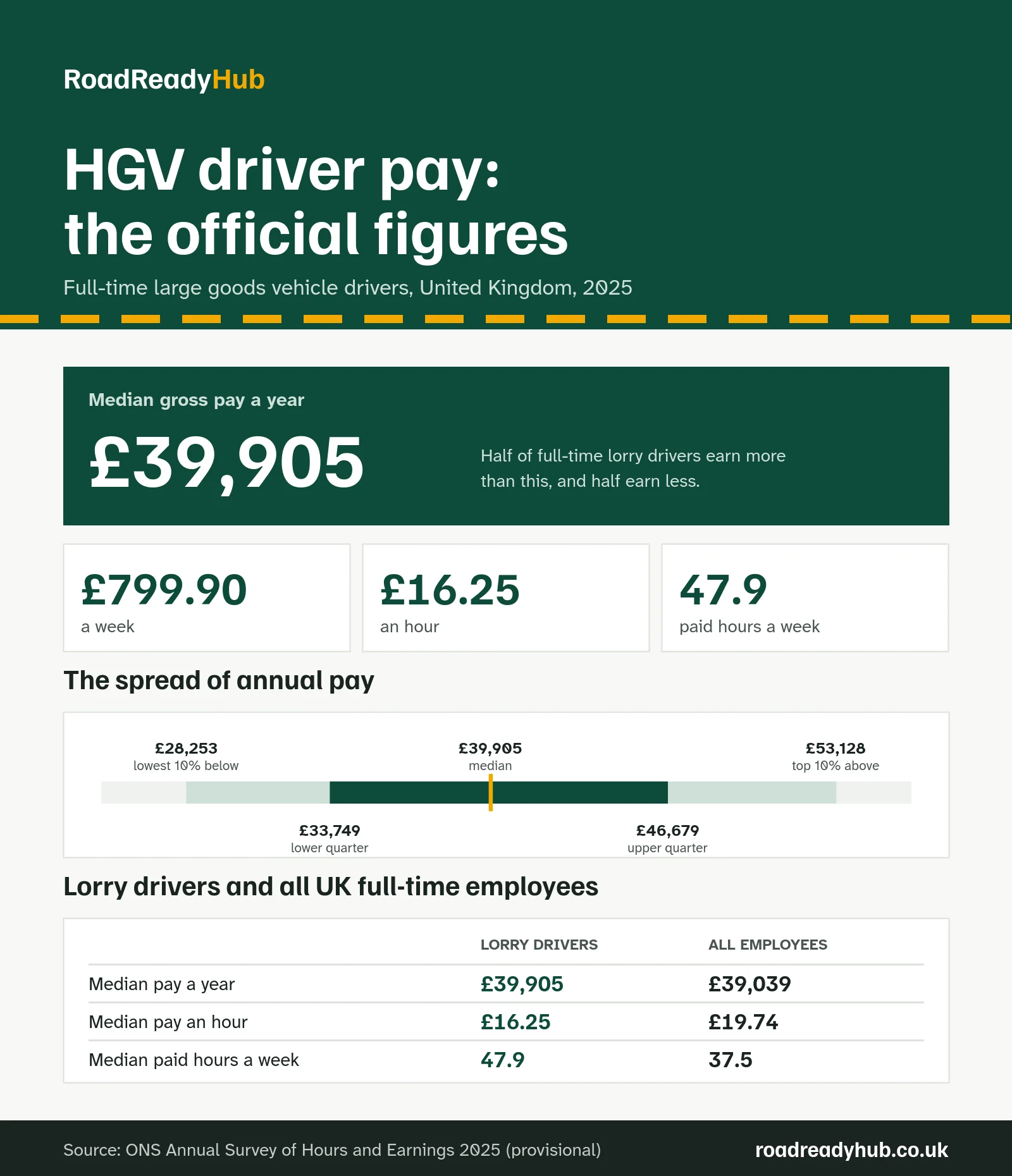
Full-time HGV drivers in the UK earned a median of £39,905 a year in 2025, according to the Office for National Statistics. That works out at £799.90 a week or £16.25 an hour, for a median of 47.9 paid hours a week. The government’s National Careers Service gives a range of £27,000 for starters to £47,000 for experienced drivers.
Most HGV salary figures online come from job adverts, recruitment agencies or training schools with courses to sell. This guide uses two official sources instead, and it tells you where those sources stop, so you know which claims you can rely on.
How much do HGV drivers earn?
The Office for National Statistics (ONS) publishes an annual survey of what employees are paid. These are its 2025 figures for full-time large goods vehicle drivers across the UK, before tax:
| Measure | Median | Mean (average) |
|---|---|---|
| Pay a year | £39,905 | £40,136 |
| Pay a week | £799.90 | £828.30 |
| Pay an hour | £16.25 | £17.00 |
| Paid hours a week | 47.9 | 48.7 |
The median is the middle value: half of drivers earn more and half earn less. It’s a better guide to typical pay than the mean, which a few very high earners can pull up. Divided by 12, the annual median is about £3,325 a month before tax.
The range: from the lowest to the highest paid
A single figure hides a wide spread. The ONS data shows how annual pay for full-time lorry drivers is distributed:
| Position | Annual pay |
|---|---|
| Lowest-paid 10% earn less than | £28,253 |
| Lowest-paid 25% earn less than | £33,749 |
| Median (the middle) | £39,905 |
| Highest-paid 25% earn more than | £46,679 |
| Highest-paid 10% earn more than | £53,128 |
That fits the National Careers Service range of £27,000 for starters to £47,000 for experienced drivers. In other words, the middle half of full-time lorry drivers earn roughly between £34,000 and £47,000.
How HGV pay compares with the UK average
| Lorry drivers | All full-time employees | |
|---|---|---|
| Median pay a year | £39,905 | £39,039 |
| Median pay an hour | £16.25 | £19.74 |
| Median paid hours a week | 47.9 | 37.5 |
This is the part most salary guides leave out. Lorry drivers earn about 2% more a year than the typical full-time employee, but about 18% less an hour. The difference is the hours: a median of 47.9 paid hours a week, around 10 more than the UK median.
Those long weeks have legal limits. Our guide to the HGV working time directive explains the 48-hour average, the 60-hour maximum week and the break rules.
So the annual figure is real, but it’s earned through long weeks. Those hours are also tightly regulated, and our HGV driving hours calculator shows the daily, weekly and fortnightly driving limits.
Lorry drivers do earn more than road transport drivers as a whole. The median for that wider group, which the ONS reports alongside it, is £35,733 a year.
What these figures do and don’t cover
- Employees only. The survey covers employee jobs. It doesn’t cover self-employed drivers.
- Full-time, adult rates. The annual figures are for employees who’d been in the same job for more than a year.
- Before tax. All figures are gross pay.
- 2025 and provisional. The annual figures relate to the tax year that ended on 5 April 2025. The ONS publishes new figures each year and revises the previous ones.
- The whole UK. These are national figures, so pay where you live may differ.
For context, the ONS reports that median annual pay for full-time lorry drivers was 3% higher than a year earlier.
What affects how much you earn
The official sources point to four things:
- Experience. The National Careers Service range runs from £27,000 for starters to £47,000 for experienced drivers.
- Overtime. It says you may be able to increase your income by working overtime, and that companies often need more drivers at peak times.
- When and where you work. The job can involve evenings, weekends and bank holidays, and time away from home.
- Extra qualifications. With experience you could train for an Advisory Dangerous Goods by Road (ADR) certificate to carry hazardous loads, or specialise in particular loads such as foodstuffs.
Does class 1 pay more than class 2?
Neither official source breaks pay down by licence class, so there’s no official class 1 versus class 2 figure. Be cautious with precise tables that claim to show one: we couldn’t find an official source for them. What we can say is what each licence lets you drive, which our guides to the class 2 licence and becoming a class 1 driver explain.
What is the highest-paying HGV job?
There’s no official ranking by type of work. The ONS data shows the highest-paid 10% of full-time lorry drivers earn more than £53,128 a year, and the National Careers Service names hazardous loads and specialist loads as ways to progress.
What do individual companies pay?
We don’t quote pay for named employers, because there’s no official source for it and rates change. The reliable way to check is the employer’s own current job adverts. The government’s free Find a job service lists vacancies.
Is HGV driving a good career?
That depends on what you want from a job, so here’s what the evidence shows on both sides.
- Pay: a little above the UK full-time median per year, but below it per hour.
- Hours: long. The National Careers Service gives typical hours of 38 to 52 a week, and the ONS median is 47.9 paid hours.
- Lifestyle: you could work evenings, weekends and bank holidays, and away from home, and the work can be physically active.
- Entry: you need to be over 18 with a car licence, then pass the Driver CPC tests. DVSA figures show 60.7% of lorry on-road tests were passed in 2025 to 2026.
- Progression: with experience you could become a road transport manager, train as an HGV driving instructor or heavy vehicle technician, or become self-employed and set up your own haulage company.
How to become an HGV driver
You need a provisional lorry licence and five Driver CPC tests, which cost £270 in DVSA fees on weekdays. Training is extra, although an employer, an apprenticeship or a government Skills Bootcamp may help with it. Start with our class 2 licence guide. If you are comparing driving careers, see our guides to driving instructor salaries and driving examiner jobs.
Frequently asked questions
How much are HGV drivers paid in the UK?
Full-time lorry drivers earned a median of £39,905 a year in 2025, according to the Office for National Statistics. The National Careers Service gives a range of £27,000 to £47,000.
How much do HGV drivers earn an hour?
A median of £16.25 an hour for full-time lorry drivers in 2025, before tax.
How much do HGV drivers earn a week?
A median of £799.90 a week for full-time lorry drivers in 2025, for a median of 47.9 paid hours.
Do HGV drivers earn more than the UK average?
Slightly more a year (£39,905 against £39,039 for all full-time employees), but less an hour (£16.25 against £19.74), because they work longer hours.
What do the top HGV drivers earn?
The highest-paid 10% of full-time lorry drivers earned more than £53,128 a year in 2025.
Sources: Office for National Statistics, Annual Survey of Hours and Earnings, Table 14 (2025 provisional, large goods vehicle drivers, full-time employees); National Careers Service HGV driver profile; GOV.UK Become a qualified HGV or bus driver; DVSA LGV driving test statistics. Percentages and the monthly figure are our own calculations from the ONS data.