Last checked: 9 October 2026
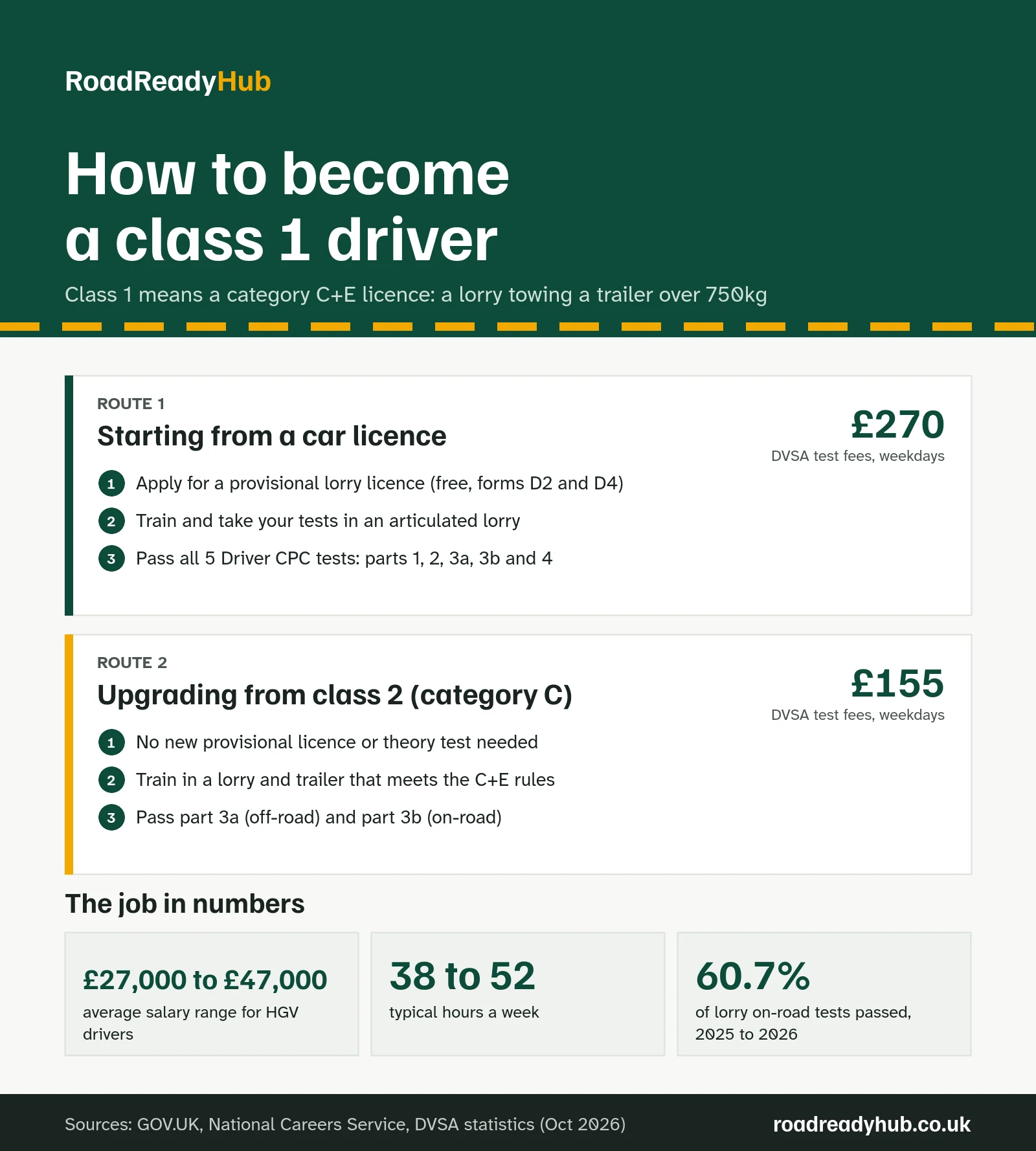
A class 1 driver holds a category C+E licence, which GOV.UK says was once known as “HGV 1”. It lets you drive a large lorry towing a trailer over 750kg, such as an articulated lorry. You need a full car licence, to be over 18 and, if driving is the main part of your job, the Driver CPC. DVSA’s test fees come to £270 starting from a car licence, or £155 if you’re upgrading from class 2.
“Class 1” is the name you’ll see in job adverts, but it isn’t what’s printed on a driving licence. The licence shows categories, and class 1 is the trade’s shorthand for the biggest one a lorry driver can hold.
This guide explains what the term means, the two ways to get the licence, what it costs in official fees, and what the government’s own careers service says about pay and hours. It covers Great Britain.
What is a class 1 driver?
| Trade name | Licence category | What you can drive |
|---|---|---|
| Class 2 (HGV 2) | C | Vehicles over 3,500kg, with a trailer up to 750kg |
| Class 1 (HGV 1) | C+E | Category C vehicles with a trailer over 750kg |
So the difference is the trailer. A class 2 licence covers the lorry itself, which in practice means rigid vehicles. Class 1 adds a heavy trailer, which is what you need for an articulated lorry. Our guide to the class 2 licence covers category C in detail, including how it compares with the 7.5 tonne (C1) licence.
Do you need class 2 before class 1?
No. In 2021 the government changed the rules so that drivers only need to take one test to drive both a rigid and an articulated lorry, instead of two separate tests. When you apply for a provisional category C licence, DVLA gives you provisional entitlement for C1, C1+E, C and C+E, and you take your tests in the category of vehicle you want a licence for. GOV.UK’s own example is an articulated lorry for category C+E.
How to become a class 1 driver
To become a lorry driver you need a full car licence, to be over 18 (there are some exceptions), and the Driver Certificate of Professional Competence (CPC) if driving a lorry will be the main part of your job.
Route 1: starting from a car licence
- Apply for a provisional lorry licence. Send DVLA form D2 and form D4, a medical report filled in by a doctor. There’s no application fee, although the doctor can charge.
- Pass Driver CPC part 1, the theory test. It has a multiple-choice part and a hazard perception part.
- Pass part 2, the case studies test.
- Pass part 3a, the off-road exercises, in an articulated lorry. It lasts up to 30 minutes and includes an ‘S’ shaped reverse into a bay and, because you’re testing with a trailer, the uncoupling and recoupling procedure.
- Pass part 3b, the on-road driving test, in the same category of vehicle. It includes vehicle safety questions and 1 hour of practical road driving.
- Pass part 4, the practical demonstration test.
Route 2: upgrading from class 2
If you already hold category C with the full Driver CPC, the route is shorter. GOV.UK says you need to:
- complete training for the vehicle and trailer combination you want to drive, for example articulated lorry training
- book and pass part 3a and part 3b in a vehicle that meets the C+E rules
You don’t need a new provisional licence, and you don’t take the part 1 theory test again.
How much does it cost to become a class 1 driver?
| DVSA test | Weekday | Evening, weekend and bank holiday |
|---|---|---|
| Part 1: multiple choice | £26 | £26 |
| Part 1: hazard perception | £11 | £11 |
| Part 2: case studies | £23 | £23 |
| Part 3a: off-road exercises | £40 | £40 |
| Part 3b: on-road driving | £115 | £141 |
| Part 4: practical demonstration | £55 | £63 |
| Route 1 total (all tests) | £270 | £304 |
| Route 2 total (3a and 3b only) | £155 | £181 |
Those are the official fees for booking with DVSA. Part 3a may cost up to £40 with an approved test provider. Training and the D4 medical are extra, and each provider sets its own prices, so get quotes before you commit.
Ways to get training funded
- Your employer. The National Careers Service says that if you already work for a transport operator in a non-driving role, your employer might support you through training.
- An apprenticeship. The Large Goods Vehicle (LGV) Driver C and E Level 2 apprenticeship takes around 1 year and combines on-the-job learning with study.
- A Skills Bootcamp for HGV driving. These last up to 16 weeks. You can apply if you’re 19 or older with a full car licence, and passing guarantees you a job interview with an employer near where you live.
Is class 1 harder to pass than class 2?
There’s no official comparison. DVSA’s published statistics give one combined pass rate for lorry tests across all categories: 60.7% of on-road lorry driving tests were passed in Great Britain from April 2025 to March 2026, which is 42,984 passes from 70,797 tests. Those figures are provisional.
What we can say is that a test with a trailer has more in it. The off-road part adds the uncoupling and recoupling procedure to the reversing exercise.
What class 1 drivers earn and the hours they work
The government’s National Careers Service gives an average salary range for HGV drivers of £27,000 for starters to £47,000 for experienced drivers, with typical hours of 38 to 52 a week. It says you could work evenings, weekends and bank holidays, and spend time away from home. Those figures cover HGV drivers generally, not class 1 drivers alone, and it notes you may be able to increase your income by working overtime. Our guide to HGV driver salaries has the full official figures, including weekly and hourly pay.
If you’ll carry hazardous goods such as fuel oil, you’ll also need an Advisory Dangerous Goods by Road (ADR) certificate.
The rules once you’re qualified
- Keep to the drivers’ hours rules and the HGV working time rules, which limit your driving and your total working week.
- Take 35 hours of Driver CPC training every 5 years to stay qualified.
- Renew your lorry licence every 5 years, and every year once you reach 65. Our licence renewal calculator shows when your forms are due.
- Apply for a digital tachograph card to record your daily work.
- Keep within the drivers’ hours limits. Our HGV driving hours calculator checks your daily, weekly and fortnightly totals.
- Protect your car licence: you automatically lose your lorry licence if you lose it.
Finding class 1 driver jobs
We’re not a job board, so we won’t list vacancies. The National Careers Service suggests looking on retail and delivery company websites and with driver recruitment agencies, especially at peak times when companies need more drivers. The government also runs a free Find a job service.
Frequently asked questions
What is a class 1 driver?
A driver who holds a category C+E licence, which allows them to drive a large lorry towing a trailer over 750kg, such as an articulated lorry.
What is the difference between a class 1 and class 2 driver?
Class 2 is category C: vehicles over 3,500kg with a trailer up to 750kg. Class 1 is category C+E, which adds a trailer over 750kg.
How much does it cost to become an HGV class 1 driver?
DVSA’s test fees total £270 on weekdays if you’re starting from a car licence, or £155 if you’re upgrading from class 2. Training and the medical cost extra.
Do you need a class 2 licence before class 1?
No. Since 2021, one test lets you drive both rigid and articulated lorries, so you can take your tests in an articulated lorry.
How old do you have to be to be a class 1 driver?
GOV.UK says you need to be over 18 to become a lorry driver, although there are some exceptions.
Sources: GOV.UK Become a qualified heavy goods vehicle (HGV) or bus driver and Driving licence categories; the government’s 2021 announcement on HGV driving test changes; National Careers Service HGV driver profile; DVSA LGV driving test statistics (table DRT321A, updated 3 September 2026).