Last checked: 19 September 2026
According to the Highway Code, the typical stopping distance at 30mph is 23 metres (9 metres thinking plus 14 metres braking), and at 70mph it’s 96 metres. On wet roads, stopping distances are at least double. On ice or snow, they can be up to ten times greater. Choose a speed and road conditions below to see the figures.
This calculator needs JavaScript switched on in your browser.
Revising for your theory test?
Figures from the Highway Code’s typical stopping distances (Rule 126), with its guidance for wet (Rule 227) and icy roads (Rule 230). Real distances vary with your attention, the road, the weather and your vehicle.
Typical stopping distances in the Highway Code
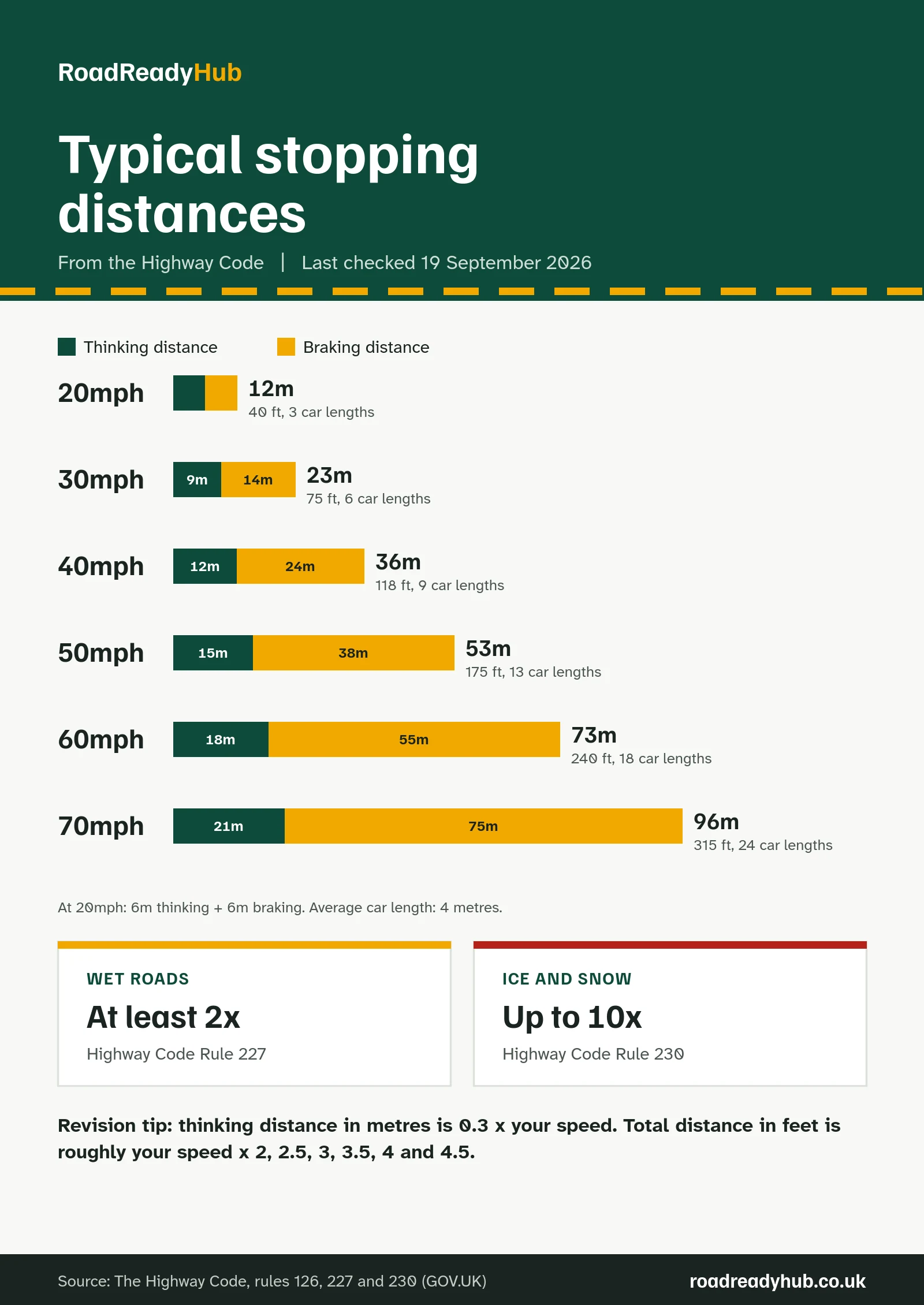
These are the official typical stopping distances from Rule 126 of the Highway Code. Each one is made up of thinking distance, the distance you travel before you react, and braking distance, the distance you travel once you’ve braked.
| Speed | Thinking distance | Braking distance | Overall stopping distance | In feet and car lengths |
|---|---|---|---|---|
| 20mph | 6 metres | 6 metres | 12 metres | 40 feet, 3 car lengths |
| 30mph | 9 metres | 14 metres | 23 metres | 75 feet, 6 car lengths |
| 40mph | 12 metres | 24 metres | 36 metres | 118 feet, 9 car lengths |
| 50mph | 15 metres | 38 metres | 53 metres | 175 feet, 13 car lengths |
| 60mph | 18 metres | 55 metres | 73 metres | 240 feet, 18 car lengths |
| 70mph | 21 metres | 75 metres | 96 metres | 315 feet, 24 car lengths |
The Highway Code bases car lengths on an average car length of 4 metres, and describes these figures as a general guide. Your real stopping distance depends on your attention, the road surface, the weather and the condition of your vehicle.
Why braking distance grows so fast
Look at what happens when you double your speed. Going from 30mph to 60mph doubles your thinking distance, from 9 metres to 18 metres. But your braking distance goes from 14 metres to 55 metres, nearly four times as far.
That’s why a small increase in speed makes such a big difference. At 70mph, braking takes up 75 of the 96 metres you need to stop, and the thinking distance alone is already 21 metres, the length of about five cars, before your foot even reaches the brake.
How to remember stopping distances for your theory test
Stopping distances are a staple of theory test revision, and learning the table by heart is easier with a couple of patterns:
- Thinking distance is 0.3 times your speed. 20mph gives 6 metres, 30mph gives 9 metres, and so on up to 21 metres at 70mph. This works for every speed in the table.
- Total distance in feet follows a simple multiplier. Multiply the speed by 2 at 20mph, 2.5 at 30mph, 3 at 40mph, 3.5 at 50mph, 4 at 60mph and 4.5 at 70mph. That gives 40, 75, 175, 240 and 315 feet exactly. At 40mph it gives 120 feet, close to the official 118.
- Use the quiz above. Test yourself until you can give every speed without looking.
Our guides to how the theory test works and how much it costs cover the rest of your preparation.
Stopping distances on wet, icy and snowy roads
The table above is for dry roads. The Highway Code is clear that bad weather changes everything:
- Wet roads (Rule 227): stopping distances will be at least double those on dry roads, because your tyres have less grip. At 30mph, that means at least 46 metres.
- Icy or snowy roads (Rule 230): stopping distances can be ten times greater than on dry roads. At 30mph, that’s up to 230 metres.
Switch the calculator to “Wet” or “Icy or snowy” to see the figures for your speed.
The two-second rule
The Highway Code says you should never get closer to the vehicle in front than the overall stopping distance, and that you should leave at least a two-second gap on high-speed roads and in tunnels where visibility is reduced. To check it, watch the vehicle in front pass a fixed point such as a sign, then count two seconds before you reach it.
- On wet roads, the gap should be at least doubled.
- On icy roads, it should be up to ten times greater.
- If you’re driving a large vehicle in a tunnel, allow a four-second gap.
- If you have to stop in a tunnel, leave at least a 5-metre gap to the vehicle in front.
At 70mph, a two-second gap works out at roughly 63 metres, which the calculator shows for each speed. Driving too close is called tailgating, and the Highway Code notes that it’s enforced by the police as a dangerous or careless driving offence. Careless driving can mean 3 to 9 penalty points, and our penalty points calculator shows how quickly points add up.
Frequently asked questions
What is the stopping distance at 30mph?
The Highway Code gives a typical stopping distance of 23 metres (75 feet) at 30mph: 9 metres thinking distance plus 14 metres braking distance.
What is the stopping distance at 70mph?
96 metres (315 feet), made up of 21 metres thinking distance and 75 metres braking distance. That’s about 24 car lengths.
What is the thinking distance at 50mph?
15 metres. Thinking distance is 0.3 times your speed in mph for every speed in the Highway Code table.
How much longer are stopping distances in the wet?
At least double, according to Rule 227 of the Highway Code. On icy or snowy roads they can be up to ten times greater.
What is the two-second rule?
Leave at least a two-second gap between you and the vehicle in front on high-speed roads and in tunnels. Double it on wet roads.
Sources: The Highway Code, Rule 126 (stopping distances) and Rules 227 and 230 (adverse weather), on GOV.UK. Two-second gap distances are calculated from your speed.