Last checked: 6 November 2026
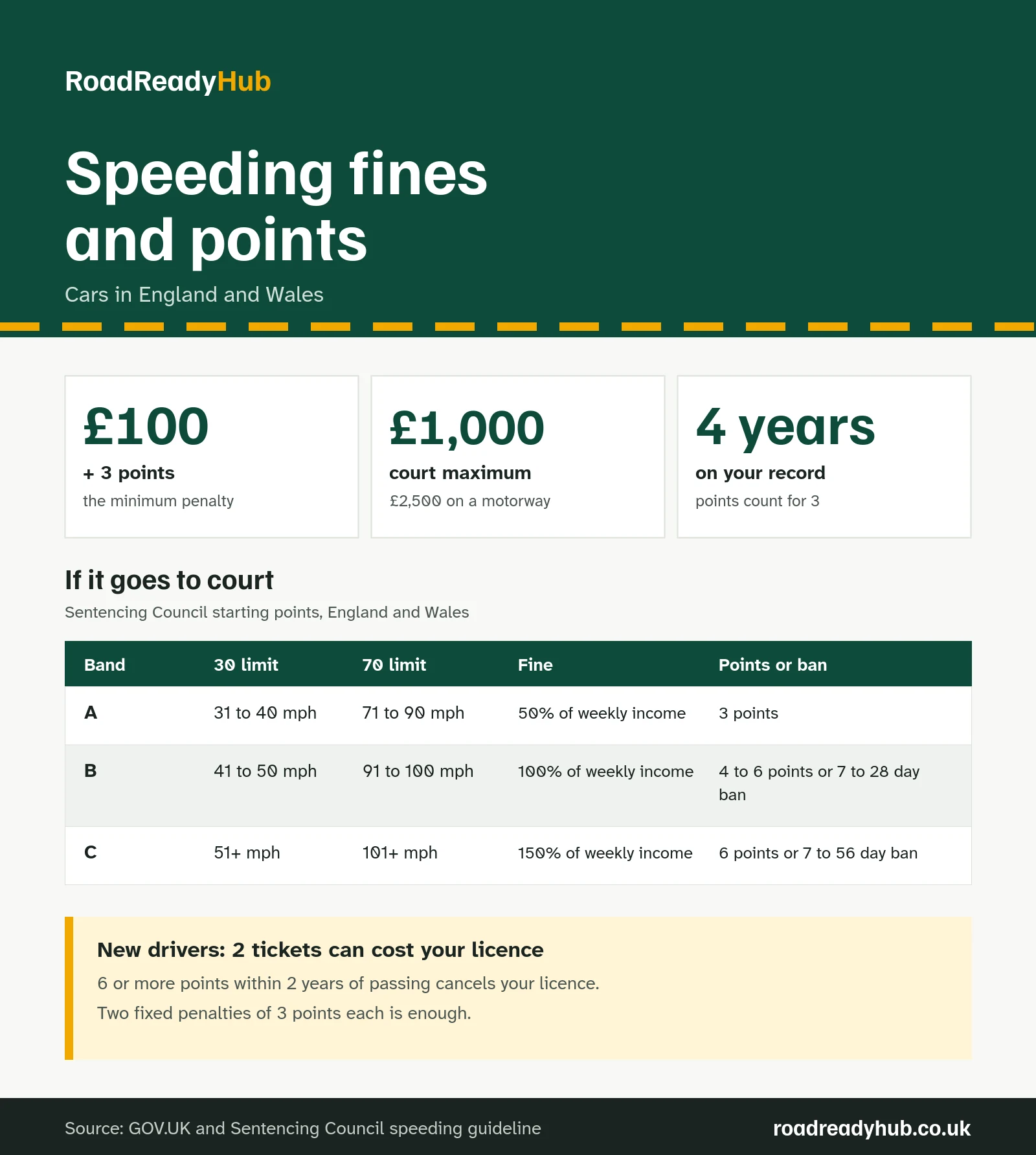
The minimum penalty for speeding in the UK is a £100 fine and 3 penalty points. You may be offered a speed awareness course instead. If your case goes to court in England or Wales, the fine is usually a percentage of your weekly income, from 50% to 150% as a starting point, up to a maximum of £1,000, or £2,500 on a motorway, and you could be banned from driving.
This guide explains what happens after you are caught speeding, from the first letter to a fixed penalty or a court hearing. It includes the Sentencing Council’s full table of court fines and points for England and Wales, and what speeding points mean for new drivers. Everything comes from GOV.UK and the Sentencing Council.
Speeding penalties at a glance
| What happens | Penalty |
|---|---|
| Speed awareness course, if offered | No fine or points; you cannot have done one in the past 3 years |
| Fixed Penalty Notice (you accept it) | £100 fine and 3 penalty points |
| Court, if you plead not guilty or are summonsed | A fine based on your weekly income, 3 to 6 points or a ban |
| Maximum court fine | £1,000, or £2,500 on a motorway |
| Speeding code on your licence | Stays for 4 years |
| 12 or more points within 3 years | You could be banned from driving |
| 6 or more points within 2 years of passing your test | Your licence is cancelled |
How you are caught and what happens next
Caught by a speed camera
Within 14 days of your car being caught speeding, the registered keeper is sent a Notice of Intended Prosecution and a Section 172 notice. You must return the Section 172 notice within 28 days, saying who was driving. If you ignore it, you may have to go to court. Once it is returned, you will be sent either a Fixed Penalty Notice or a letter telling you to go to court.
Stopped by the police
If the police stop you, they can give you a verbal warning, give or send you a Fixed Penalty Notice, or order you to go to court, in which case you will be sent a letter telling you what to do.
Fixed Penalty Notices
With a Fixed Penalty Notice you can choose to plead guilty or not guilty.
- If you plead guilty, you pay a £100 fine and get 3 points on your licence, unless you are offered a speed awareness course. In England and Wales you can pay online; in Scotland and Northern Ireland there are separate ways to pay.
- If you plead not guilty, the case goes to court. If the court finds you guilty, you can be fined more and get more points than with the fixed penalty.
Speed awareness courses
You may be offered a speed awareness course instead of the fine and points if the police decide it is appropriate for your offence and you have not been on a speed awareness course in the past 3 years. Whether it is offered is up to the police, not you.
Speeding fines in court
In England and Wales, magistrates follow the Sentencing Council’s speeding guideline. It sorts offences into 3 bands by the speed limit and how fast you were going:
| Speed limit | Band A | Band B | Band C |
|---|---|---|---|
| 20 mph | 21 to 30 | 31 to 40 | 41 and above |
| 30 mph | 31 to 40 | 41 to 50 | 51 and above |
| 40 mph | 41 to 55 | 56 to 65 | 66 and above |
| 50 mph | 51 to 65 | 66 to 75 | 76 and above |
| 60 mph | 61 to 80 | 81 to 90 | 91 and above |
| 70 mph | 71 to 90 | 91 to 100 | 101 and above |
| Fine starting point | 50% of weekly income (range 25 to 75%) | 100% of weekly income (range 75 to 125%) | 150% of weekly income (range 125 to 175%) |
| Points or ban | 3 points | Ban of 7 to 28 days, or 4 to 6 points | Ban of 7 to 56 days, or 6 points |
For example, if your weekly income is £500, a Band A starting point is £250, Band B £500 and Band C £750, before the court adjusts for the factors below. The fine cannot go above £1,000, or £2,500 on a motorway. Where someone was driving grossly over the limit, the guideline says the court should consider a ban of more than 56 days.
What can increase or reduce the penalty
The guideline lists factors that can make the offence more serious, including:
- previous convictions
- poor road or weather conditions
- driving a goods vehicle or passenger vehicle, towing a caravan or trailer, or carrying passengers or a heavy load
- driving for hire or reward
- evidence of an unacceptable standard of driving as well as the speed
- location, for example near a school
Having no previous or recent relevant convictions can reduce it. The court must also take your finances into account, and a guilty plea can reduce the sentence under the Sentencing Council’s guilty plea guideline. This guideline applies in England and Wales: Scotland and Northern Ireland have their own courts and sentencing practice.
Speeding points and bans
Speeding offences carry 3 to 6 points. The most common codes are SP30 (exceeding the speed limit on a public road) and SP50 (exceeding the speed limit on a motorway). The code stays on your driving record for 4 years from the date of the offence, and DVLA records it on the drivers’ database, where third parties such as insurance companies can view it.
- Totting up: if you build up 12 or more points within 3 years, you could be disqualified. Our guide to 12 points on your licence explains what happens.
- New drivers: if you get 6 or more points within 2 years of passing your test, your licence is cancelled. Two speeding tickets of 3 points each are enough. See our guide to the new driver 6 points rule.
- Learners: points on a provisional licence carry over to your full licence when you pass.
- Phones: using a hand-held phone while driving is another 6 points and £200. See our guide to the mobile phone driving law.
Our penalty points calculator shows how close you are to a ban, and our guide to how long points stay on your licence explains the timings.
Speed limits: a quick reminder
GOV.UK says the speed limit is the absolute maximum, not a target, and it does not mean it is safe to drive at that speed in all conditions. On roads with street lights the limit is 30 mph in England, Scotland and Northern Ireland, and 20 mph in Wales, unless signs show otherwise. For cars, the national limits are 60 mph on single carriageways and 70 mph on dual carriageways and motorways. Our stopping distance calculator shows how much further you travel before stopping at higher speeds.
Frequently asked questions
How much is a speeding fine in the UK?
The minimum is £100 and 3 penalty points with a Fixed Penalty Notice. In court in England and Wales, the fine is usually 50% to 150% of your weekly income as a starting point, up to £1,000, or £2,500 on a motorway.
How many points do you get for speeding?
3 points with a fixed penalty. In court, speeding carries 3 to 6 points, or a driving ban instead.
How long do speeding points stay on your licence?
The speeding code stays on your driving record for 4 years from the date of the offence. You could be banned if you build up 12 or more points within 3 years.
Can I do a speed awareness course instead?
Only if the police offer it. They decide whether it is appropriate for your offence, and you cannot have been on a speed awareness course in the past 3 years.
What happens if I ignore a speeding notice?
You must return the Section 172 notice within 28 days to say who was driving. If you ignore it, you may have to go to court.
Can you be banned for speeding?
Yes. A court can ban you instead of giving points, especially at higher speeds, and you can be banned under the totting up rules if you reach 12 points within 3 years.
Is there an allowance over the speed limit?
GOV.UK says the speed limit is the absolute maximum. Do not rely on any unofficial allowance.
What happens if a new driver gets a speeding ticket?
A single 3 point ticket does not cancel your licence, but a second one within 2 years of passing takes you to 6 points, and your licence would be cancelled. You would need to reapply for a provisional licence and pass both tests again.
Sources: GOV.UK Speeding penalties; GOV.UK Speed limits; GOV.UK Penalty points (endorsements) and New drivers; Sentencing Council Speeding (Revised 2017) guideline, Road Traffic Regulation Act 1984 s.89(1), last updated 5 October 2026. This is general information, not legal advice.