Last checked: 5 November 2026
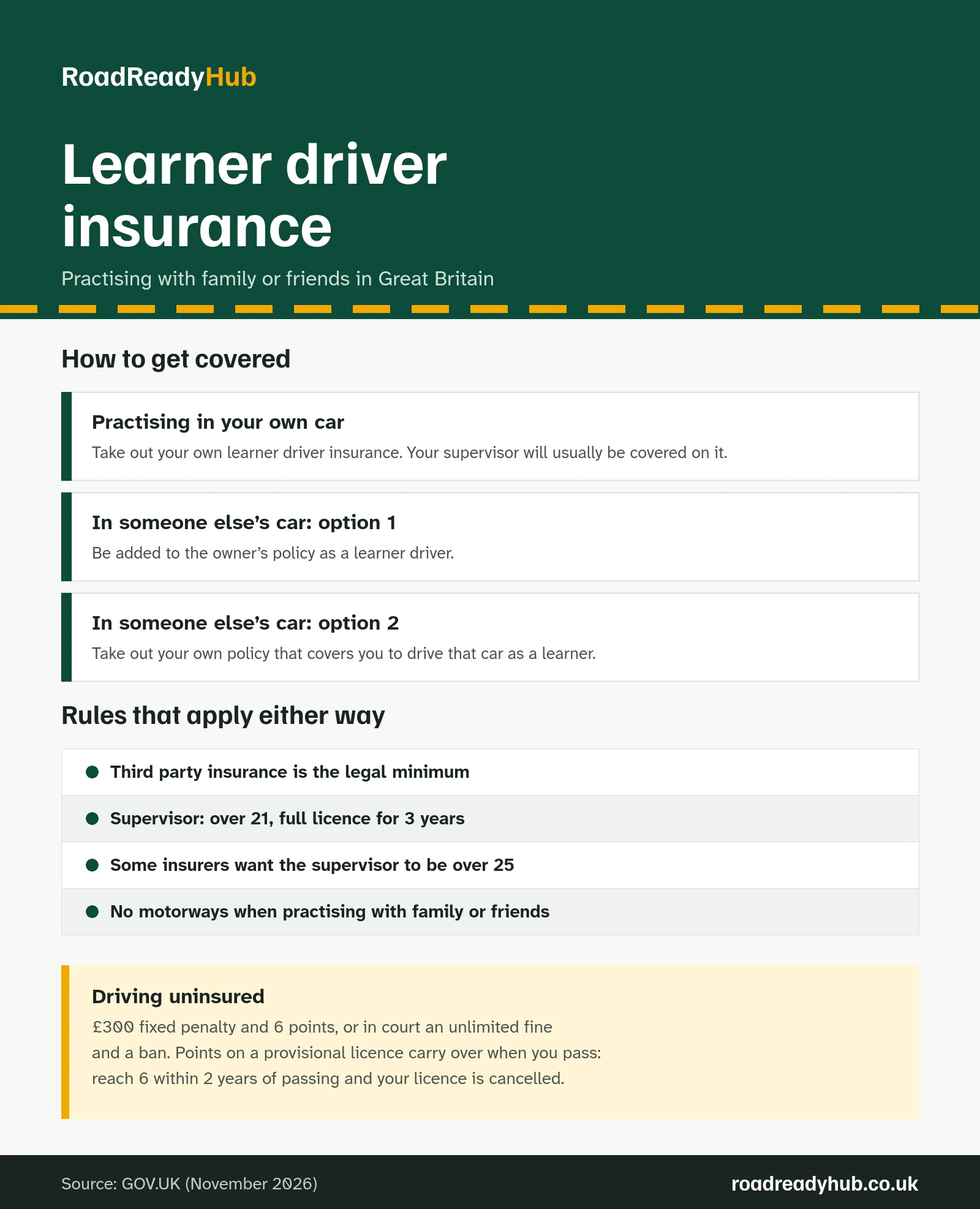
You need insurance to practise driving in a car with family or friends. If you practise in your own car, you need your own learner driver insurance. In someone else’s car, you either get added to the owner’s policy as a learner driver or take out your own policy that covers you in their car. Driving uninsured can mean a £300 fixed penalty and 6 penalty points on your provisional licence.
Most of the pages that rank for learner driver insurance are run by insurers and comparison sites. This guide is different: we do not sell insurance or earn anything from quotes. It sets out the legal rules from GOV.UK, the options you have, what to watch out for according to the Financial Ombudsman Service, and what happens if you get it wrong. It is general information for England, Scotland and Wales, not advice about which policy to buy.
Do learner drivers need insurance?
Yes. GOV.UK says you must have motor insurance to drive on UK roads, and third party insurance is the legal minimum. It also makes a point that catches learners out: even if the car itself is insured, you can be penalised if you are not correctly insured to drive it. A parent’s policy does not automatically cover a learner.
Your options
| Where you practise | How you can be insured |
|---|---|
| In a car you own | Take out your own learner driver insurance. GOV.UK says your family member or friend supervising you will usually be covered on it. |
| In someone else’s car, such as a parent’s | Either be added to the owner’s policy as a learner driver, or take out your own policy that covers you to drive that car as a learner. |
| In your driving instructor’s car during lessons | Ask your instructor how their car is insured for lessons. |
| On your driving test in your own car | The car must be insured for a driving test. Check with your insurer. |
Added to a parent’s policy or your own policy?
Both are allowed. The practical difference is whose policy you are driving on. If you are added to the owner’s policy, any claim made while you are driving goes on their policy. With your own learner policy, you are insured on a separate policy. Some insurers sell short-term learner cover, so you can insure yourself only for the weeks or months you are practising. Getting quotes for both routes is the only way to compare them for your situation.
The rules your supervisor must meet
The law sets the minimum, and insurers can add their own conditions on top. By law, anyone supervising you without being paid must:
- be over 21
- be qualified to drive the type of car, for example hold a manual licence to supervise you in a manual car
- have held their full driving licence for 3 years (from the UK, the EU, Switzerland, Norway, Iceland or Liechtenstein)
GOV.UK notes that some insurance companies require the supervisor to be over 25. Insurers can set other conditions too, so read your policy’s conditions as well as the legal rules.
It is illegal for your supervisor to use a mobile phone while supervising you, and you cannot drive on a motorway when practising with family or friends. Our guide to learners on motorways explains how to do it with an instructor.
Types of cover
Third party cover is the legal minimum. GOV.UK explains that it covers you if you cause damage or injury to any other person, vehicle, animal or property, but not repairs to your own car. Insurers also sell wider cover. In general, third party, fire and theft adds cover if the car is stolen or damaged by fire, and comprehensive cover, which people often call “full” insurance, also covers damage to the car you are driving. Which levels are available to a learner depends on the insurer.
How to keep the cost down without risking your cover
No official body publishes an average price for learner insurance, and the cost depends on the insurer, the car and the people involved. Rather than quoting figures, here is what the Financial Ombudsman Service, which handles insurance complaints, tells young drivers:
- Be honest about who drives. Always give accurate information about who will be driving, where the car is kept and any convictions. If you are not truthful, your policy could be invalid and claims may not be paid.
- Never use fronting. Fronting is when a more experienced driver, such as a parent, claims to be the main driver of a car mainly used by a younger driver. In one case the Ombudsman reviewed, a policy was set up with a mother as the main driver and her son as a named driver. The Ombudsman found the insurer had acted fairly in cancelling it for misrepresentation and keeping the premium.
- Understand telematics before you sign. “Black box” policies can reduce premiums for good driving, but the Ombudsman has seen policies cancelled when the data did not match the policy terms, including cars left unused at home.
- Declare modifications. Changes such as body kits, custom paint or engine tuning can invalidate a policy if you do not tell the insurer.
- Check the details. Look at the excess, courtesy car cover, windscreen cover and what happens if the car is written off, and ask the insurer if anything is unclear.
For the rest of your learning budget, our driving lesson cost calculator adds up lessons and the official fees.
What happens if you drive uninsured
The penalties are the same for learners as for anyone else:
- a fixed penalty of £300 and 6 penalty points
- if the case goes to court, an unlimited fine and a driving ban
- the police can seize the car, and in some cases destroy it
- the offence (code IN10, 6 to 8 points) stays on your driving record for 4 years
For a learner, the points matter even more. GOV.UK says points on your provisional licence that have not expired carry over to your full licence when you pass. Your licence is then cancelled if you reach 6 or more points within 2 years of passing, so 6 points for driving uninsured as a learner means any further points in those 2 years would cancel your new licence. Our guide to the new driver 6 points rule explains how it works.
Checking a car is insured
GOV.UK points to askMID, the Motor Insurance Database, to check whether a vehicle is insured. It shows whether the car has cover, not whether you personally are insured to drive it, so check your own policy documents too.
When you pass your test
Your cover was arranged for a learner, so contact your insurer before you drive on your own after passing, and make sure the details are correct for a newly qualified driver. If you have a complaint about your insurer that you cannot resolve with them, the Financial Ombudsman Service handles complaints for free. Northern Ireland has different rules for vehicle insurance.
Frequently asked questions
What is the cheapest way to insure a learner driver?
There is no single cheapest option. Compare quotes both for adding the learner to the car owner’s policy and for a separate learner policy, check the excess and conditions, and only consider a black box policy if you understand how it works. Never put a parent down as the main driver if the learner will mainly drive the car: this is fronting, which can invalidate the policy.
Is it expensive to put a learner driver on my insurance?
It depends on your insurer, your car and the learner. No official body publishes an average price, so ask your insurer for a quote and compare it with standalone learner policies. Remember that any claim made while the learner is driving would go on your policy.
Can you get full insurance as a learner driver?
Comprehensive cover, which people often call full insurance, is sold to learners by some insurers. The legal minimum is third party cover.
Can I have learner driver insurance on someone else’s car?
Yes. GOV.UK says you can either be covered by the car owner’s policy as a learner driver, or take out your own policy that covers you driving their car as a learner.
Does my supervisor need to be insured?
If you practise in your own car on your own learner policy, GOV.UK says the family member or friend supervising you will usually be covered. Check your policy, as some insurers require the supervisor to be over 25.
Do I need my own insurance for driving lessons?
Ask your driving instructor how their car is insured for lessons. You only need to arrange your own cover for practice outside lessons, or if you take your test in your own car.
What happens to my learner insurance when I pass?
Contact your insurer before driving alone so your cover matches your new full licence.
Sources: GOV.UK Practising with family or friends; GOV.UK Vehicle insurance and Driving without insurance; GOV.UK Penalty points (endorsements) and New drivers; GOV.UK Driving test: using your own car; Financial Ombudsman Service press release, 10 March 2026 and decision DRN-4541527. RoadReadyHub does not sell or recommend insurance products.