Last checked: 26 September 2026
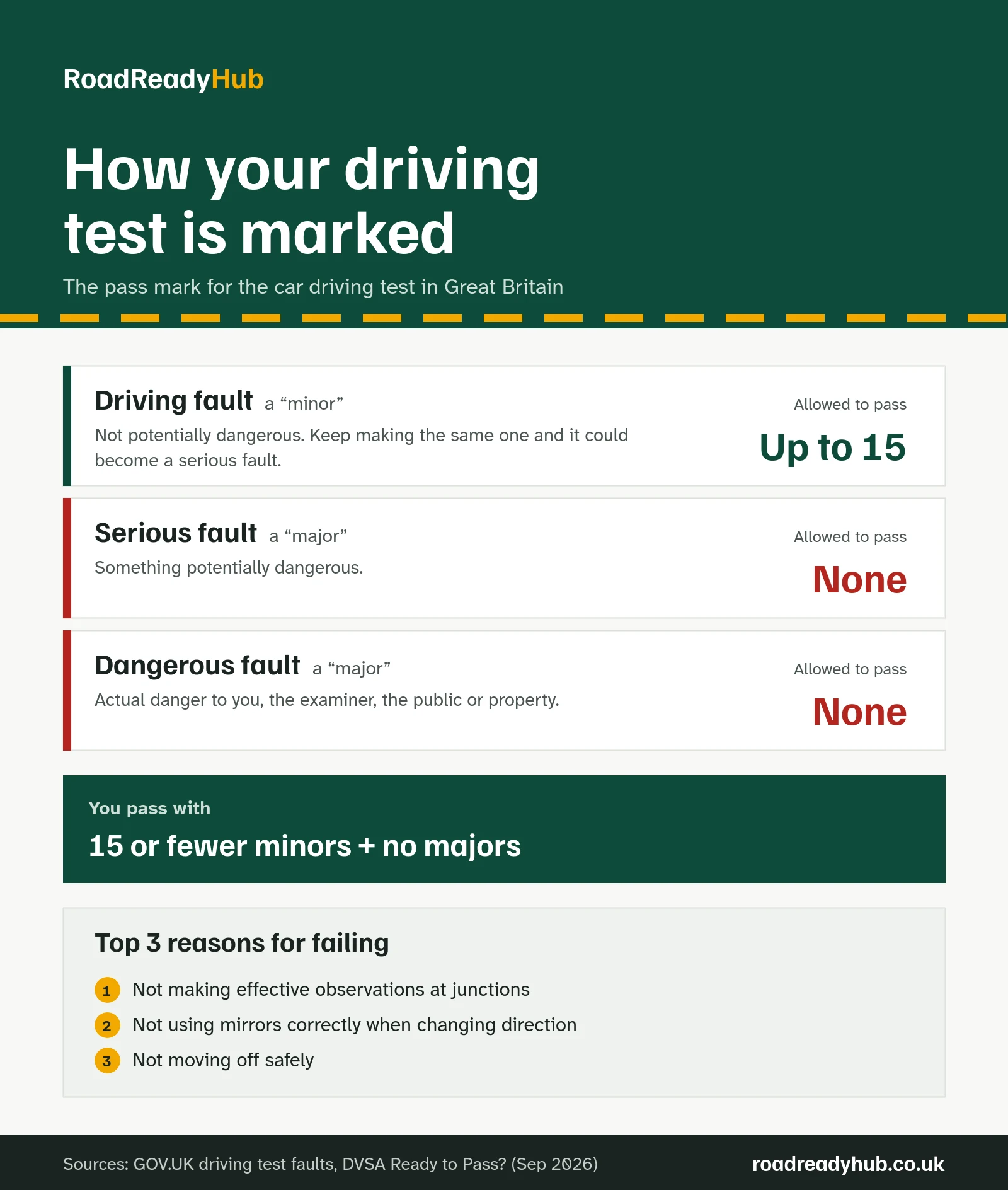
You can make up to 15 driving faults (minors) and still pass your car driving test, as long as you make no serious or dangerous faults (majors). A 16th minor means you fail. So does a single serious or dangerous fault, even if you have no minors at all.
It’s the question almost every learner asks their instructor at some point, usually in the week before their test. The rule itself is short. What catches people out is the detail around it: how a harmless minor can turn into a fail, what the examiner actually marks, and which mistakes cost learners their test most often.
This guide covers the car driving test in England, Scotland and Wales, using DVSA’s own marking rules.
The driving test pass mark
Your examiner can mark 3 types of fault. Only one of them is allowed if you want to pass.
| Type of fault | What it means | How many you can have and still pass |
|---|---|---|
| Driving fault (a “minor”) | Not potentially dangerous, but if you keep making the same fault, it could become a serious fault | Up to 15 |
| Serious fault (a “major”) | Something potentially dangerous | None |
| Dangerous fault (a “major”) | Actual danger to you, the examiner, the public or property | None |
So there are two ways to fail: making 16 or more driving faults, or making any serious or dangerous fault at all. Most fails come from the second one. One moment of poor observation at a junction can end a test that was otherwise almost perfect.
When a minor becomes a serious fault
A driving fault on its own isn’t potentially dangerous. But GOV.UK is clear that if you keep making the same fault, it could become a serious fault. A single late mirror check might be a minor. Missing your mirrors again and again shows the examiner a pattern, and that pattern can be marked as serious.
DVSA doesn’t publish a set number of repeats that turns minors into a major. That’s why “how many minors can you have in one category?” has no fixed answer: it depends on whether the repeated fault starts to look potentially dangerous.
Stalling is a good example. DVSA says you won’t automatically fail if you stall once and keep control of the car. You will fail if you stall and roll back a considerable distance, or if you stall repeatedly.
Is 3, 5 or 7 minors good?
If you make 15 or fewer driving faults and no serious or dangerous faults, you pass. The result is pass or fail: a pass with 3 minors and a pass with 12 minors both get you the same pass certificate and the same full licence.
The number is still worth paying attention to. Whether you pass or not, your examiner will tell you what faults you made. Those are the habits to keep working on once you’re driving on your own, especially if the same type of fault came up more than once.
How rare is a pass with 0 minors?
We couldn’t find any official DVSA figures on how many people pass with no driving faults, so be wary of claims about how rare a “clean sheet” is. What DVSA does publish is the overall picture: 48 out of every 100 driving tests were failed in Great Britain during July 2026.
The 10 most common reasons for failing
DVSA publishes the top 10 reasons people fail the driving test in Great Britain. If you regularly make any of these in your lessons or practice, DVSA says it means you’ve still got more work to do before you’re ready.
- Not making effective observations at junctions
- Not using mirrors correctly when changing direction
- Not moving off safely
- Incorrect positioning when turning right at junctions
- Not having proper control of the steering
- Not responding appropriately to traffic lights
- Not responding correctly to traffic signs
- Poor positioning on the road during normal driving
- Not responding correctly to road markings
- Not keeping control of the vehicle during reverse parking
Notice how many are about observation and awareness rather than car control. Use the list with your instructor to find the areas you still need to work on, and our guide to how many driving lessons you need explains how DVSA measures when you’re ready.
Things that don’t count against you
Plenty of test-day worries are based on myths. According to DVSA and GOV.UK:
- Taking a wrong turning isn’t a fault. The examiner will help you get back on the route.
- Crossing your hands on the steering wheel isn’t marked. The examiner looks at whether your steering is smooth, safe and under control.
- You don’t need to exaggerate head movements to show you’ve checked your mirrors. Examiners are trained to spot proper observations.
- Examiners don’t have pass quotas. If you drive to the required standard, you pass.
- The time of day doesn’t matter. DVSA says experience, practice and managing your nerves are what make a difference.
If you make a mistake during the test
Keep going. GOV.UK says you can carry on if you make a mistake, and it might not affect your result if it’s not serious. The examiner will only stop the test if they think your driving is a danger to other road users. The one exception is the eyesight check at the start: if you fail that, the test ends there. Our guide to how long the driving test lasts walks through each part.
What happens after your result
If you pass
The examiner will tell you what faults you made, if any, give you a pass certificate and ask if you want your full licence sent to you automatically. You can start driving straight away; you don’t need to wait for the licence to arrive. Contact DVLA if it hasn’t arrived 3 weeks after you applied.
If you don’t pass
The examiner will tell you what faults you made. You’ll need to book another test and pay again, choosing a date at least 10 working days away. A car test costs £62 on weekdays or £75 at evenings, weekends and bank holidays; see our guide to driving test costs, and to finding an earlier test if the wait is long.
Can you appeal the result?
Only if you can prove the examiner didn’t follow the law. You can complain to DVSA, and if they don’t agree you may be able to appeal to a court: within 6 months of your test in England and Wales, or 21 days in Scotland. Even if you succeed, your result can’t be changed, but you might get a refund or a free retest. An unsuccessful court appeal can mean significant legal costs.
Getting ready for the day? Check our list of what to bring to your driving test so nothing gets your test cancelled before it starts.
Frequently asked questions
How many minors can you get and still pass your driving test?
Up to 15 driving faults, as long as you make no serious or dangerous faults.
Is 16 minors a fail?
Yes. The pass mark is no more than 15 driving faults, so 16 or more is a fail even without any serious or dangerous faults.
How many majors can you have on a driving test?
None. A single serious or dangerous fault means you fail, however few minors you have.
Do you fail your driving test if you stall?
Not automatically. DVSA says stalling once while keeping control won’t automatically fail you, but stalling repeatedly or rolling back a considerable distance will.
Can repeated minors make you fail?
Yes. If you keep making the same driving fault, it could become a serious fault, which is a fail.
Sources: GOV.UK Driving test faults and your result and What happens during the test; DVSA Ready to Pass? Driving test marking, faults and results and Driving test myths.