Last checked: 12 November 2026
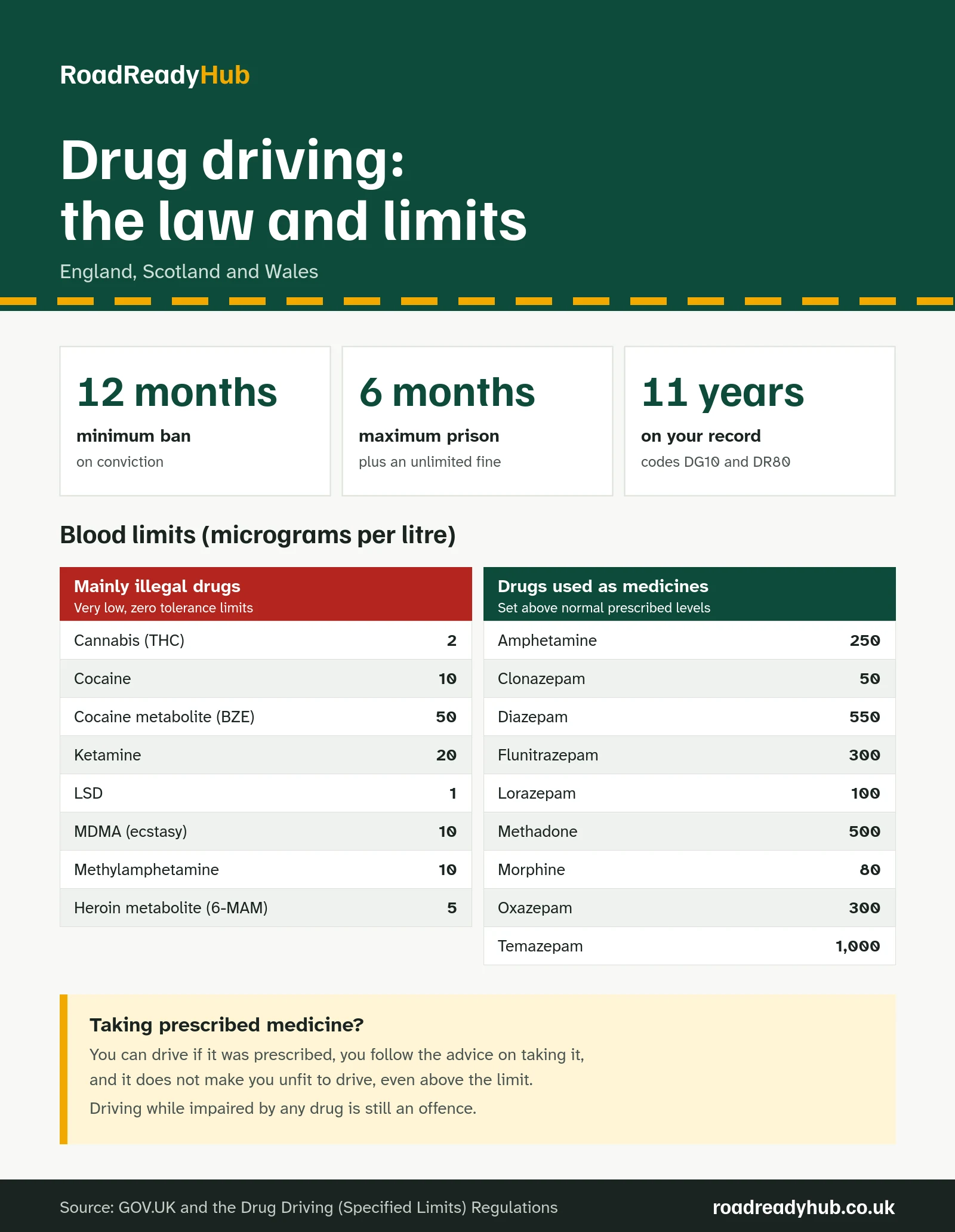
In England, Scotland and Wales it is illegal to drive if you are unfit through any drug, legal or illegal, or if you have certain drugs in your blood above set limits, even if they have not affected your driving. The limit for cannabis (THC) is just 2 micrograms per litre of blood. A conviction means a ban of at least 1 year, an unlimited fine, up to 6 months in prison and a criminal record.
This guide explains the two drug driving offences, the legal limits for all 17 drugs in the regulations, how roadside drug testing works, the rules for people taking prescribed medicine, and the penalties courts use. It is based on GOV.UK, the Drug Driving (Specified Limits) Regulations and the Sentencing Council’s guideline for England and Wales.
The two drug driving offences
- Driving while unfit through drugs. This covers any drug, including prescription and over-the-counter medicines, if it impairs your driving.
- Driving with a specified drug above the legal limit. This applies even if the drug has not affected your driving. It came into force in England and Wales on 2 March 2015 and in Scotland on 21 October 2019.
GOV.UK notes that the limits law does not cover Northern Ireland, but you can still be arrested there if you are unfit to drive.
The legal drug driving limits
The limits are set as micrograms of the drug per litre of blood. The Department for Transport explains that they fall into two groups. Drugs most associated with illegal use have very low limits, a zero tolerance approach that still rules out accidental exposure. Drugs mainly used as medicines have higher limits, set above the levels normally found in people taking them as prescribed.
| Drug | Limit (micrograms per litre of blood) | Group |
|---|---|---|
| Cannabis (delta-9-tetrahydrocannabinol, THC) | 2 | Low limit |
| Cocaine | 10 | Low limit |
| Benzoylecgonine (a cocaine metabolite) | 50 | Low limit |
| Ketamine | 20 | Low limit |
| LSD (lysergic acid diethylamide) | 1 | Low limit |
| MDMA (ecstasy) | 10 | Low limit |
| Methylamphetamine | 10 | Low limit |
| 6-monoacetylmorphine (a heroin metabolite) | 5 | Low limit |
| Amphetamine | 250 | Medicinal |
| Clonazepam | 50 | Medicinal |
| Diazepam | 550 | Medicinal |
| Flunitrazepam | 300 | Medicinal |
| Lorazepam | 100 | Medicinal |
| Methadone | 500 | Medicinal |
| Morphine | 80 | Medicinal |
| Oxazepam | 300 | Medicinal |
| Temazepam | 1,000 | Medicinal |
The same limits apply in England, Wales and Scotland. Amphetamine was added to the list in England and Wales from 14 April 2015.
How police test for drugs
If the police think you are on drugs, they can stop you and carry out a field impairment assessment, a series of tests such as asking you to walk in a straight line. They can also use a roadside drug kit to screen for cannabis and cocaine. If they think you are unfit to drive because of drugs, you will be arrested and have to give a blood or urine test at a police station. You could then be charged if the test shows you have taken drugs.
Refusing to cooperate is an offence in its own right: failing to co-operate with a preliminary test carries code DR70 and 4 penalty points.
Prescription and over-the-counter medicines
It is illegal to drive with legal drugs in your body if they impair your driving. GOV.UK says you should talk to your doctor about whether you should drive if you have been prescribed any of these:
- amphetamine, for example dexamphetamine or selegiline
- clonazepam, diazepam, flunitrazepam, lorazepam, oxazepam or temazepam
- methadone
- morphine or opiate and opioid-based drugs, for example codeine, tramadol or fentanyl
You can drive after taking these medicines if they were prescribed to you, you have followed the advice on how to take them, and they are not making you unfit to drive, even if you are above the specified limit. This is known as the statutory medical defence. You could be prosecuted if you drive above the limit with medicines that were not prescribed to you. If you are not sure whether you should drive, talk to your doctor, pharmacist or another healthcare professional.
Penalties for drug driving
GOV.UK says a drug driving conviction can mean:
- a ban of at least 1 year
- an unlimited fine
- up to 6 months in prison
- a criminal record
Causing death by careless driving under the influence of drugs carries a maximum of life imprisonment. GOV.UK also warns that a conviction will significantly increase your insurance costs, that an employer will see it on your licence if you drive for work, and that you may have trouble travelling to countries such as the USA.
How courts sentence drug driving
In England and Wales, magistrates use the Sentencing Council’s guideline for driving with a specified drug above the limit, which has applied since 1 July 2023. The court first decides your culpability and the harm caused. Higher culpability includes driving a goods vehicle or passenger vehicle, driving for commercial purposes, or having another drug or alcohol in your body as well. Greater harm means obvious signs of impairment or an unacceptable standard of driving.
| Category | Starting point | Ban (first offence) | Ban (second offence in 10 years) |
|---|---|---|---|
| 1: higher culpability and greater harm | 12 weeks’ custody | 29 to 36 months | 36 to 60 months |
| 2: higher culpability and lesser harm, or lower culpability and greater harm | Medium level community order | 17 to 28 months | 36 to 52 months |
| 3: lower culpability and lesser harm | Band C fine (150% of weekly income) | 12 to 16 months | 36 to 40 months |
As with drink driving, the court must ban you for at least 12 months, at least 2 years if you have had two or more bans of 56 days or more in the previous 3 years, and at least 3 years if you have a relevant conviction in the previous 10 years. The guideline also notes that there is no direct connection between the level of a drug detected and the level of harm. Our guide to drink driving penalties explains the alcohol equivalent.
How long drug driving stays on your record
| Code | Offence | Points | On your record for |
|---|---|---|---|
| DG10 | Driving with a drug level above the specified limit | 3 to 11 | 11 years from conviction |
| DR80 | Driving when unfit through drugs | 3 to 11 | 11 years from conviction |
| DG60 | Causing death by careless driving with a drug level above the limit | 3 to 11 | 11 years from conviction |
| DG40 | In charge of a vehicle with a drug level above the limit | 10 | 4 years |
| DR90 | In charge of a vehicle when unfit through drugs | 10 | 4 years |
| DR70 | Failing to co-operate with a preliminary test | 4 | 4 years |
Our guide to how long points stay on your licence explains the difference between 4 and 11 year endorsements, and our penalty points calculator shows how close you are to a ban.
Frequently asked questions
What is the drug driving limit for cannabis?
2 micrograms of THC per litre of blood. It is one of the drugs with a very low, zero tolerance limit.
Can I drive on prescribed medication?
Yes, if it was prescribed to you, you follow the advice on how to take it, and it does not make you unfit to drive, even if you are above the specified limit. If you are unsure, ask your doctor or pharmacist.
What is the penalty for drug driving?
A ban of at least 1 year, an unlimited fine, up to 6 months in prison and a criminal record. The conviction stays on your driving record for 11 years.
How do police test for drugs at the roadside?
They can carry out a field impairment assessment, such as asking you to walk in a straight line, and use a roadside kit to screen for cannabis and cocaine. If they think you are unfit, you will be arrested and tested at a police station.
Can I drive with codeine or tramadol?
GOV.UK says to talk to your doctor about driving if you have been prescribed opiate or opioid-based drugs such as codeine or tramadol. It is illegal to drive with any drug in your body if it impairs your driving.
Is drug driving law the same in Scotland?
Yes. Scotland introduced the same specified limits on 21 October 2019. Northern Ireland does not have the limits law, but you can still be arrested there if you are unfit to drive.
How long does drug driving stay on your licence?
Driving with a drug above the limit (DG10) and driving while unfit through drugs (DR80) stay on your driving record for 11 years from the date of conviction.
Sources: GOV.UK Drugs and driving: the law; The Drug Driving (Specified Limits) (England and Wales) Regulations 2014 (as amended) and The Drug Driving (Specified Limits) (Scotland) Regulations 2019; Department for Transport Drug driving: guidance for healthcare professionals; GOV.UK Endorsement codes and penalty points; Sentencing Council Driving or attempting to drive with a specified drug above the specified limit guideline. This is general information, not legal or medical advice.